
Apple leaf miner
Bucculatrix bechsteinella
Description
How to identify
The apple leaf miner (Bucculatrix bechsteinella) is a small moth belonging to the family Bucculatricidae, known for its specific life cycle on fruit-bearing trees.
Adult moths have a wingspan of approximately 8–10 mm, with mottled brownish wings that provide excellent camouflage against the bark of trees during the day.
The life cycle consists of eggs, larvae (caterpillars), pupae, and adults, with the larvae exhibiting both internal leaf-mining and external feeding behaviors.
Pupae are found within small, white, spindle-shaped cocoons, typically located in bark crevices or at the forks of branches on the host plant.
Depending on the climatic zone, the pest may complete one or two generations per year, with the final generation overwintering as a pupa.
What it damages
The moth primarily targets plants of the Rosaceae family, including hawthorn, apple, pear, rowan, cherry, and plum trees.
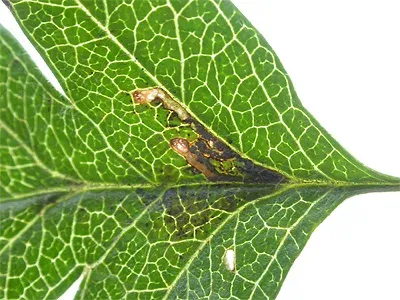
Initially, newly hatched larvae create narrow, winding mines inside the leaf tissue, which become wider as the caterpillar matures and develops.
Upon exiting the mines, the caterpillars transition to skeletonizing the leaves, feeding on the parenchyma and leaving only the veins intact.
Severe infestations cause early leaf senescence and drop, which drastically reduces the tree's photosynthetic capacity and weakens its general vigor.
Reduced vigor often makes trees more susceptible to winter frost damage and secondary fungal or bacterial pathogens, impacting future fruit yield.
When it appears
Adult moth activity typically begins in late spring, coinciding with the flowering period of apple and hawthorn trees.
Eggs are deposited singly on the underside of leaves, usually near the midrib, providing a sheltered starting point for the emerging larvae.
Active feeding by larvae occurs throughout the summer months, with the most damage observed from June to August as the population reaches its peak.
Pupation takes place in late summer or early autumn, with the cocoons remaining attached to the tree during the winter period until the following spring.
Monitoring should be continuous from the first leaf expansion until the end of summer to detect early signs of mining or skeletonization.
Signs of infestation
The earliest signs of infestation are thin, serpentine tracks or translucent lines visible on the surface of the leaves when held up to the light.
As the larvae grow, these tracks expand into irregular pale blotches, followed by leaf skeletonization where only the vein structure remains visible.
Observation of the tree bark may reveal small white cocoons, which are a definitive sign of successful development and future re-infestation.
Extensive damage results in a scorched or ragged appearance of the canopy, often accompanied by premature leaf fall even in mid-summer.
- Winding mine tracks inside leaves
- Skeletonized leaf surfaces
- Presence of white cocoons on bark
- Premature yellowing and leaf loss
Control measures
Orchard sanitation is a critical management strategy, including the removal of dead bark and leaf litter to eliminate overwintering pupal sites.
Biological control methods using specific bacteria (Bacillus thuringiensis) are effective when applied shortly after larvae exit their mines to begin open feeding.
Chemical insecticides should be applied selectively based on local monitoring thresholds to avoid harming beneficial pollinators and predatory insects.
Encouraging a diverse ecosystem in the orchard helps sustain natural predators, such as parasitic wasps, which can significantly suppress moth populations.
Proper pruning practices improve airflow and light penetration within the canopy, creating an environment less suitable for high-density pest colonization.
Taxonomy
- Latin name
- Bucculatrix bechsteinella
- Order
- Lepidoptera (butterflies)
- Family
- Bucculatricidae
- EPPO code
- BUCCCR
Discussion
No discussions yet — be the first.