
Elm ribbed-cocoon maker
Bucculatrix albedinella
Description
How to identify
The elm ribbed-cocoon maker (Bucculatrix albedinella) belongs to the family Bucculatricidae, order Lepidoptera. It is a small moth with a wingspan ranging from 7 to 9 mm.
The forewings have a whitish to yellowish color with distinctive dark markings and streaks. The hindwings are narrow and heavily fringed, which is a classic feature of these micro-moths.
The larvae progress through several stages, initially mining the leaves and later feeding externally on the underside of the foliage. The caterpillar has a greenish appearance, providing excellent camouflage.
The pupae are enclosed in very distinct, white, spindle-shaped cocoons with longitudinal ribs. These are often found attached to the bark or leaves.
This species is highly specific to trees of the genus Ulmus and can be commonly found in both urban parks and forested areas.
What it damages
The primary host trees are various elm species (Ulmus spp.). The pest causes significant damage to both the appearance and the physiological health of the trees.
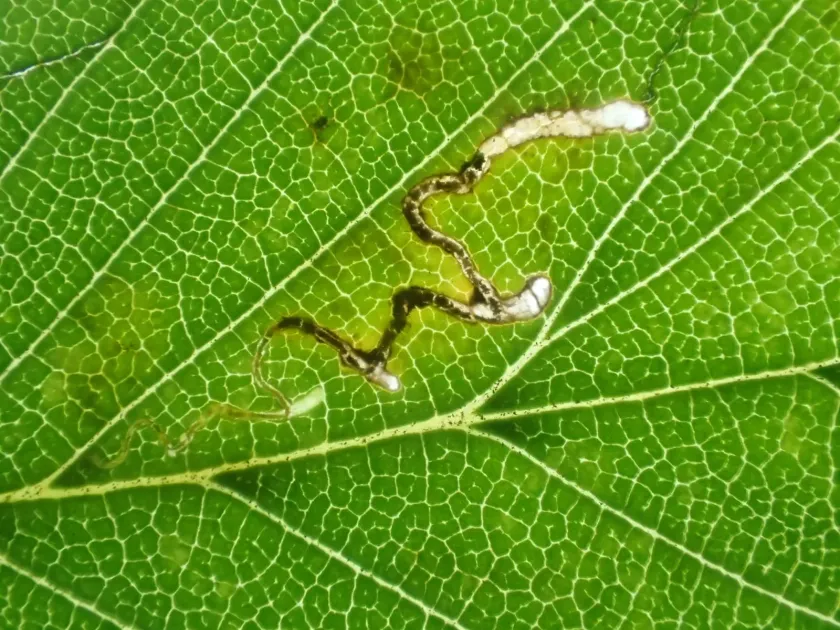
Early-stage larvae create narrow, winding tunnels (mines) inside the leaf tissue, which are visible as pale, squiggly lines when held against the light.
As the larvae mature, they switch to external feeding, consuming the leaf tissue while leaving the upper epidermis intact, creating characteristic small holes or windows.
Heavy infestations can lead to substantial leaf loss, which reduces the tree's photosynthetic capacity and weakens its annual growth increment.
Severe and chronic defoliation may render the elm trees more susceptible to secondary pests and various pathogens, potentially causing branch dieback.
When it appears
The insect typically overwinters as a pupa inside its characteristic ribbed cocoon, usually attached to the tree trunk or fallen leaves.
Adult moths emerge in late spring, coinciding with the initial leaf flush of the elm trees. Mating and egg-laying occur shortly thereafter.
Depending on the climatic zone, the species may complete one or two generations per year. The activity peaks during the warmer summer months.
Environmental factors such as temperature and humidity significantly influence the development speed of each larval stage.
By late autumn, the final generation of larvae pupates, and the cocoons enter a state of dormancy until the following spring.
Signs of infestation
The earliest signs of infestation are the fine, winding mines on the foliage that appear in late spring or early summer.
As the feeding continues, the "window-feeding" damage becomes widespread, giving the elm canopy an intricate, lace-like, or perforated appearance.
During an inspection, one can find the small, greenish larvae on the underside of the leaves, which often react to disturbance by dropping on silken threads.
The presence of white, ribbed cocoons on the bark of trunks or branches is a definitive indicator of the pest's presence in the current season.
Significant infestations often result in premature yellowing and leaf fall, causing a notable decline in the aesthetic value of elm plantings.
Control measures
Management of the elm ribbed-cocoon maker involves a combination of cultural and chemical strategies to keep populations below damaging levels.
Sanitation is a key cultural practice; removing and disposing of infested leaf litter in autumn can significantly reduce the overwintering population.
If chemical control is necessary, applications of insecticides should target the larval stages when they are actively feeding on the leaf surface.
- Application of biological insecticides containing Bacillus thuringiensis.
- Use of contact insecticides during the larval emergence period.
- Encouraging natural predators such as insectivorous birds and parasitic wasps.
Ongoing monitoring of elm trees is essential to detect early infestations, allowing for targeted treatments rather than broad-spectrum spraying.
Taxonomy
- Latin name
- Bucculatrix albedinella
- Order
- Lepidoptera (butterflies)
- Family
- Bucculatricidae
- EPPO code
- BUCCBO
Discussion
No discussions yet — be the first.