
Oak leafminer
Bucculatrix ainsliella
Description
How to identify
The oak leafminer (Bucculatrix ainsliella) is a small moth belonging to the Bucculatricidae family. These insects are extremely tiny, with an adult wingspan of only about 7–9 mm.
Adult moths are generally brownish-gray with distinct markings on their forewings. Due to their size and camouflage, they are rarely seen by the casual observer.
The life cycle consists of the egg, larval (caterpillar), pupal, and adult stages. Each stage is adapted for specific growth phases, often linked to the host plant's development.
Overwintering occurs primarily in the pupal stage. They form small, ribbed, white cocoons on the bark, twigs, or fallen leaves, which are resilient to harsh winter conditions.
The emergence of adults is highly synchronized with the leaf development of oak trees, ensuring that newly hatched larvae have an immediate food source.
What it damages
The primary host for this species is the oak tree (Quercus). While they prefer oaks, their feeding activity can significantly impact the health of the tree's foliage.
Larval feeding happens in two distinct phases: first as leaf miners, creating winding tunnels inside the leaf tissue, and later as external skeletonizers.
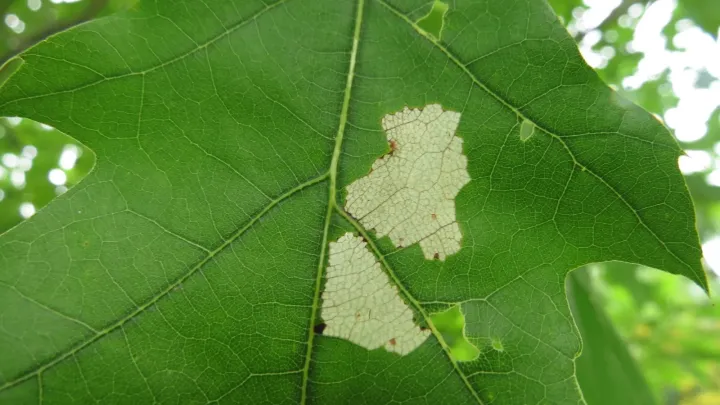
During the mining stage, larvae consume the inner tissue of the leaf, leaving the upper and lower surfaces intact, which creates visible trails or blotches.
As the larvae grow, they leave the tunnels and graze on the leaf surface, consuming the green material while leaving behind a thin, translucent layer.
Heavy infestations lead to widespread leaf browning, which reduces the tree's ability to photosynthesize, ultimately leading to stress and reduced growth rates.
When it appears
Adult moths typically emerge in early spring, precisely when the oak buds are breaking. This timing allows for optimal larval development on young, tender leaves.
The species usually completes two or more generations per season, depending on the latitude and local climate conditions throughout the growing year.
Peak larval feeding activity is often observed during late spring and throughout the summer months, with noticeable damage accumulation by mid-summer.
Warm weather accelerates the developmental rate of the larvae, potentially leading to faster population surges in favorable years.
By late autumn, the final generation pupates to survive the cold, dormant season, marking the end of the year's cycle for the population.
Signs of infestation
The most diagnostic sign is the presence of winding, narrow lines on the leaf surface, which eventually expand into irregular blotches as the larva grows.
Small amounts of dark frass (insect waste) are often visible inside the mines or on the underside of the leaves, indicating active or past feeding.
Tiny white, ribbed cocoons can be found attached to the bark of branches or the undersides of leaves during the pupation phase.
In cases of severe infestation, the tree crown may turn prematurely brown or appear scorched as the leaves lose their functional photosynthetic tissue.
- Winding, serpentine tunnels on leaves
- Translucent blotches on leaf tissue
- Presence of tiny, white, ribbed cocoons
- Early browning or scorching of the canopy
- Accumulation of dark larval frass on foliage
Control measures
Sanitation is a primary management tool; collecting and destroying fallen leaves in autumn significantly reduces the overwintering population.
Natural predators, including various parasitoid wasps, play a vital role in keeping populations in check; protecting these beneficial insects is encouraged.
If chemical intervention is necessary on high-value ornamental trees, systemic insecticides are usually the most effective against mining larvae.
Timing applications is crucial; insecticides must be applied when the larvae are actively mining or just beginning to skeletonize the leaves.
Using pheromone traps can assist in monitoring the flight timing of adults, helping to predict when subsequent larval generations will appear.
Taxonomy
- Latin name
- Bucculatrix ainsliella
- Order
- Lepidoptera (butterflies)
- Family
- Bucculatricidae
- EPPO code
- BUCCAI
Discussion
No discussions yet — be the first.