
Cotton leaf miner
Bucculatrix loxoptila
Description
How to identify
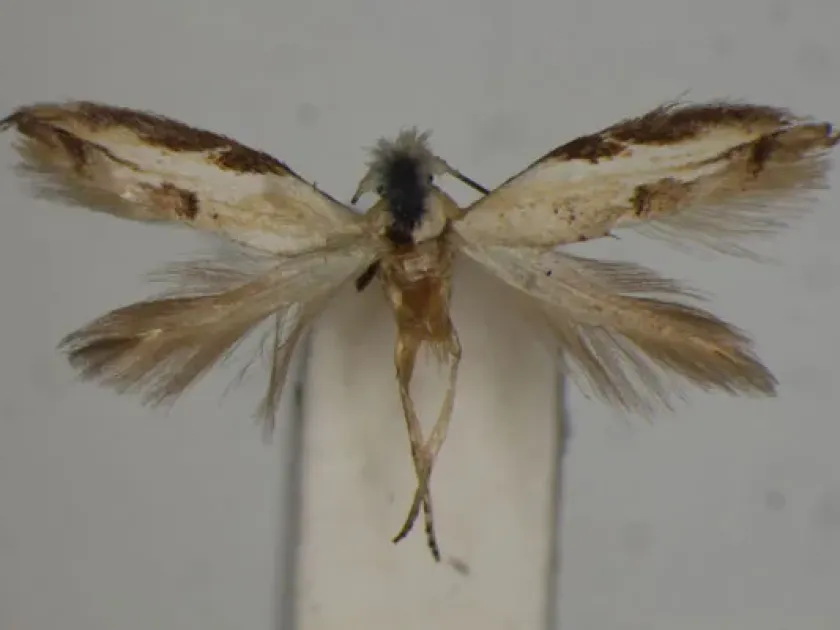
The cotton leaf miner (Bucculatrix loxoptila) belongs to the family Bucculatricidae, order Lepidoptera. It is a tiny moth species with a wingspan of approximately 6–8 mm.
Adult moths are typically brownish-gray or ochre, which provides camouflage against the foliage of the cotton plant, making them difficult to detect.
The life cycle encompasses eggs, larvae (caterpillars), pupae, and adults, with the larvae passing through several instars during their development.
Adults are primarily active during the evening and night hours, whereas larvae are most active on the underside of leaves during the day.
Proper identification in the field often relies on distinguishing the moth's specific mining patterns and the small, distinct cocoons found on the plants.
What it damages
Cotton (Gossypium) is the primary host for this pest. The damage caused by the larvae significantly affects the photosynthetic capacity of the plant.
Early-stage larvae create mines within the leaf tissue, while later instars skeletonize the leaves, consuming all but the epidermal layers.
Severe infestations result in premature leaf drop, which stunts the growth of the plant and directly reduces the yield and quality of the cotton fiber.
Affected plants become susceptible to secondary infections and struggle to support the development of squares and bolls.
In hot and arid regions, where the pest thrives, leaf loss can be substantial, leading to significant economic losses for farmers.
When it appears
The development of the cotton leaf miner is highly dependent on ambient temperatures, with activity generally starting as the weather warms in spring.
In optimal conditions, the species can produce multiple overlapping generations within a single growing season.
Winter is typically spent in the pupal stage, encased in resilient cocoons attached to soil particles, crop residue, or nearby weeds.
Adult activity begins when temperatures consistently rise above the developmental threshold, usually aligning with the growth of early cotton stages.
Population peaks are typically observed during the mid-to-late summer months, coinciding with the peak vegetative and reproductive phases of the cotton crop.
Signs of infestation
The first signs of an infestation are small, serpentine mines visible on the surface of the cotton leaves as larvae feed internally.
As the larvae mature, they emerge from the mines to skeletonize the leaves, resulting in large, irregular necrotic patches that eventually turn brown.
The presence of white, elongated, ribbed cocoons on the underside of leaves or on stems is a definitive indicator of the moth's presence.
Heavily infested fields exhibit a general yellowish or brownish discoloration and an overall lack of vigor in the canopy.
Fine silk webbing produced by the larvae during their growth and molting phases can often be observed on the leaf surface.
Control measures
Effective control starts with robust cultural practices, including post-harvest tillage to bury crop debris and destroy overwintering pupae.
Weed management, both within and around cotton fields, is essential to eliminate alternative host plants and reduce initial pest pressure.
Chemical control involving systemic insecticides is effective but should be applied according to economic thresholds to avoid killing beneficial predatory insects.
Integrated Pest Management (IPM) programs encourage the conservation of natural enemies, such as parasitic wasps, which can suppress moth populations.
Using pheromone traps for monitoring allows agronomists to determine the precise timing of interventions, ensuring maximum efficacy and minimal pesticide use.
Taxonomy
- Latin name
- Bucculatrix loxoptila
- Order
- Lepidoptera (butterflies)
- Family
- Bucculatricidae
- EPPO code
- BUCCLO
Discussion
No discussions yet — be the first.