
Water buffalo
Bubalus bubalis
Description
How to identify
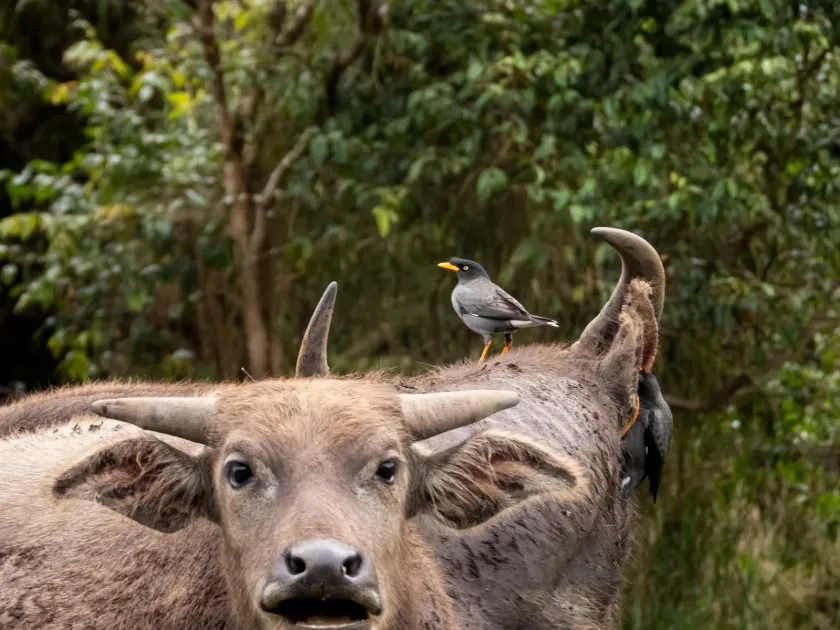
The water buffalo (Bubalus bubalis) belongs to the Bovidae family and is characterized by a massive frame and heavy bone structure. These animals are well-adapted to wetland environments, which brings them into direct conflict with rice cultivation.
Adult individuals can weigh over 1,000 kilograms, making them physically dominant in any field they enter. Their broad hooves are evolved for walking in mud, which allows them to traverse agricultural land that would otherwise be inaccessible.
They are gregarious animals, usually moving in herds. This social behavior means that when a group enters a field, the impact is multiplied by the number of animals present, leading to widespread damage in a short timeframe.
Water buffalo exhibit high ecological adaptability, allowing them to thrive in human-modified landscapes where food and water resources are abundant, often encroaching on farm boundaries.
Their temperament can be aggressive when threatened or when protecting calves, which complicates attempts by farmers to drive them away from protected areas without professional intervention.
What it damages
The primary agricultural damage caused by water buffalo is the physical destruction of crops, especially rice. They consume significant amounts of biomass and trample the remainder, which kills the plants and ruins the yield.
Beyond crop loss, these animals pose a major threat to irrigation infrastructure. They often destroy earthen dams and irrigation levees by walking over them, causing water leaks and system failure.
Trampling leads to soil compaction, which is detrimental to the soil structure, aeration, and future root growth. This impact can persist for several planting seasons after the event.
Damage to irrigation canals requires costly repairs and can interrupt the water supply necessary for sustaining the crop, leading to secondary losses due to water stress.
Buffalo also act as vectors for invasive weed seeds, carrying them on their fur and hooves into clean fields, which increases the long-term weed control burden for farmers.
When it appears
Activity levels are highest during the monsoon season, when increased water availability allows herds to expand their range into low-lying agricultural areas that are typically flooded.
The planting and growing season of rice often overlaps with the peak activity periods of these animals, making the threat constant throughout the critical phases of crop development.
During dry spells, buffalo congregate around remaining irrigation sources. Because irrigation channels are essential for farming, this creates a high likelihood of contact between buffalo and crops.
Nighttime behavior is a significant factor in seasonal damage. During hot periods, buffalo move at night to graze and bathe, leaving farmers to discover damaged fields only at dawn.
Seasonal herd migrations, driven by temperature and food availability, lead to influxes of buffalo into valley regions, often coinciding with harvest times when the risk of economic loss is highest.
Control measures
The most reliable control method involves physical barriers. Heavy-duty fencing or reinforced stone barriers are necessary to withstand the brute force of a large animal.
Electric fencing is a highly effective, non-lethal deterrent when maintained with high voltage, effectively discouraging herds from encroaching on cultivated zones.
Auditory and visual deterrents, such as sirens or flashing lights, can be deployed, although these require rotation to prevent the animals from becoming habituated to the signals.
Maintaining clear buffer zones between natural habitats and cropland helps reduce the likelihood of accidental encounters, giving farmers more time to detect and respond to approaching animals.
- Regular inspection and repair of irrigation levees.
- Deployment of professional animal deterrent systems.
- Collaborative community monitoring of herd movements.
- Planting of unpalatable vegetation as a natural barrier.
Taxonomy
- Latin name
- Bubalus bubalis
- Family
- Bovidae
- EPPO code
- BUBABU
Discussion
No discussions yet — be the first.