
Buffalo treehopper
Bubalus
Description
How to identify
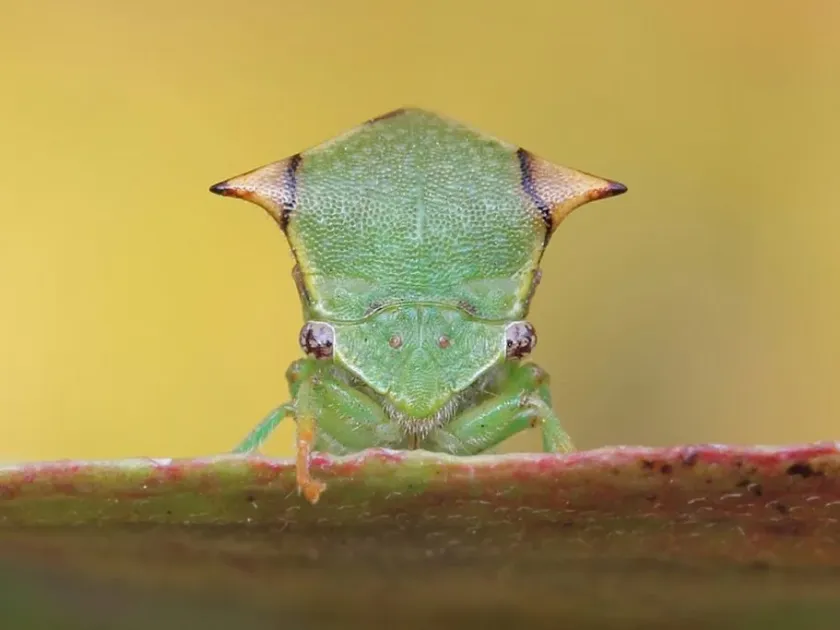
The buffalo treehopper (Stictocephala bisonia) belongs to the order Hemiptera and the family Membracidae. The adult insect is about 8–10 mm long and has a distinctive appearance with a pronotum that resembles the hump of a buffalo.
The insect’s body is light green or yellowish-green, providing excellent camouflage among foliage. It has clear wings held close to the body and short, bristle-like antennae on its head.
Nymphs lack wings and possess characteristic spine-like projections along their backs. They are relatively sluggish and tend to remain in the lower sections of plants, feeding on the sap of herbaceous vegetation.
The life cycle includes the egg stage, five nymphal instars, and the adult stage. In most regions, there is one generation per year, with the species overwintering as eggs laid beneath the bark of perennial woody plants.
These insects prefer habitats such as abandoned orchards, hedgerows, and areas with dense ground vegetation, which provide optimal conditions for feeding and reproduction during the summer months.
What it damages
This pest is a polyphage, causing significant damage to a wide range of plants. Fruit trees, including apple, pear, peach, apricot, and various berry bushes, are the primary targets for its activity.
In addition to woody species, the buffalo treehopper feeds on herbaceous plants, such as vegetable crops, sunflowers, alfalfa, and weeds, which serve as essential food sources for nymphs early in the season.
The most severe damage is caused by females during oviposition. They make deep, crescent-shaped slits in the bark of young twigs, which disrupts sap flow and weakens the structural integrity of the branches.
Heavy infestations result in stunted tree growth, reduced vigor, and increased susceptibility to secondary fungal and bacterial infections that enter through the bark wounds.
In cases of severe infestation, young saplings may die back or succumb to disease within a few years, particularly in orchards located near uncultivated land or overgrown field borders.
When it appears
The cycle begins in early spring, usually April or May, when nymphs hatch from overwintered eggs. This period coincides with the active sap flow in host trees.
Nymphs initially feed on the base of trees or on weeds in the orchard floor. As they develop, they migrate to more suitable host plants and eventually move to trees as they mature into adults.
Adults appear in July and remain active until late autumn. During this time, they disperse throughout the orchard to feed, mate, and seek out suitable sites for egg-laying.
Peak egg-laying occurs in late August and September. Females select young branches with smooth bark, making series of punctures where they deposit eggs to ensure protection throughout the winter.
Thus, the treehopper causes damage in two phases: spring sap-feeding by nymphs and late-season bark injury by females preparing for the winter period.
Signs of infestation
The primary sign of infestation is the presence of characteristic twin parallel, crescent-shaped slits on the bark of young twigs, often arranged in distinct rows.
Affected trees may appear stressed, exhibiting premature yellowing or twisting of leaves. Gumming or callus-like growths on the bark at the site of punctures are common manifestations of the damage.
During the summer, you may notice jumping insects that quickly move to the underside of branches or fly away when disturbed, making detection difficult without careful observation.
On herbaceous hosts, symptoms include discolored patches and deformation of stems and leaves caused by intensive sap-feeding by the nymphs.
An abundance of weeds in the orchard and surrounding areas is a strong indicator of high pest pressure and a potential reservoir for the buffalo treehopper population.
Control measures
Effective management of the buffalo treehopper requires an integrated approach that combines cultural practices with targeted pest control measures.
- Mow orchard floors and surrounding areas regularly to eliminate the weeds that nymphs rely on for early development.
- Perform selective pruning to remove and destroy branches showing severe bark damage or signs of heavy egg-laying.
- Maintain optimal tree vigor through proper fertilization and irrigation to help trees withstand minor infestations.
- Apply systemic insecticides during the peak nymphal emergence period if population levels threaten the health of young trees.
- Manage orchard borders by clearing scrub and unwanted vegetation that serves as an overwintering or breeding habitat for the treehopper.
Chemical intervention is most effective in the spring when nymphs are concentrated on low-growing vegetation and have not yet dispersed into the trees.
When choosing pesticides, select products that minimize impact on beneficial insects to maintain a balanced ecosystem within the orchard environment.
Taxonomy
- Latin name
- Bubalus
- Family
- Bovidae
- EPPO code
- BUBASP
Discussion
No discussions yet — be the first.