
Great Banded Grayling
Brintesia circe
Description
How to identify
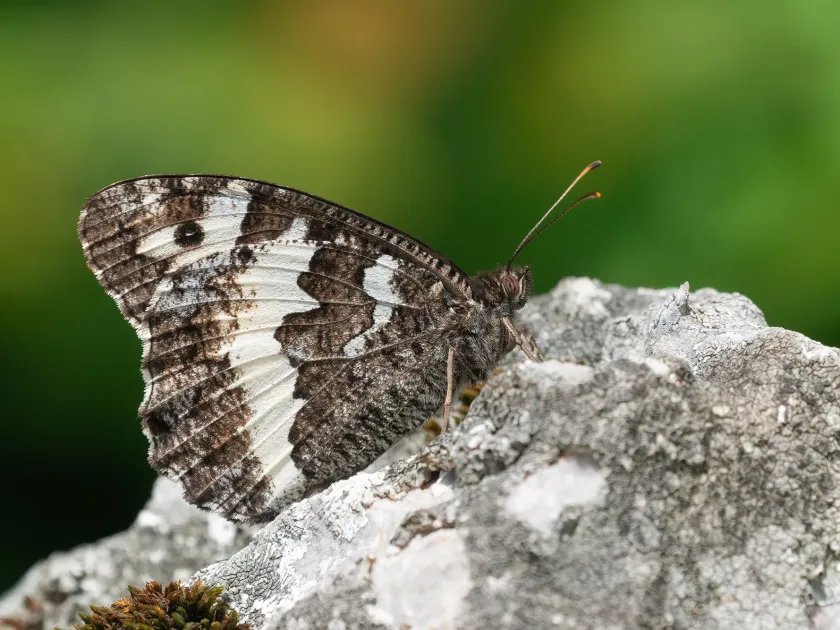
The Great Banded Grayling (Brintesia circe) is a butterfly species within the Nymphalidae family, order Lepidoptera. It has a notable wingspan reaching up to 85 mm.
The upper side of the wings is dark brown or black with a distinct white band, which serves as a visual diagnostic feature for identification.
When resting, the underside of the wings provides excellent camouflage, resembling bark or dry grass, making the insect hard to detect.
The body is covered in dense hairs, aiding survival in various weather conditions typical of its habitat in meadows and forest edges.
Larvae have a spindle-shaped body, typically brownish, allowing them to remain hidden among grass stems throughout their growth stage.
What it damages
Larvae primarily feed on various grass species, including wild types and occasionally cereal crops when infestations are high.
By consuming leaf tissue, the larvae reduce the photosynthetic capacity of host plants, leading to stunted growth and reduced vigor.
Cereal crops near grassy habitats are most at risk, as larvae can migrate from wild grasses to cultivated crops during development.
Significant damage is observed when high population density leads to heavy defoliation, which directly impacts the crop's yield potential.
Weakened plants are more susceptible to secondary fungal infections, further complicating the health management of the infested field.
When it appears
Adults are typically active during the mid-summer months, usually between June and August, which is their primary mating season.
The species completes one generation per year, meaning the period of larval activity is strictly seasonal and predictable.
Winter is spent in the larval stage, which remains dormant in the soil surface or protected among thick plant debris.
Activity resumes in the spring, as the larvae emerge to feed on young grass shoots, which are vital for their final growth stages.
Pupation occurs in early summer, often in sheltered soil, followed by the emergence of the new adult generation of butterflies.
Signs of infestation
Typical signs include ragged leaf edges and localized areas where leaf tissue has been systematically consumed by larvae.
The presence of larval excrement at the base of host plants is a reliable indicator that an active infestation is occurring nearby.
Visible yellowing of leaves or premature wilting of host plants indicates that the plants are struggling due to feeding damage.
Direct observation of adult butterflies in agricultural areas suggests that egg-laying is underway, indicating a future pest presence.
Spotty distribution of damaged plants across a field often highlights specific areas where larval populations have established themselves.
Control measures
Effective control starts with strict weed management, focusing on removing wild grasses that serve as the species' primary food source.
Deep plowing after the harvest helps disturb and destroy hibernating larvae, significantly reducing the population for the next season.
Biological control methods, such as using specific bacterial preparations, can safely manage larval numbers during the early stages.
Chemical intervention should be considered only when economic thresholds are reached and based on professional agricultural advice.
Regular field scouting and the use of pheromone traps help detect population increases early, allowing for timely and precise action.
Taxonomy
- Latin name
- Brintesia circe
- Order
- Lepidoptera (butterflies)
- Family
- Nymphalidae
- EPPO code
- BRTSCI
Discussion
No discussions yet — be the first.