
Great banded grayling
Brintesia
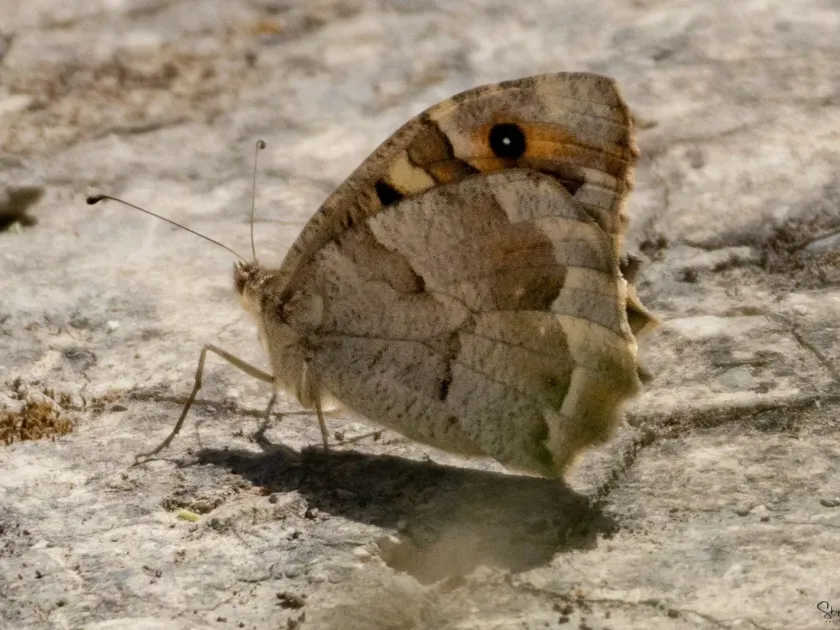
Description
How to identify
The Great banded grayling, scientifically known as Brintesia circe, belongs to the family Nymphalidae, subfamily Satyrinae. It is a large diurnal butterfly with a wingspan of 75–85 mm.
The dorsal side of the wings is dark, almost black, with a prominent white band crossing both wings. A characteristic bluish dusting is often visible at the base of the forewings.
The ventral side of the wings has cryptic coloration: a marbled pattern of gray, brown, and white lines. This camouflage allows the insect to blend perfectly with tree bark or dry grass when resting.
The larva of this species reaches a length of 40–45 mm. Its body is light yellowish or grayish-brown with two dark dorsal stripes and a forked tail appendage characteristic of many satyrs.
The pupa is exposed and usually suspended from plant stems or hidden in debris near the root zone, which protects it from temperature fluctuations and predators.
What it damages
The primary food sources for Great banded grayling larvae are various species of wild grasses, such as Poa, Festuca, and Bromus.
In agricultural ecosystems, this pest can pose a potential threat to cereal crops if fields are located adjacent to fallow lands or unplowed steppe sections.
Adults (imagines) feed on flower nectar and aphid honeydew, so they do not cause direct mechanical damage to crop tissues, unlike the larvae.
Crop damage occurs mainly during the early larval stages, as they graze on the leaf blades, reducing the total photosynthetic surface area of the plant.
Significant economic loss is extremely rare and usually localized, mainly in fields prone to weed overgrowth, which serve as the primary host base for the species.
When it appears
The life cycle of the Great banded grayling involves one generation per year. Adults appear in mid-summer, with peak flight activity occurring in July and August.
Eggs are laid individually by females on grass stems, leaves, or nearby soil and plant litter.
The overwintering stage is the larva of the first or second instar. They hide at the base of host plant roots, surviving adverse winter conditions.
In spring, as stable temperatures return, the larvae resume active feeding, rapidly increasing their biomass by consuming young spring shoots of grasses.
Pupation occurs in early summer, typically in June, after which the cycle repeats, and a new generation of butterflies emerges by mid-summer.
Signs of infestation
The main sign of pest presence is ragged leaf edges on grasses, showing irregular, "bitten" outlines.
During surveys of field margins, one can find the larvae themselves, which are primarily nocturnal, hiding in the root zone during daylight hours.
The presence of butterflies near fields during the summer indicates egg-laying activity, which serves as a trigger for monitoring population density.
The presence of specific frass on leaves and stems of grasses indicates active feeding, requiring a density assessment per square meter.
Wilting of individual grass shoots, in the absence of fungal disease, can also indirectly indicate insect activity damaging the base of the stems.
Control measures
The primary control measure is sound agronomic practice aimed at eliminating weeds along field edges where the pest accumulates.
Deep autumn plowing helps destroy overwintering larvae by disrupting their natural habitat in the root zone layer of the soil.
Crop rotation and timely field maintenance reduce the attractiveness of the agro-ecosystem for butterfly egg-laying.
In cases of high pest density, the application of systemic or contact-stomach insecticides registered for use on cereal crops is recommended.
Biological control methods, including the use of entomophages, naturally keep grayling populations in check; therefore, preserving biodiversity in adjacent areas is crucial.
Taxonomy
- Latin name
- Brintesia
- Order
- Lepidoptera (butterflies)
- Family
- Nymphalidae
- EPPO code
- BRTSSP
Discussion
No discussions yet — be the first.