
Ino fritillary
Brenthis ino
Description
How to identify
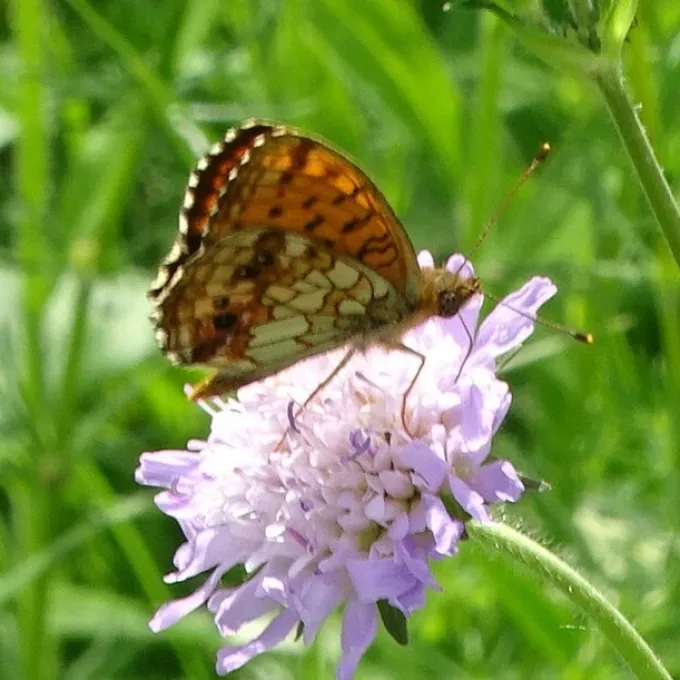
The Ino fritillary (Brenthis ino) is a butterfly species within the Nymphalidae family, order Lepidoptera. Adults typically exhibit an ochre-yellow wingspan of 35–45 mm, marked with a distinctive pattern of black spots and lines that provide camouflage in natural habitats.
The underside of the hindwings has a characteristic yellowish-grey appearance with a pearlescent sheen. This iridescent quality is a diagnostic feature used to differentiate it from related fritillary species found in similar grassy environments.
Larvae (caterpillars) are brownish-grey with lighter longitudinal stripes and small, dark spines along their segments. This morphological structure aids in their defense and allows them to blend in with the foliage of their primary host plants, such as meadowsweet and great burnet.
The species undergoes a complete metamorphosis: egg, larva, pupa, and adult. In most temperate regions, it completes one generation per year, with the egg being the primary overwintering stage. This biological cycle determines the timing of its emergence.
The butterfly thrives in moist, open meadows, forest clearings, and marshy grasslands. It is considered a localized species, often found near permanent water sources where its host plants grow abundantly.
What it damages
Damage is primarily caused by the larval stage, which feeds on the foliage of host plants. While not a primary agricultural pest, high densities of Ino fritillary larvae can cause economic impact on specialized crops if fields are located near their natural habitats.
The larvae consume leaf tissue, creating irregular holes and consuming leaf edges. This reduction in foliage significantly hinders the plant's photosynthetic capacity, leading to reduced vigor and potentially diminished yield in leafy crops.
Young plants are particularly vulnerable, as they lack the biomass necessary to compensate for lost tissue. Severe defoliation can lead to stunted development and an increased susceptibility to secondary environmental stressors.
The presence of larvae also creates wounds in the foliage that can serve as entry points for bacterial and fungal pathogens. This secondary infection risk often causes more significant harm to the plant than the direct feeding of the caterpillars.
In herb production, where leaf quality is the primary value, even minor defoliation can lead to quality degradation, making the harvested product unsuitable for market requirements due to visible damage.
When it appears
Adult butterflies are typically on the wing from mid-June to early August. During this period, mating occurs, and females lay eggs on or near host plants, setting the stage for the next year's larval development.
Larvae hatch in late spring as temperatures rise, matching the timing of the flush of new growth on host plants. Feeding activity is most intense during May and June, as the caterpillars grow rapidly before preparing to pupate.
Pupation occurs in early summer, usually within a few weeks of the final larval instar. The pupal stage is often attached to stems or leaf undersides, hidden from plain view to avoid predators.
Monitoring for signs of larval feeding should be conducted early in the season, particularly during the late spring months. Identifying the presence of larvae before they reach maturity is crucial for effective intervention.
The annual cycle is strictly dependent on local climate conditions. In cooler, wetter years, the emergence and feeding periods may be slightly delayed, requiring flexible management plans that adapt to seasonal weather variations.
Signs of infestation
The most common sign of infestation is visible feeding damage on leaves, ranging from small punctures to complete loss of leaf blades. Larvae are often gregarious in early stages, leading to localized clusters of damage.
The accumulation of dark, pellet-like frass (excrement) on the leaves or in the leaf axils is a clear indication that caterpillars are present and feeding in the immediate vicinity.
Larvae may also use silk to bind leaf edges together, creating a small shelter. This behavior protects them from wind and predators, making it a reliable sign to look for when scouting fields for potential threats.
Yellowing of the leaf tissue around the areas of damage indicates that the plant's transport system is being affected, which is a symptom of significant larval feeding activity.
Visual confirmation of the caterpillars on the underside of leaves during cool, low-light periods (early morning or evening) is the most accurate way to verify the presence of the pest versus other environmental damage.
Control measures
Cultural control is the most effective strategy for managing the Ino fritillary. This involves the removal of wild host plants like meadowsweet from the edges of fields and drainage ditches to eliminate breeding grounds.
Mowing field margins and surrounding grassy areas during the spring, before larvae complete their development, can drastically reduce the local population by depriving them of their food source.
Biological control agents, such as microbial insecticides containing Bacillus thuringiensis, are highly effective against larval stages while maintaining safety for non-target beneficial insects and the surrounding environment.
Chemical intervention should be reserved for scenarios where economic thresholds are exceeded. Selective, low-persistence insecticides should be chosen to minimize impact on pollinators and other useful entomofauna.
Integrated Pest Management (IPM) practices, including the use of light traps for adult monitoring and regular field scouting, allow for precise timing of interventions, ensuring that control measures are both sustainable and effective.
Taxonomy
- Latin name
- Brenthis ino
- Order
- Lepidoptera (butterflies)
- Family
- Nymphalidae
- EPPO code
- BRENIN
Discussion
No discussions yet — be the first.