
Barnacle goose
Branta leucopsis
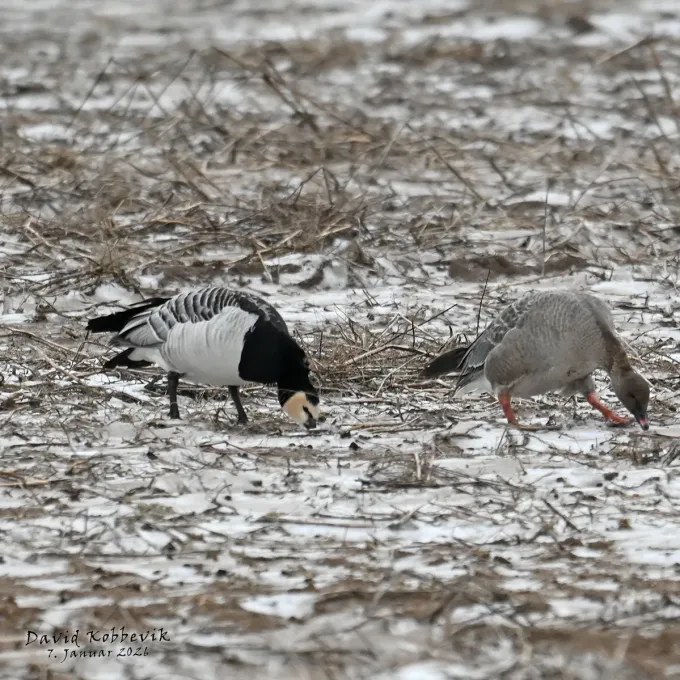
Description
How to identify
The Barnacle goose (Branta leucopsis) is a member of the Anatidae family, order Anseriformes. It is a distinctive migratory bird recognized by its contrasting plumage.
The name comes from its white face against a black head and neck. Its body features a mix of grey, black, and white, making it visually unique among other geese.
Adults typically weigh between 1.5 and 2.5 kg. These birds are known for their strong migratory behavior, traveling vast distances between their breeding and wintering grounds.
They are highly social birds that forage in large, coordinated flocks. This collective behavior allows them to rapidly exploit food sources in agricultural landscapes.
Over recent decades, populations have expanded, bringing these birds into frequent contact with cultivated fields during their migration and wintering periods.
What it damages
Barnacle geese cause significant economic damage to winter cereal crops such as wheat and rye, as well as managed grasslands, by grazing on young shoots.
Grazing reduces the green biomass of crops, which can lead to a decrease in overall yield if the damage occurs during sensitive stages of plant development.
Apart from direct feeding, the birds cause structural damage through trampling, creating bare patches in fields that are susceptible to soil erosion and weed encroachment.
The heavy deposition of droppings in concentrated areas can alter local soil chemistry, which may affect the uniformity of crop growth in subsequent periods.
The intensity of damage is often concentrated in fields located near resting areas or water bodies, where the geese may stay for extended periods during the migration season.
When it appears
The primary period of impact is during spring and autumn migrations, when large flocks stop in agricultural regions to refuel their energy reserves.
In autumn, geese often target newly emerged winter cereals, finding the fresh green growth to be a high-quality nutritional source before their onward journey.
Spring activity coincides with the return migration, where birds remain on fields until environmental conditions allow them to proceed further north to breeding sites.
Daily activity patterns show that birds are most active in the early morning and late evening, traveling between roosting waters and agricultural feeding sites.
Weather patterns, including mild winters, can lead to geese staying in specific agricultural areas for longer durations, increasing the risk of chronic crop damage.
Signs of infestation
The most prominent sign of presence is the combination of bird droppings across the field and characteristic footprints left on soft, moist soil surfaces.
Plants grazed by geese exhibit clean-cut edges on leaves and stems, distinct from the shredded appearance often caused by insects or mammalian pests.
The vocal nature of the flocks often serves as an early warning, as their loud, barking calls can be heard from a significant distance while they are feeding.
Field monitoring can identify "grazing lines" or heavily trampled zones, which are visible even from a distance or through high-resolution aerial imagery.
Rapid flushing of large groups of birds when disturbed by farm machinery or human activity is a clear indicator of their established presence in the area.
Control measures
Visual deterrents, including scarecrows, predatory bird silhouettes, and reflective tape, can be effective if rotated frequently to prevent habituation.
Acoustic deterrents, such as gas cannons or bio-acoustic systems that play alarm calls, are often employed to displace flocks from highly valuable crop areas.
Drones are increasingly used as a management tool, providing a flexible and mobile way to monitor and disperse goose flocks from fields effectively.
Agronomic strategies include managing buffer zones and creating "sacrifice" areas away from primary production fields to reduce the overall impact on yields.
- Regular monitoring of winter cereal fields
- Strategic deployment of pyrotechnic deterrents
- Implementation of field rotation and deterrent timing
- Engagement with local wildlife management experts
Taxonomy
- Latin name
- Branta leucopsis
- Family
- Anatidae
- EPPO code
- BRNTLE
Discussion
No discussions yet — be the first.