
Giant cricket
Brachytrupes portentosus
Description
How to identify
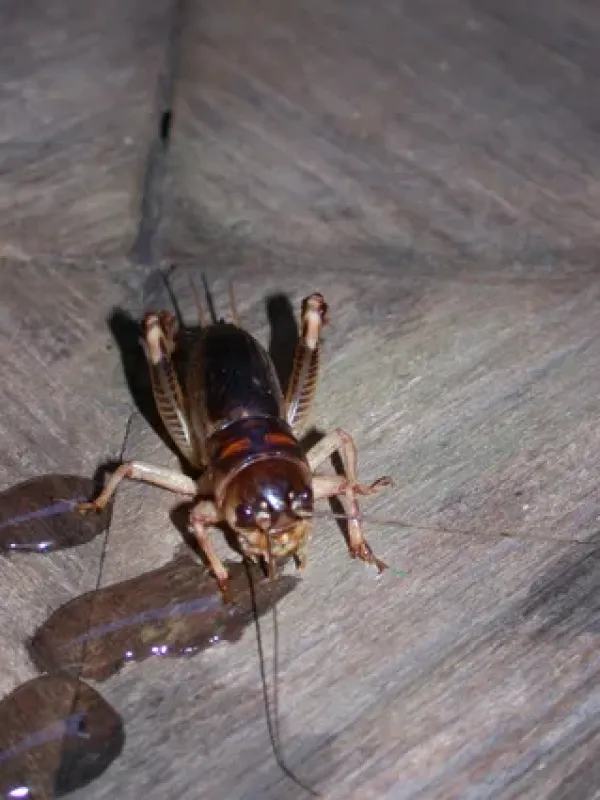
The giant cricket (Brachytrupes portentosus) is a large member of the Gryllidae family. Adults can grow up to 50 mm in length, possessing a robust body with a distinctive brownish coloration.
These insects are equipped with powerful mandibles, specifically evolved for cutting through plant stems and excavating deep, elaborate burrows in the soil.
Adults have well-developed wings, enabling them to migrate over significant distances to find optimal feeding grounds and mating sites during the reproductive season.
Nymphs resemble the adults but are smaller and lack fully developed wings. They spend most of their life cycle underground, minimizing exposure to predators.
Their anatomy is highly specialized for subterranean life, featuring strong, digging legs that allow them to navigate compacted soil with relative ease.
What it damages
This species is a destructive polyphagous pest that affects a wide variety of crops, including rice, maize, tobacco, cotton, and various leafy vegetables.
Active primarily at night, the crickets emerge from their burrows to graze on the succulent parts of young plants, often severing the entire stem at ground level.
Beyond surface feeding, they frequently attack the root systems of seedlings. This subterranean damage is particularly lethal, causing plants to wilt and die rapidly.
High population densities can lead to the total destruction of young nurseries or newly planted fields, resulting in significant economic losses for farmers.
The severity of the damage is often highest during the early growth stages of crops, where plants have less structural integrity and are unable to recover from feeding wounds.
When it appears
Activity patterns are heavily influenced by environmental factors such as soil moisture and temperature, with peak activity often following significant rainfall.
Moist soil conditions facilitate burrowing and make it easier for crickets to move between the underground chambers and the surface where they find food.
The life cycle duration varies depending on the region, but these insects often overwinter deep in the soil, effectively surviving periods of low temperature or drought.
Reproduction involves the creation of specialized nesting chambers where eggs are deposited, ensuring offspring survival through protective subterranean environments.
In tropical climates, the breeding cycle can occur year-round, making it a persistent threat to agricultural stability throughout the growing seasons.
Signs of infestation
The most reliable sign of an infestation is the presence of distinctive, circular entry holes in the soil, often found in proximity to withered or missing plants.
Patchy crop damage, where young seedlings are cut off or severely eaten, suggests the presence of a cricket colony in the immediate vicinity of the field.
During the night, the characteristic loud chirping sound produced by males serves as a clear acoustic marker for the presence of a large population.
Piles of excavated soil or fresh debris around the entrance of the burrows are indicative of recent activity and should be treated as a warning of potential crop loss.
Regular field scouting, particularly after dusk, allows growers to observe the pests directly as they emerge to feed on the tender vegetation.
Control measures
Deep tillage or mechanical plowing is the most effective cultural method to disrupt burrow systems, crush the insects, and expose eggs to environmental stress.
The application of poisoned baits containing stomach-action insecticides is widely used to target the crickets when they emerge to feed at night.
Light traps can be utilized during the peak mating season to capture adults, thereby reducing the total population size and preventing future egg-laying events.
Sanitation practices, such as the removal of host weeds and field debris, limit the available shelter and food sources that sustain cricket populations.
In areas of severe infestation, granular insecticides applied to the soil during planting provide a necessary protective barrier for the roots of vulnerable crops.
Taxonomy
- Latin name
- Brachytrupes portentosus
- Order
- Orthoptera (locusts)
- Family
- Gryllidae
- EPPO code
- BRCTPO
Discussion
No discussions yet — be the first.