
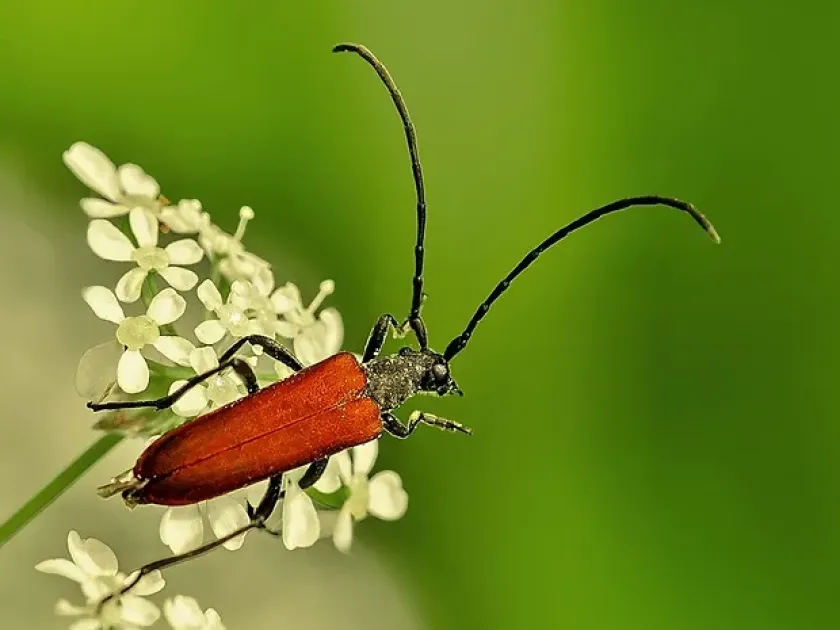
Red-femured longhorn beetle
Brachyleptura sanguinolenta
Description
How to identify
Brachyleptura sanguinolenta is a species of beetle belonging to the family Cerambycidae, commonly known as longhorn beetles. Adults measure about 10–15 mm in length, with females possessing distinct reddish-brown elytra.
The head and pronotum of this beetle are typically black. Males often appear darker than females. Their antennae are of moderate length, which is a characteristic feature of the Lepturinae subfamily to which they belong.
The larvae are cylindrical and white, with well-developed thoracic legs and strong mandibles designed for boring into wood. They live primarily beneath the bark and in the sapwood of coniferous trees.
This beetle is widely distributed throughout the temperate zones of Eurasia, where it thrives in forest environments rich in coniferous species that serve as its primary hosts.
Adult beetles are diurnal and are frequently observed visiting flowering plants, especially Apiaceae, to feed on nectar and pollen, which is vital for their reproductive maturity.
What it damages
The primary hosts of this pest are coniferous trees, particularly spruce and pine. The species acts as a secondary pest, preferring to colonize trees already weakened by drought, disease, or other environmental stressors.
Larvae feed on the inner bark and sapwood, creating extensive tunnels that disrupt the transport of nutrients and water within the tree. This damage eventually compromises the tree's health.
Severe infestations weaken trees significantly, making them more susceptible to primary pests, such as bark beetles. This synergy often leads to the death of the standing timber.
Beyond ecological damage, the presence of these beetles reduces the economic value of the wood, as the tunnels created by larvae degrade timber quality and structural integrity.
In forestry, monitoring this beetle is essential to assess the overall sanitation status of the forest and prevent the development of outbreaks in healthy stands.
When it appears
The flight period for adult beetles begins in late spring and continues throughout the summer, usually until August. During this time, adults mate and locate suitable host trees for oviposition.
The life cycle from egg to adult generally spans one to two years. Most of this time is spent in the larval stage, feeding and growing inside the host tree’s wood.
Pupation typically occurs during the warmer months. After metamorphosis, the newly formed adults bore exit holes to emerge from the timber and begin the cycle once more.
Warm spring and early summer weather conditions play a significant role in determining the timing and intensity of adult emergence and subsequent colonization of new host trees.
Adults are most active on warm, sunny days, which facilitates their movement between trees and their search for mating partners and food sources.
Signs of infestation
The most visible sign of an infestation is the presence of small, circular exit holes on the bark of the trunk, created when adults emerge after completing their development.
The accumulation of "frass"—a mixture of wood dust and excrement—at the base of the tree or within bark crevices is a clear indicator of active larval feeding underneath.
Discoloration of the needles and the premature shedding of branches are late-stage symptoms indicating that the tree’s internal vascular system has been severely compromised.
Careful inspection of the trunk may reveal patterns of larval galleries if the bark is peeled back, showing the extent of the damage caused by the feeding activity.
- circular exit holes on the tree trunk;
- piles of sawdust-like frass at the base;
- yellowing and dropping of needles;
- loosening or peeling bark;
- presence of adults on nearby flowers during summer.
Control measures
Effective management begins with maintaining good forest hygiene. Prompt removal of dying, stressed, or fallen trees is the most important preventive measure to eliminate breeding grounds.
Loggers should avoid leaving fresh timber or logging slash in the forest, as these materials provide ideal conditions for the beetle population to thrive and multiply.
Pheromone traps can be deployed in forest areas to monitor population levels and reduce the number of adults in the vicinity of vulnerable stands.
In cases involving high-value ornamental conifers, systemic insecticides can be used to treat trunks and branches to prevent larval development and adult colonization.
Regular forest health surveys are critical for identifying early-stage infestations and managing outbreaks before they can spread to healthy trees.
Taxonomy
- Latin name
- Brachyleptura sanguinolenta
- Order
- Coleoptera (beetles)
- Family
- Cerambycidae
- EPPO code
- LPTUSA
Discussion
No discussions yet — be the first.