
Gaur
Bos gaurus
Description
How to identify
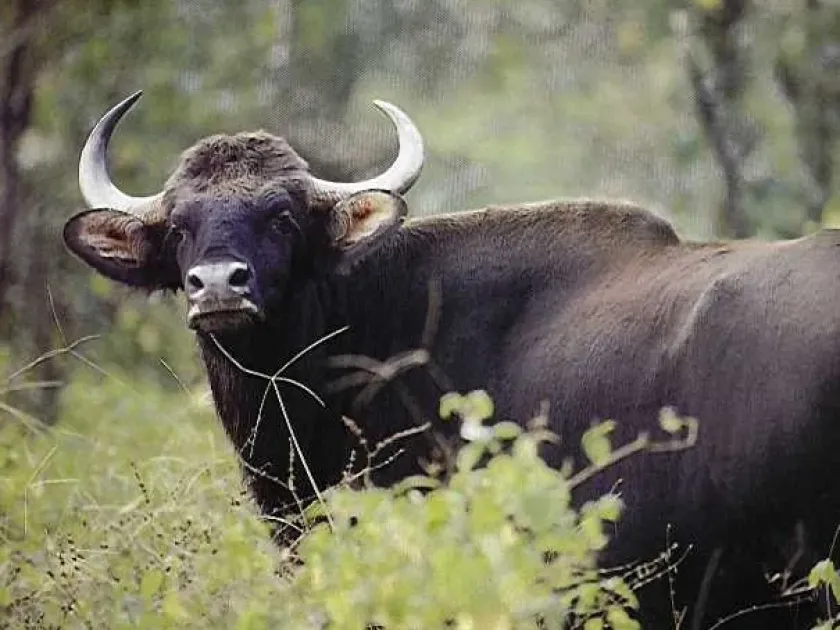
The Gaur (Bos gaurus), also known as the Indian bison, is the largest member of the Bovidae family and the order Artiodactyla. Adult males can weigh over 1,000 kg, possessing a distinctive ridge on their back.
These animals are typically found in hilly regions and lowland forests, but they frequently encroach upon agricultural areas when their natural habitat provides insufficient forage.
Gaurs exhibit a gregarious behavior, often seen in small herds. Their size and muscular build make them capable of navigating rough terrain and breaking through conventional farm barriers.
Identification in the field is relatively easy due to their massive size, dark coat, and white markings on their lower legs, which resemble stockings.
They are generally shy but become bold when food sources are scarce, posing a unique challenge for farmers located near forest fringes.
What it damages
Gaurs cause extensive agricultural damage by consuming large quantities of crops such as paddy rice, maize, and sugar cane during their nocturnal feeding forays.
Beyond ingestion, the primary damage stems from trampling, where the massive weight of the herd crushes crops, leading to significant yield reduction.
In plantation settings, gaurs frequently damage young trees by rubbing against trunks or consuming tender bark, which often results in the mortality of the saplings.
Their movement patterns often destroy irrigation channels and pathways between fields, requiring costly maintenance for farmers.
- Consumption of cereal crops at the milky stage.
- Destruction of fruit tree saplings.
- Trampling damage to soil structure.
- Damage to protective fencing and infrastructure.
Signs of infestation
The most reliable sign of gaur presence is the discovery of large, deep hoof prints that are distinctively larger than those of domesticated cattle.
Farmers can identify feeding areas by observing patches of crops that have been completely flattened and stripped of leaves.
The presence of large, fibrous droppings in the vicinity of the fields is a strong indicator that a herd has recently passed through the area.
Physical evidence of struggle, such as broken fence posts or snapped branches, often accompanies the feeding activity of these heavy animals.
Monitoring during dusk or dawn, when the animals are most active, often reveals sightings of the herd or their characteristic low vocalizations.
Control measures
Effective exclusion requires the installation of high-tensile, reinforced fencing that can withstand the significant physical pressure exerted by an adult gaur.
Integrated pest management strategies often include the use of motion-activated light and sound systems to deter the animals from entering sensitive zones.
Buffer cropping with unpalatable or deterrent plant species along the perimeter of the field can help reduce the attractiveness of the area to grazing herds.
Community-based monitoring and the use of traditional herding techniques can successfully divert herds away from high-value crops during peak harvest seasons.
Maintaining clear zones between forest boundaries and agricultural lands is essential to discourage the animals from habitual encroachment.
Taxonomy
- Latin name
- Bos gaurus
- Family
- Bovidae
- EPPO code
- BOVSGA
Discussion
No discussions yet — be the first.