
Grey Pine Carpet
Boarmia secundaria
Description
How to identify
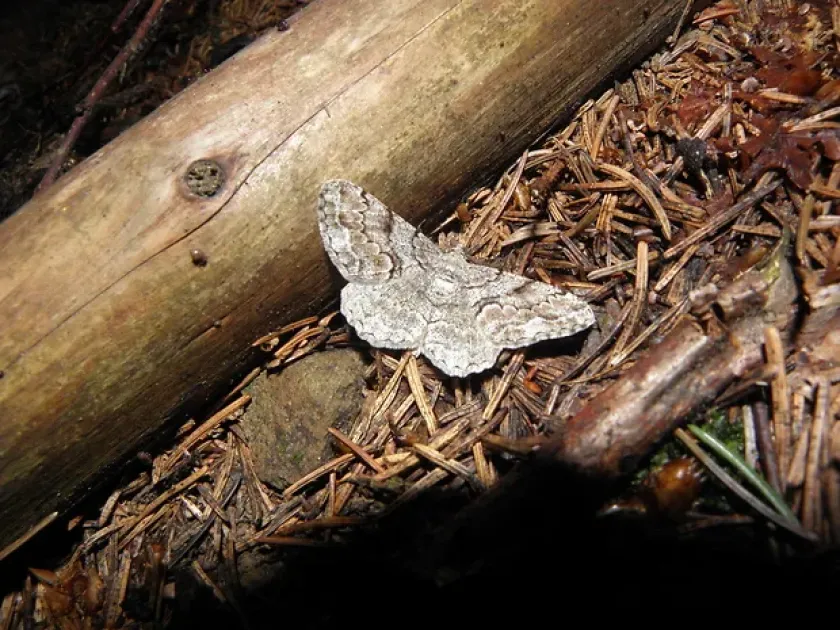
The Grey Pine Carpet (scientific name: Peribatodes secundaria, formerly classified under the genus Boarmia) belongs to the family Geometridae. This moth is a nocturnal insect, well-camouflaged against the bark of conifer trees.
Adult moths have a wingspan ranging from 35 to 45 mm. Their wing coloration is a blend of grey and brown tones, providing an excellent match to the texture and colour of tree bark, which serves as a vital survival strategy against avian predators during the day.
The larvae, known as loopers, exhibit the characteristic movement of the Geometridae family. They move by arching their bodies into a loop, often remaining motionless during the day, effectively mimicking small twigs or needles of the host plant.
Pupation occurs in the soil or within forest litter. The pupae are dark brown and have a hardened exterior, which protects them from fluctuating temperatures and predators throughout their developmental stage.
The species completes one generation per year. Adults are primarily active during twilight and nighttime, which often makes their presence difficult to detect without the use of specialized monitoring equipment such as light traps.
What it damages
This pest is a specialist defoliator that primarily targets various coniferous species. Its preferred host trees include spruce (Picea), fir (Abies), and pine (Pinus) trees.
Larval feeding is the primary cause of damage. Young larvae begin by browsing the edges of needles, whereas older larvae may consume needles entirely, leaving behind bare twigs and skeletonized remains.
Severe infestations can lead to substantial canopy thinning, which weakens the trees significantly. In young stands or tree nurseries, heavy defoliation can cause stunted growth and significantly reduce the overall health and vigor of the plants.
Trees stressed by repeated defoliation become highly susceptible to opportunistic secondary pests, such as bark beetles and wood-boring insects, which can eventually lead to the death of the host tree.
In forestry, the economic impact is measured by the loss of timber increment and the degradation of the aesthetic value of ornamental conifer landscapes.
When it appears
The adult moth flight period typically occurs in the second half of summer, primarily spanning from July to August. During this period, mating occurs, and females lay eggs on the needles of host trees.
The larvae overwinter in the early instar stages, seeking refuge within the needle litter or tucked away among the branches. When spring arrives, the warming temperatures trigger their emergence and resumption of feeding.
Spring feeding is the most aggressive period for the larvae, as they consume fresh buds and developing needles. This activity coincides with the most critical growth phase for the conifer trees.
Pupation takes place in early summer within the soil layer. The metamorphosis period lasts several weeks, followed by the emergence of the new generation of adults to repeat the cycle.
Environmental conditions significantly influence the population dynamics; warm and stable weather patterns generally support higher larval survival rates, potentially leading to noticeable outbreaks.
Signs of infestation
Initial signs of infestation include yellowing or browning needles on the branches. As the larvae grow, the consumption of needles becomes more apparent, often resulting in sparse or thinning crowns.
Looking closely at the branches, one might notice skeletonized needle parts or small, dark frass pellets accumulating on lower branches or the forest floor. The loopers themselves are masters of disguise and are rarely seen unless specifically searched for.
- Yellowing and premature needle drop.
- Thinning of the canopy in the upper or middle tree sections.
- Presence of skeletonized or partially eaten needles.
- Accumulation of small, dark larval excrement beneath the tree canopy.
Effective monitoring involves the use of light or pheromone traps during the flight season to determine population levels and the necessity for subsequent control measures.
Control measures
Integrated pest management strategies focus on maintaining tree health through good silvicultural practices, such as removing overly crowded or unhealthy trees and clearing dense litter from the base of young trees.
Biological control using Bacillus thuringiensis (Bt) is highly effective against young larvae. This approach is preferred in sensitive ecosystems as it is selective and does not harm beneficial insects or local biodiversity.
In cases of severe outbreaks, targeted applications of systemic or contact insecticides may be necessary. These should be applied during the evening to ensure maximum contact with the nocturnal larvae.
Encouraging natural bird populations and parasitic insects is a cornerstone of sustainable forest management. These natural enemies significantly contribute to the regulation of moth populations by predating on both eggs and larvae.
Regular spring assessments allow for the early detection of larval activity. Early intervention with localized measures is almost always more cost-effective and environmentally friendly than large-scale chemical applications.
Taxonomy
- Latin name
- Boarmia secundaria
- Order
- Lepidoptera (butterflies)
- Family
- Geometridae
- EPPO code
- BOARSC
Discussion
No discussions yet — be the first.