
Boarmia japygiaria
Boarmia japygiaria
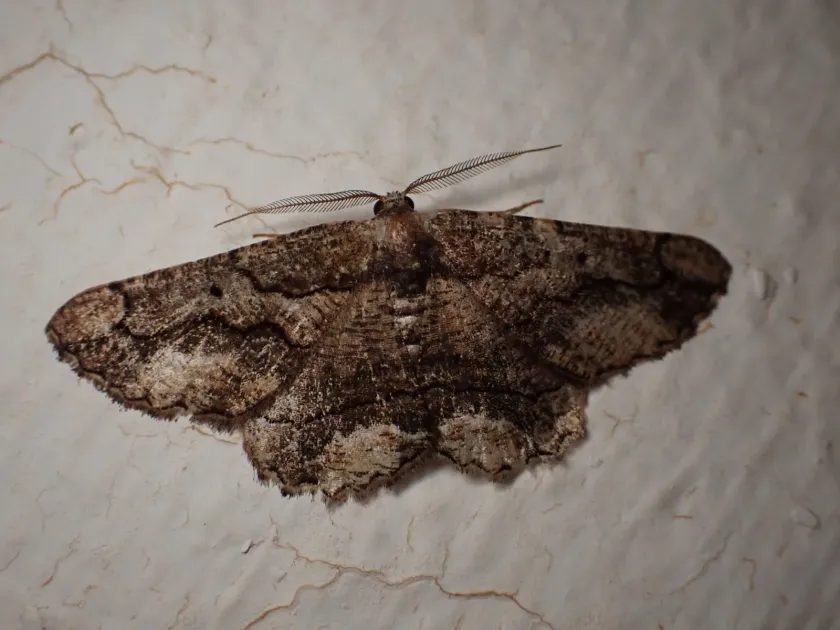
Description
How to identify
Boarmia japygiaria belongs to the family Geometridae, commonly known as geometer moths. This species is characterized by its moth stage, which is usually nocturnal, and its larval stage, known as an inchworm due to the distinctive way it moves.
Adult moths have a wingspan typically ranging from 35 to 45 mm. Their coloration consists of intricate grey-brown patterns that provide excellent camouflage against the bark of trees, which is their primary resting site during daylight hours.
The larvae are specialized to resemble small twigs, allowing them to remain undetected by avian predators. They have a reduced number of prolegs, which contributes to their unique looping locomotion method.
Pupation generally occurs in the soil or within crevices of the host plant's bark. The pupae are robust and dark-colored, protected by a light cocoon or simply embedded in the substrate to survive the winter season.
The life cycle encompasses four distinct stages: egg, larva, pupa, and adult. The moths emerge in late spring or summer to mate and lay eggs, starting the cycle anew for the next generation.
What it damages
The damage is caused entirely by the larval stage of the moth. These caterpillars are generalist feeders that consume the foliage of various woody plants and some agricultural crops.
When feeding, they often start from the edges of the leaves, moving inward. In cases of high population density, they can completely defoliate host plants, causing severe stress to the vegetation.
Repeated defoliation by these larvae reduces the photosynthetic capacity of the plants, which subsequently stunts growth and reduces fruit production in orchards.
Beyond direct tissue consumption, the wounds created by the larvae serve as entry points for secondary pathogens like fungi and bacteria, which may cause further decay of the branches.
Young plants, particularly in nursery environments, are at the highest risk as they cannot compensate for the rapid loss of leaf area as effectively as mature trees.
When it appears
Adult moth activity peaks during late spring and summer months. Being nocturnal, they remain active during the dark, while spending their days hidden in sheltered locations.
The larval stage coincides with the peak growing season of host plants. The highest feeding activity typically occurs during June and July, when temperatures are optimal for larval development.
As the weather begins to cool in late summer or autumn, the larvae reach maturity and seek sites for pupation. They overwinter in this stage, dormant until the arrival of the next year's spring.
Monitoring for adult flight activity using light traps is a standard method to predict larval outbreaks and schedule monitoring efforts effectively.
Weather conditions, specifically humidity and temperature, play a crucial role in population dynamics; warm, humid springs often lead to more rapid larval development.
Signs of infestation
Early signs of infestation include the appearance of notched leaf edges and fine granular frass (excrement) scattered on the leaves or the ground beneath the host plant.
Visual identification of the caterpillars can be challenging due to their cryptic coloration and "twig-like" posture. They are often found resting along the veins of leaves or on thin stems.
Dense webbing connecting multiple leaves may indicate high larval activity, as some species use silk to protect themselves while feeding or preparing for pupation.
Trees infested by a large number of larvae may exhibit an overall sparse canopy or exhibit visible signs of skeletonized foliage before full defoliation occurs.
Farmers should look for small holes in leaves and the presence of larvae moving in the characteristic inching motion during early morning or evening inspections.
Control measures
Cultural control measures, such as soil cultivation under the canopy in autumn, can significantly disrupt the overwintering pupae and reduce the population for the following year.
Biological control agents, particularly microbial insecticides containing Bacillus thuringiensis, are highly effective against young larvae while preserving beneficial insect populations.
If chemical intervention is deemed necessary based on economic threshold levels, localized application of selective insecticides is recommended to minimize impact on non-target species.
Pheromone traps can be deployed to attract and monitor male populations, providing a warning system that helps in timing other control measures effectively.
- Sanitation of the orchard by removing dead or diseased branches.
- Encouraging natural predators such as birds and parasitic wasps.
- Regular field monitoring to detect infestation before it reaches critical levels.
Taxonomy
- Latin name
- Boarmia japygiaria
- Order
- Lepidoptera (butterflies)
- Family
- Geometridae
- EPPO code
- BOARJA
Discussion
No discussions yet — be the first.