
Oak beauty
Boarmia ilicaria
Description
How to identify
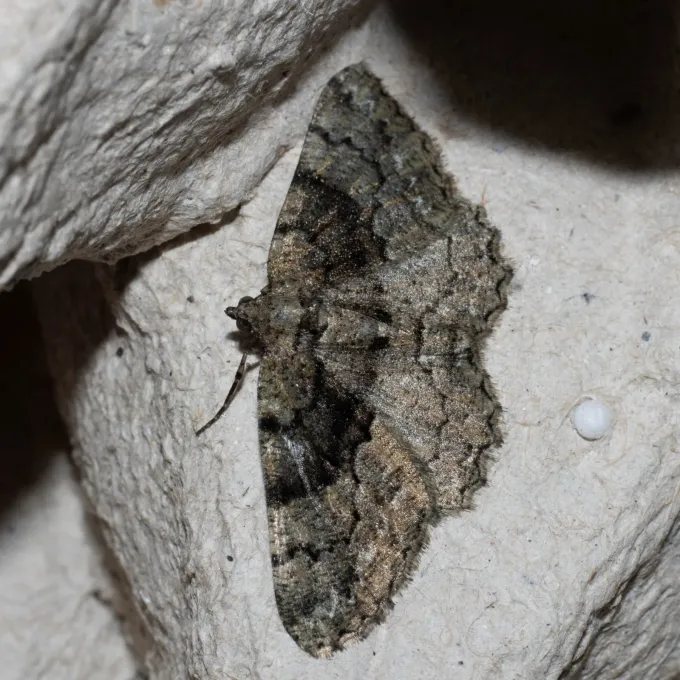
The Oak beauty (Boarmia ilicaria) belongs to the Geometridae family, order Lepidoptera. It is a nocturnal moth species known for its remarkable camouflage capabilities.
The adult moth has a wingspan of approximately 35–45 mm. The wings feature shades of gray and brown with intricate patterns that mimic the texture of tree bark perfectly.
Caterpillars of this species exhibit the characteristic "looping" movement of all geometrid larvae, where they draw their hind legs toward their thoracic legs to create a loop.
The body of the caterpillar is often brownish or greenish, covered in small bumps that allow it to resemble small twigs or petioles when resting on a branch.
This species is a common inhabitant of deciduous forests, where it finds suitable conditions for feeding and reproduction throughout the growing season.
What it damages
The primary food source for Boarmia ilicaria larvae is the genus Quercus (oak), which gives the species its common name.
In addition to oaks, the larvae can feed on various other deciduous trees, including beech, potentially posing a risk to mixed forest stands.
Young caterpillars start by feeding on tree buds in early spring and subsequently move to the foliage, skeletonizing leaves or consuming large sections of the leaf blade.
In cases of mass outbreaks, the moth can cause significant defoliation of individual trees or entire forest sections, severely impacting tree health.
Repeated damage over several seasons weakens trees significantly, reducing their growth rates and making them susceptible to secondary pests like wood-boring beetles.
When it appears
Adult moths are generally active during the spring and summer months, when warm nights provide optimal conditions for mating and egg-laying.
The species typically undergoes one generation per year, which is typical for many geometrid species in temperate climate zones.
The appearance of larvae in the spring correlates with the bud burst phase, ensuring that the caterpillars have access to fresh, nutrient-rich food immediately after hatching.
Active feeding lasts for several weeks, after which the caterpillars descend or prepare to pupate in the soil or forest litter layer.
The overwintering stage is typically the pupa, which remains dormant in the soil surface until the next spring growing season.
Signs of infestation
One of the first signs of infestation is the presence of characteristic leaf damage, including small holes or ragged edges on the leaf margins within the canopy.
When inspecting branches, you may find the larvae themselves, which stay perfectly still and mimic twigs when threatened, making them difficult to spot.
Large amounts of frass (caterpillar droppings) accumulating on the forest floor beneath trees indicate a high density of the pest population in the canopy.
During mass outbreak years, the sound of intense feeding by a large number of larvae can often be heard in quiet forest environments.
Affected trees may show premature yellowing or leaf drop, and sometimes the production of "second foliage" in mid-summer, which drains the tree's energy reserves.
Control measures
Biological control measures include promoting populations of natural predators, such as insectivorous birds, ants, and predatory insects, in forest areas.
The use of biological insecticides based on Bacillus thuringiensis is an effective and environmentally friendly method for controlling young larval stages.
In forest management, if there is a threat of severe defoliation, the application of authorized chemical insecticides may be necessary via ground or aerial spraying.
Maintaining high biological diversity within forest stands is the best preventive measure to keep pest populations below the economic threshold.
Regular population monitoring using pheromone traps allows for early detection of potential outbreaks, enabling timely and targeted protection actions.
Taxonomy
- Latin name
- Boarmia ilicaria
- Order
- Lepidoptera (butterflies)
- Family
- Geometridae
- EPPO code
- BOARIL
Discussion
No discussions yet — be the first.