
Boarmia ectropodes moth
Boarmia ectropodes
Description
How to identify
Boarmia ectropodes belongs to the family Geometridae (inchworms/loopers), part of the Lepidoptera order. Adult moths are nocturnal and possess excellent camouflage.
The larvae, commonly known as inchworms, exhibit the characteristic looping movement of the family due to the reduced number of abdominal prolegs.
Their skin coloration is adapted to blend with the bark and twigs of host plants, providing high levels of protection against avian predators.
Pupae are typically found in the soil or protected crevices on the tree trunk, surviving harsh winter conditions through diapause.
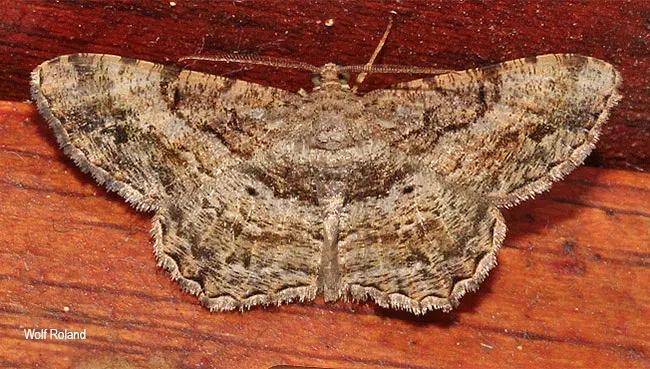
Visual identification of adult moths is challenging due to their nocturnal behavior and cryptic coloring, which helps them vanish into the environment.
What it damages
As a polyphagous insect, Boarmia ectropodes feeds on a wide range of woody plants, including various deciduous fruit and forest species.
The larvae cause damage by consuming leaf tissue, which drastically reduces the photosynthetic capacity of the affected plant during critical growth stages.
Heavy infestations can lead to significant defoliation, leaving the branches bare and exposing the tree to solar scorching and secondary infections.
Repeated annual damage weakens the plant, resulting in stunted growth, reduced yields, and increased vulnerability to environmental stressors.
In severe cases, the physiological balance of the tree is disrupted, leading to branch dieback and an overall decrease in plant longevity.
When it appears
The life cycle of the moth is finely tuned to the phenology of its host plants, ensuring that larvae emerge when foliage is most abundant.
Adult emergence typically occurs in the spring or early summer, depending on local climate conditions and regional temperature patterns.
Eggs are deposited in sheltered locations such as bark crevices or leaf undersides, ensuring the larvae have immediate access to food upon hatching.
Peak feeding activity for the caterpillars usually occurs throughout the spring and early summer, matching the peak period of vegetative growth.
By late summer, the larvae complete their development and pupate, remaining in a dormant state until the next reproductive cycle begins.
Signs of infestation
The first signs of infestation are small irregular holes or notches on the leaf edges, often seen on younger leaves during the spring season.
As the larvae mature, they consume more leaf area, leading to severe defoliation that starts at the outer canopy and moves inward.
The presence of fine, dark granular frass (excrement) scattered on the leaves or the ground beneath the tree indicates the presence of an active infestation.
Observing the caterpillars themselves requires close inspection, as they remain motionless along twigs to mimic the appearance of a woody structure.
A noticeable decline in tree vigor, combined with visible leaf loss, is a strong indicator of a serious pest population that requires intervention.
Control measures
Effective management of Boarmia ectropodes requires an integrated approach that focuses on minimizing damage while protecting the ecosystem.
Manual control methods, including hand-picking or mechanical shaking of branches onto tarps, are effective for smaller or younger trees.
- Deploying sticky bands around tree trunks to prevent larvae from climbing or moving between ground and canopy.
- Encouraging natural predators, such as insectivorous birds and parasitic wasps, to control larval populations naturally.
- Applying Bacillus thuringiensis-based microbial insecticides to target larvae in the early instars safely.
Chemical control should be implemented judiciously, using systemic insecticides only when pest populations exceed acceptable economic thresholds.
Maintaining high plant health through balanced fertilization and proper pruning reduces the overall risk of significant pest pressure in the orchard.
Taxonomy
- Latin name
- Boarmia ectropodes
- Order
- Lepidoptera (butterflies)
- Family
- Geometridae
- EPPO code
- BOAREC
Discussion
No discussions yet — be the first.