
Chinch bug
Blissus leucopterus
Description
How to identify
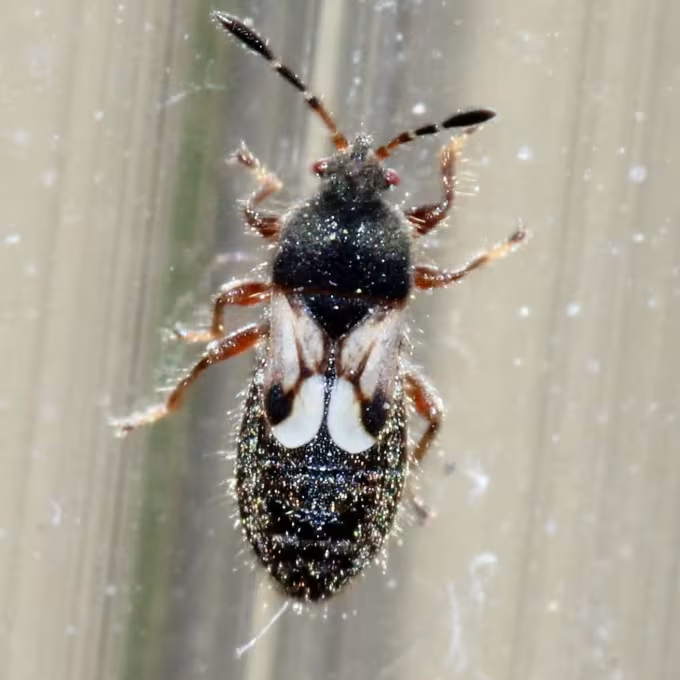
The chinch bug (Blissus leucopterus) is a member of the Blissidae family within the order Hemiptera. Adults are approximately 4 mm long, featuring a black body with white wings that bear distinctive black triangular markings.
Nymphs undergo five developmental stages (instars). They start as bright red insects with a white band across their back and gradually transition to a black color as they reach maturity.
This pest thrives in warm, dry weather conditions, which makes outbreaks particularly severe during drought years. Adult bugs are capable of flight, allowing them to migrate rapidly between neighboring fields.
Reproduction typically occurs near the base of host plants. Females lay eggs in moist soil or within the leaf sheaths of grasses, ensuring that newly hatched nymphs have immediate access to food.
They overwinter as adults in dense clumps of bunchgrass, leaf litter, or crop debris, which provides necessary protection against winter freezing temperatures.
What it damages
Chinch bugs primarily attack small grains including wheat, barley, rye, and oats. They are also highly destructive to corn, sorghum, and millet crops throughout their growing season.
The insects use their piercing-sucking mouthparts to feed on plant sap. This process removes vital nutrients and moisture, severely stressing the vascular system of the host plant.
Severe infestations lead to stunted growth, leaf yellowing, and eventually the death of the plant. In extreme cases, entire sections of a field may turn brown and wither completely.
The damage to cereal crops results in poor kernel development, leading to significantly lower yields and reduced test weights at harvest time.
In addition to direct feeding, the bug's saliva contains toxic components that can cause localized necrosis, which further weakens the plant and makes it susceptible to secondary pathogens.
When it appears
The activity cycle begins in early spring as temperatures rise above 15-20°C. Overwintered adults emerge and move onto young winter wheat or emerging spring grain seedlings.
The most damaging period occurs in mid-summer when the second generation of nymphs matures. This peak activity often coincides with the critical grain-filling stages of many crops.
In favorable conditions, the chinch bug can complete two full generations within a single growing season, leading to a massive increase in population density.
As crops mature and dry down, adults migrate to alternative hosts like corn or wild grasses, where they remain active until the onset of autumn chill.
When temperatures drop in late autumn, they seek out protected areas in crop stubble or field borders to enter diapause for the duration of the winter.
Signs of infestation
The first sign of an infestation is often the appearance of irregular patches of stunted, yellowing plants, particularly in areas near field margins or grass borders.
Careful inspection of the lower stem and soil surface often reveals the presence of nymphs, which may be clustered together in large numbers around the base of the plant.
Feeding sites appear as small, darkened, necrotic spots where the bug has pierced the stem tissue. These spots prevent the flow of nutrients to the upper parts of the plant.
If the infestation is severe, the plants will exhibit significant lodging or may appear completely blighted, a condition often described as "chinch bug blight."
- Presence of dark-colored nymphs at the base of stems.
- Wilting plants that do not respond to irrigation.
- A characteristic unpleasant, "buggy" odor emitted when disturbed.
Control measures
Crop rotation is one of the most effective cultural controls, as interrupting the sequence of host grasses forces the pest to migrate to distant fields.
Tillage practices, such as deep plowing after harvest, can bury crop residues and destroy the overwintering sites, significantly reducing the spring population.
Eliminating grassy weeds along fence lines and field perimeters removes critical reservoirs where the chinch bug population survives before moving into crops.
Chemical control involving systemic or contact insecticides is recommended when nymph populations reach or exceed established economic thresholds.
Selecting early-maturing varieties or adjusting planting dates can help crops reach stages of maturity where they are less vulnerable to chinch bug feeding.
Taxonomy
- Latin name
- Blissus leucopterus
- Order
- Hemiptera (bugs, aphids, leafhoppers)
- Family
- Lygaeidae
- EPPO code
- BLISLE
Discussion
No discussions yet — be the first.