
Chinch bug
Blissus
Description
How to identify
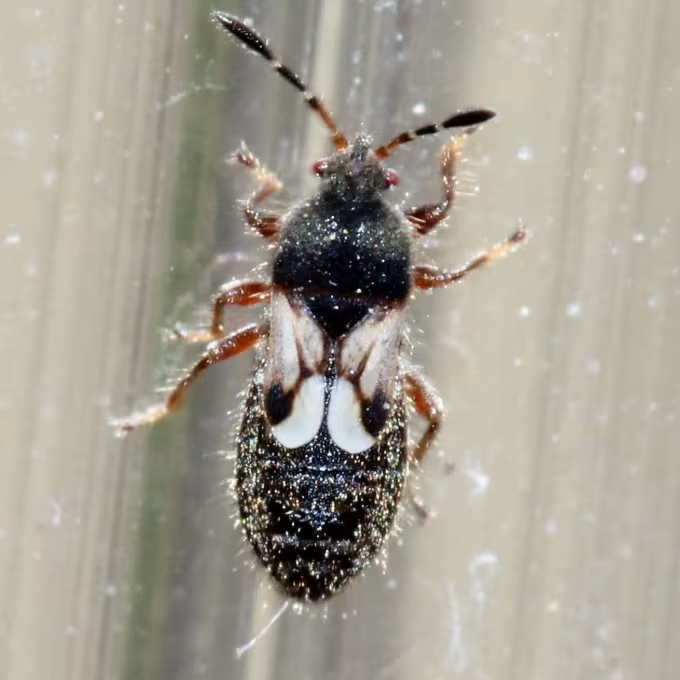
The chinch bug (Blissus) belongs to the family Lygaeidae in the order Hemiptera. These are small insects, typically measuring 3 to 5 mm in length, characterized by a dark body and wings that often have distinct white markings.
Adults are known for their strong legs and well-developed wings, allowing them to migrate between fields as food sources become depleted or conditions change.
Nymphs of the chinch bug go through several molting stages, changing their appearance and coloration from bright red-orange to dark brown as they mature into adults.
Like many other hemipterans, these insects possess specialized glands that release a pungent odor when the insect is disturbed or handled, which serves as a defense mechanism.
Correct identification often requires examining the base of the plant stem, as these bugs prefer to stay close to the ground, hidden from direct sunlight and predators.
What it damages
Chinch bugs primarily attack small grains such as wheat, barley, rye, and oats. They are notorious pests that can cause significant economic losses in cereal production.
Both adults and nymphs feed by inserting their piercing-sucking mouthparts into the stem of the plant to extract sap, which deprives the plant of essential nutrients and water.
The saliva injected by the bugs during feeding is toxic to the plant tissues, leading to localized necrosis, wilting, and eventually the death of the affected plant.
Damage is most severe during the early stages of plant development, such as the tillering phase, where the destruction of young shoots can lead to sparse and patchy crop stands.
In addition to direct feeding damage, the weakened condition of the plants makes them more susceptible to drought stress and secondary infections by various fungal pathogens.
When it appears
The life cycle of the chinch bug is heavily influenced by temperature and humidity. Adults typically overwinter in dense grass, leaf litter, or crop debris near agricultural fields.
With the arrival of warmer spring temperatures, adults emerge from hibernation and migrate to young cereal fields to feed and lay their eggs on the stems of host plants.
Depending on the climatic conditions, chinch bugs can complete one or more generations per year, with populations often peaking during the late spring or mid-summer period.
As crops mature or are harvested, the insects migrate to greener, more succulent grasses or neighboring fields, continuing their activity until the onset of autumn cooling.
Monitoring for the presence of nymphs is crucial during the early growing season, as they are often more destructive than the mobile adult stages.
Signs of infestation
Early symptoms of a chinch bug infestation often include the yellowing and wilting of the lower leaves of cereal plants, which may eventually turn brown and die.
In heavily infested fields, patches of stunted or dead plants appear, often referred to as "chinch bug spots," which expand in size as the population grows.
Close inspection of the plant base often reveals clusters of blackish bugs with white wing patches, or red-colored nymphs actively feeding on the stem.
Severe infestations during the grain-filling stage result in empty or poorly developed ears, a condition known as whiteheads, significantly reducing crop yields.
- Yellowing and drying of lower plant foliage
- Clusters of nymphs and adults at the stem base
- Development of stunted, necrotic patches in the field
- High incidence of empty or shriveled grain ears
Control measures
Effective cultural control includes the use of crop rotation, which breaks the pest's cycle by ensuring that host plants are not available in the same field sequentially.
Field sanitation is critical; destroying crop residues and maintaining clean margins around fields reduces the availability of overwintering sites for the adult bugs.
When infestation levels exceed the economic threshold, chemical control using systemic or contact insecticides is recommended to prevent rapid spread across the field.
Encouraging natural predators, such as lady beetles and lacewings, can help manage chinch bug populations naturally in well-balanced agroecosystems.
Selecting resistant crop varieties can provide a solid foundation for integrated pest management (IPM), reducing the reliance on intensive chemical applications.
Taxonomy
- Latin name
- Blissus
- Order
- Hemiptera (bugs, aphids, leafhoppers)
- Family
- Lygaeidae
- EPPO code
- BLISSP
Discussion
No discussions yet — be the first.