
Coffee stem borer
Bixadus sierricola
Description
How to identify
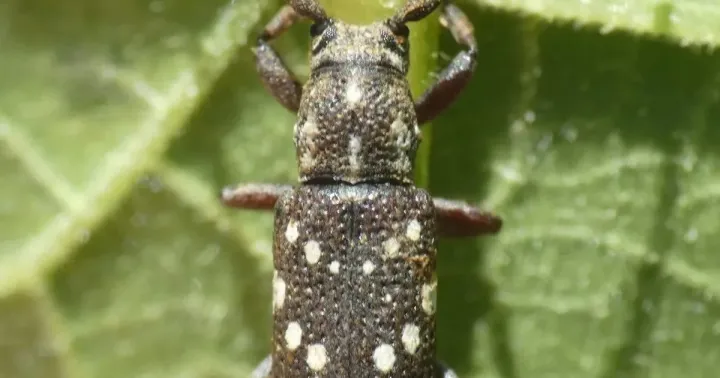
The coffee stem borer (Bixadus sierricola) belongs to the longhorn beetle family (Cerambycidae), order Coleoptera. Adult beetles are large, typically measuring between 30 to 40 millimeters, making them highly visible on infested host plants.
The adult beetle is dark brown to black in color, often covered with a fine gray or yellowish pubescence on the elytra. Long antennae, a hallmark of the Cerambycidae family, extend well beyond the body length, aiding in detection.
Larvae are cream-colored, cylindrical, and possess strong mandibles capable of boring through hardened wood. They spend their entire developmental phase hidden inside the trunks or main branches of the coffee tree.
Pupation occurs deep within the larval tunnels carved into the wood. The larva creates a protected chamber where it transitions into a pupa, effectively shielding itself from the external environment until it emerges as an adult.
The life cycle is closely linked to the physiological status of the coffee trees. Adults are nocturnal, showing high activity during the night, which is when they mate and lay eggs on the bark of host plants.
What it damages
The primary host for this pest is the Arabica coffee plant (Coffea arabica), although other species can occasionally be affected. The damage is primarily internal and inflicted by the tunneling activity of the larvae.
By boring through the sapwood and heartwood, larvae disrupt the plant's vascular system, preventing the upward movement of water and essential nutrients from the root system to the canopy.
Trees damaged by stem borers become physically brittle and are prone to breaking under moderate wind conditions. This structural instability is a major risk factor for coffee plantations in windy regions.
Yield reduction is significant, as the tree redirects its energy into healing internal wounds rather than producing berries. Chronic infestation leads to a gradual decline in the plant's vigor and berry production.
In severe cases, if the infestation is not managed, the damage becomes terminal, resulting in the death of the coffee tree as its vascular integrity is permanently compromised.
Signs of infestation
The earliest visual sign is the presence of small, circular entry holes on the bark of the trunk, typically near the base of the tree. These are often accompanied by piles of sawdust, which the larvae eject while feeding.
Yellowing of the foliage followed by premature leaf drop is a classic indication of borer activity. As the vascular blockage worsens, the leaves lose their green color and the tree begins to appear visibly stressed.
Severe infestations manifest as sudden wilting of the entire canopy. If the tree does not recover, it indicates that the tunnels have severely girdled the stem, cutting off all nutrient transport.
Bark splitting or peeling around the tunnel openings may occur. In some instances, tree sap may leak from the infestation sites, drying into dark, gummy residues that are easily spotted during routine inspections.
During the night, adult beetles may be observed crawling on the trunks of coffee trees. They are attracted to trees that are already showing signs of physiological distress, which often makes those trees a target for future egg-laying.
Control measures
Cultural control is the most effective strategy, specifically the removal and burning of severely infested trees. This practice destroys the larvae inside the wood before they can emerge as adults and continue the cycle.
Regular monitoring of trunks for sawdust and entry holes allows farmers to spot infestations early. In some cases, manual extraction of larvae using wire probes can save trees if the damage is localized and minor.
Chemical control can be applied in the form of contact insecticides during the peak activity period of adult beetles. However, timing is crucial, as the insecticide must hit the beetles before they lay eggs.
Good agricultural practices, such as proper pruning, fertilization, and shade management, keep coffee trees vigorous and less attractive to boring insects, minimizing the risk of a successful infestation.
- Routine monitoring and inspection of tree trunks.
- Prompt sanitation through burning of infested wood.
- Manual extraction of larvae using probing tools.
- Targeted application of insecticides to tree bark.
Taxonomy
- Latin name
- Bixadus sierricola
- Order
- Coleoptera (beetles)
- Family
- Cerambycidae
- EPPO code
- BIXASI
Discussion
No discussions yet — be the first.