
Red-legged march fly
Bibio rufiventris
Description
How to identify
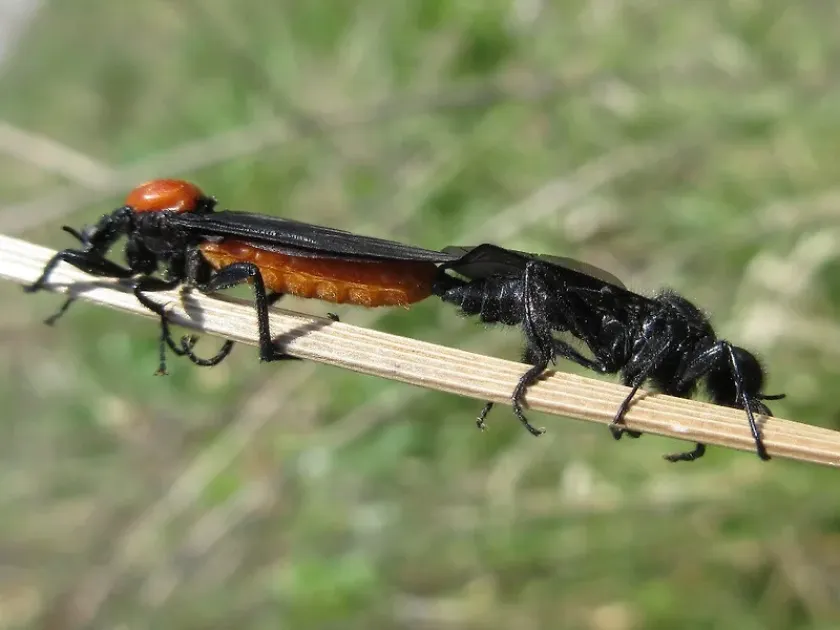
The Red-legged march fly (Bibio rufiventris) belongs to the Bibionidae family, order Diptera. Adult flies typically measure 7–10 mm in length, featuring a black body and distinct reddish-brown legs, which serves as a primary diagnostic feature for this species.
Larvae are cylindrical and greyish in color, measuring up to 15 mm. They are characterized by a well-developed head capsule and scattered bristles on their body segments, which helps them maneuver through organic-rich soil layers.
Adults are most commonly observed in early spring, often swarming in warm, sunny locations near vegetation. Their lifecycle is synchronized with the first warm days of the season, allowing for efficient mating and egg-laying in moist soils.
The development cycle consists of four larval instars, a pupal stage, and the adult phase. Most of the lifecycle is spent underground, where larvae feed on decaying organic matter, but they may cause damage to living plants under certain conditions.
Pupation typically occurs in the soil within a small chamber. Environmental factors such as soil temperature and moisture levels are critical determinants of the timing and success of their emergence each spring.
What it damages
While adults are harmless, the larvae represent a threat to cultivated plants. They dwell in the soil and feed on the roots, tubers, and underground stems of various crops, including vegetables like carrots, potatoes, and various seedlings.
Damage is often localized but can become severe in fields or greenhouses where organic matter levels are high. The larvae create feeding tunnels in plant roots, which severely compromises the plant's ability to absorb water and nutrients.
Young plants are particularly vulnerable to larval attacks. Root damage often leads to stunting, yellowing of foliage, and can result in the complete death of the seedling if the main taproot is heavily severed by the larvae.
Furthermore, the physical injury caused by feeding allows opportunistic pathogens, such as soft rot bacteria and soil-borne fungi, to enter the root system, causing further degradation and potential crop loss during the storage phase.
The economic impact is most significant in early-season crops, where the root systems are not yet mature enough to withstand the feeding pressure exerted by a dense population of larvae.
Control measures
Management of the Red-legged march fly is primarily based on cultural practices. Deep plowing in the autumn helps to expose larvae to natural predators and freezing temperatures, effectively reducing the overwintering population.
It is crucial to ensure that manure applied to fields is well-composted. Fresh manure attracts egg-laying females and provides an optimal food source for developing larvae, which can lead to localized infestations in the following season.
In greenhouses and nursery beds, soil sterilization or using artificial growing media is a highly effective preventative measure. Eliminating organic debris from the soil surface can also discourage females from selecting the area for oviposition.
Chemical control can be implemented in severe infestations using soil-applied insecticides. However, integrated pest management (IPM) strategies, including biological control using beneficial nematodes or entomopathogenic fungi, are increasingly preferred.
- Crop rotation to break the pest's cycle.
- Regular weed control to minimize alternative food sources for larvae.
- Proper irrigation management to prevent excessive soil moisture that favors pest development.
Taxonomy
- Latin name
- Bibio rufiventris
- Order
- Diptera (flies)
- Family
- Bibionidae
- EPPO code
- BIBIRU
Discussion
No discussions yet — be the first.