
St. Mark's fly
Bibio marci
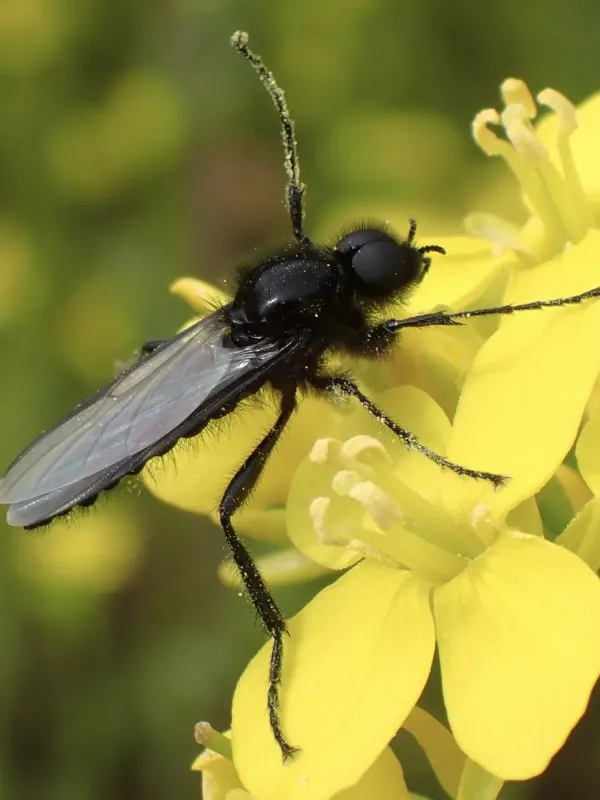
Description
How to identify
The St. Mark's fly, scientifically known as Bibio marci, belongs to the family Bibionidae, commonly referred to as March flies. These insects are distinguished by their black bodies, dense hair, and robust legs, which make them easily recognizable during their spring emergence.
The larvae of this species develop within the soil and are cylindrical in shape. They typically reach 15–20 mm in length and exhibit a brownish-grey coloration. Their bodies are covered with numerous small tubercles and stiff bristles, which aid in their movement through the soil.
The insect follows a complete metamorphosis life cycle, consisting of egg, larva, pupa, and adult stages. Most populations in temperate regions are univoltine, meaning they complete only one generation per year, with the larvae serving as the primary soil-dwelling stage.
While the adult flies feed on nectar and are generally harmless to crops, the larvae are the focus of agricultural concern. Adults appear in late spring, coinciding with the feast day of Saint Mark, which explains their common name.
Identification in the field is usually achieved through observation of the swarming adults in spring or by taking soil samples to identify the characteristic groups of larvae in agricultural beds or potting substrates.
What it damages
The larvae are polyphagous, meaning they feed on a variety of organic matter. However, in the absence of sufficient decaying material, they turn to living plant tissues, specifically targeting the roots of vegetables, fruit seedlings, and ornamental grasses.
The damage is particularly severe in nursery settings and greenhouses, where larvae can strip the fine roots of young plants. This causes stunted growth, wilting, and in many cases, total plant failure if the infestation density is high enough.
In field conditions, the St. Mark's fly larvae can significantly impair the development of crops like strawberries or young cereal shoots. By disrupting the root system, they leave the plants vulnerable to secondary infections from soil-borne pathogens like fungi and bacteria.
Turf and sport fields are also commonly affected. The larvae feed on the roots of grasses, leading to the creation of dead patches that can be easily pulled away from the soil, causing aesthetic and functional problems for landscaping professionals.
Because the larvae often feed in groups, damage is usually concentrated in patches, allowing for targeted monitoring and treatment. Their presence can be deceptive, as many growers mistake the resultant wilting for simple drought or nutrient deficiency.
When it appears
As the name suggests, the activity of St. Mark's flies is strongly linked to the spring season. In most European climates, the swarming of adults occurs around late April, closely aligned with Saint Mark's Day (April 25th), depending on temperature thresholds.
The adult stage is relatively short-lived, with flies only surviving for a few weeks. During this time, the primary focus is mating and oviposition, where females deposit hundreds of eggs into moist, organic-rich soil layers to ensure the success of the next generation.
Larvae develop throughout the summer and autumn months, growing progressively larger. They remain in the soil through the winter, often remaining active during milder spells, and undergo their final growth phase in the early spring.
Pupation takes place in the spring within the soil profile. The pupal stage is short, leading to the rapid emergence of the next generation of adults, effectively completing the annual cycle that challenges growers each year.
Early spring warm spells can lead to an earlier and more intense emergence of the flies, prompting farmers to pay closer attention to soil health and larval presence before planting season begins in earnest.
Signs of infestation
One of the first signs of an infestation is the sudden wilting of young plants or seedlings, especially when the soil moisture levels are adequate, which indicates root damage rather than drought stress.
Digging around the base of affected plants reveals the presence of brownish, bristled larvae. These are often found in clusters, as the larvae are gregarious and feed collectively in the upper soil horizons.
The presence of large, swarming numbers of black flies on crops or greenhouse structures during warm spring days is a clear indicator that egg-laying is occurring, signaling the need for immediate soil inspection.
For lawns, a major sign is the ease with which turf can be lifted, as the roots have been severed. Increased bird activity, specifically birds picking at the grass, often points to a high population of larvae beneath the surface.
Fine tunnels in the soil, often accompanied by plant residue and excrement, indicate active feeding sites. These tunnels can be found near the root zones of garden vegetables and should be treated as a warning of pending damage.
Control measures
Cultural control is the most sustainable approach. Deep autumn cultivation or tilling helps expose the larvae to the surface, where they become susceptible to freezing temperatures and natural predators such as birds.
Proper management of organic fertilizers is essential. Growers should avoid using fresh, uncomposted manure, as this attracts female flies seeking a nutrient-rich site to deposit their eggs. Fully mature compost is significantly less attractive to the pest.
In high-value agricultural systems, soil-applied insecticides can be used to manage populations. These should be applied according to the manufacturer's recommendations and in compliance with local regulations to protect beneficial insects.
Biological control, such as the use of entomopathogenic nematodes (e.g., Steinernema feltiae), is highly effective for larvae in greenhouses or high-value garden beds. These nematodes infect and kill the larvae without leaving chemical residues.
Monitoring with yellow sticky traps during the flight period helps track the population density of adults. By identifying the peak flight time, growers can implement preventive measures before eggs are laid, effectively reducing the damage potential for the season.
Taxonomy
- Latin name
- Bibio marci
- Order
- Diptera (flies)
- Family
- Bibionidae
- EPPO code
- BIBIMA
Discussion
No discussions yet — be the first.