
St. Mark's fly
Bibio johannis
Description
How to identify
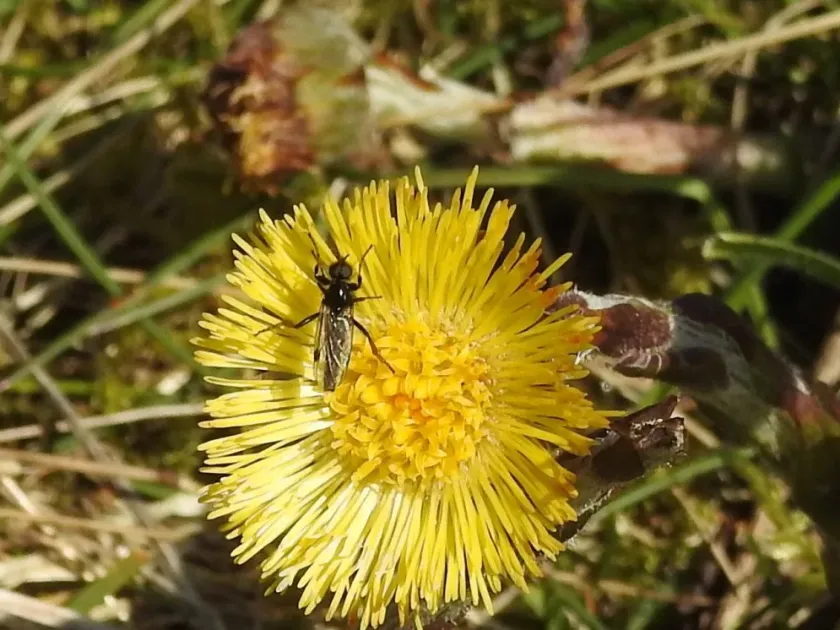
The St. Mark's fly (Bibio johannis) is a member of the Bibionidae family, within the order Diptera. Adult flies typically measure 6–9 mm in length and possess a black body with long, dangling legs.
Sexual dimorphism is clear: males have large, holoptic eyes that nearly touch, while females are smaller and often display reddish-brown coloration on their legs.
The larvae of this species are easily recognized by their cylindrical, greyish bodies covered with small, prickly projections and a distinct, dark head capsule.
The life cycle encompasses the egg stage, four larval instars, the pupal stage, and the adult form. Adults emerge in spring for a short period to mate and lay eggs.
A mass emergence of adults often results in impressive mating swarms, where males hover in the air in search of females near shrubs and garden vegetation.
What it damages
St. Mark's fly larvae are primarily detritivores, feeding on decaying organic matter; however, they can become significant pests when natural food sources are scarce.
They are known to damage the roots of various garden plants, including vegetable seedlings, turf grasses, and nursery stock, leading to stunted growth or plant death.
When larvae density is high, they can destroy entire patches of seedlings by feeding on the root system, causing the plants to lose vigor and eventually wilt.
Root damage caused by these larvae also creates entry points for secondary pathogens like fungi and bacteria, leading to root rot and systemic infections.
In greenhouses or nursery beds with high organic content in the soil, the larvae can multiply rapidly, presenting a persistent challenge for plant health.
When it appears
The common name "St. Mark's fly" is derived from the emergence of adults around St. Mark's Day (April 25th) in the UK, reflecting their typical early spring appearance.
Adult activity is usually restricted to a brief window in spring, typically spanning a few weeks when temperatures begin to rise consistently.
Following mating, females deposit clusters of eggs into the moist soil or leaf litter, ensuring the survival of the next generation of larvae.
The larval stage lasts throughout the summer and autumn, during which time they feed and grow steadily within the upper layers of the soil.
The larvae overwinter in the soil, showing high cold tolerance, and prepare for pupation once the soil temperatures increase in the following spring.
Signs of infestation
One of the primary signs of an infestation is the sudden wilting of young plants or seedlings, even when irrigation and environmental conditions are optimal.
Upon inspecting the root zone, gardeners may find a high concentration of grey, bristly larvae clustered around the plant's roots or buried in the mulch layer.
The presence of large, localized swarms of adult flies during spring serves as a warning of potential larval populations in the soil for the coming season.
Disturbed soil texture, where the earth appears overly loose or granulated due to larval activity, can indicate a significant presence of these pests.
Stunted plant growth and general yellowing of foliage in areas where high amounts of organic manure have been applied are common indicators of larval feeding.
Control measures
Effective management begins with good cultural practices, such as ensuring that all compost is fully decomposed before applying it to the garden soil.
Mechanical cultivation and regular hoeing of the soil surface can disrupt the life cycle, exposing eggs and larvae to predators and environmental stresses.
- Deep autumn ploughing to reduce the number of overwintering larvae.
- Using fine-mesh netting to prevent adults from laying eggs on vulnerable garden beds.
- Applying biological control agents, such as entomopathogenic fungi, if necessary.
For severe infestations in garden beds, soil-applied insecticides registered for use against soil-dwelling pests may be considered as a last resort.
Maintaining a tidy garden by removing unnecessary plant debris significantly reduces the habitat and food sources required for larval development.
Taxonomy
- Latin name
- Bibio johannis
- Order
- Diptera (flies)
- Family
- Bibionidae
- EPPO code
- BIBIJO
Discussion
No discussions yet — be the first.