
Sycamore lace bug (or Sycamore seed bug)
Belonochilus numenius
Description
How to identify
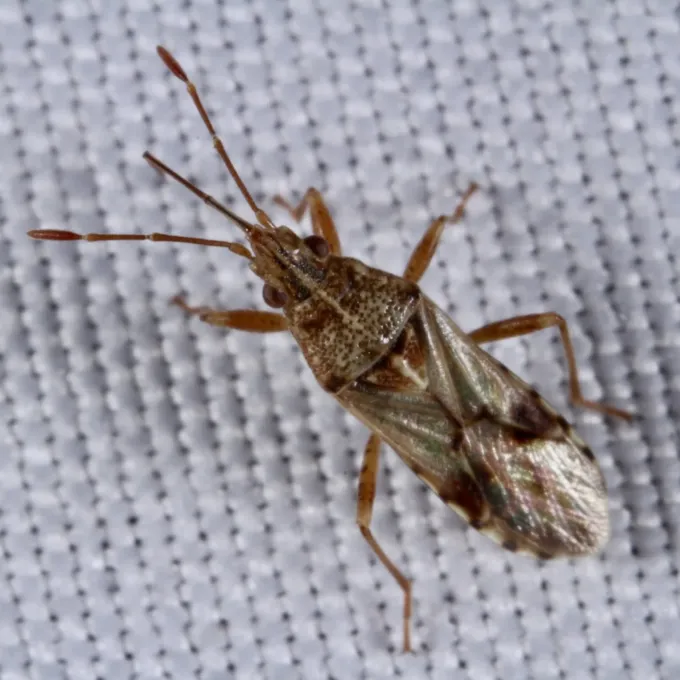
The Sycamore seed bug, scientifically known as Belonochilus numenius, belongs to the family Orsillidae within the order Hemiptera. These insects are small, measuring approximately 3 to 4 millimeters in length, with a brownish-gray body.
They possess a specialized needle-like mouthpart called a rostrum. This organ is perfectly adapted to pierce the tough outer layers of sycamore fruit heads to access the seeds inside.
The life cycle includes several nymphal stages. As they develop, their appearance shifts, and they often display reddish colorations, which can help in distinguishing them from other similar insects on the bark.
The adults are winged and exhibit high mobility, allowing them to disperse efficiently across urban environments. Their ability to fly aids in the rapid colonization of new host trees throughout the season.
Because they spend much of their time hidden deep inside the fuzzy seed balls, their presence is often overlooked until the population reaches high levels of density.
What it damages
This pest is highly specialized and feeds primarily on the seeds of sycamore trees, such as Platanus orientalis and Platanus x acerifolia. The damage is concentrated on the reproductive structures.
By feeding on the developing seeds within the fruit, the bugs destroy the embryos, rendering the seeds unviable. This disrupts the tree's natural reproductive cycle.
Although the primary impact is on the fruit, heavy infestations can lead to premature dropping of the seed balls, which creates significant litter in public parks and residential walkways.
While the tree itself usually remains healthy, the aesthetic value of the sycamore is reduced due to the damaged fruits and the potential presence of thousands of insects on the bark.
In nursery settings, the Sycamore seed bug poses a more significant economic risk by severely reducing the yield and quality of seeds intended for future tree propagation.
When it appears
The activity of the Sycamore seed bug is heavily influenced by temperature. Adults overwinter in protected spots, emerging as soon as spring temperatures start to rise steadily.
The first generation typically feeds on last year’s fruit heads that remain on the branches. This is the period when reproduction begins, with eggs being laid on the developing fruit.
During the summer months, the population peaks as the new crop of sycamore fruit heads matures. Multiple generations can occur within a single growing season under favorable conditions.
As autumn approaches and temperatures drop, the bugs begin to seek overwintering sites. They often choose crevices in the bark of sycamore trees or accumulate under piles of fallen leaves.
This seasonal pattern makes it essential for landscape managers to monitor tree health during the peak summer months when the bug population is most active and visible.
Signs of infestation
The most noticeable sign of an infestation is the premature browning and disintegration of the sycamore fruit heads. Upon examination, the inside often appears hollowed out.
Tiny entry holes on the exterior of the fruit balls indicate where the bugs have inserted their mouthparts to feed. Discarded exuviae (cast-off skins) and excrement can often be found inside the fruit structure.
Large clusters of these bugs on the tree trunks, especially on sunny sides of the tree, are a strong indicator of an established colony in the vicinity.
When disturbed, the bugs may emit a distinct, unpleasant odor. This defensive mechanism is a common trait among many hemipteran species and can assist in identification.
During their autumn migration, the bugs may accidentally enter buildings, leading to nuisance complaints from residents living near infested sycamore avenues.
Control measures
Managing the Sycamore seed bug is challenging because the bugs are protected by the fruit's dense structure, making them largely inaccessible to contact insecticides.
- Sanitary pruning and destruction of old fruit heads before spring to eliminate overwintering sites.
- Using systemic insecticides in nurseries to control the bug population before it reaches the fruit.
- Encouraging the presence of natural predators, such as birds and predatory insects, to manage population levels.
- Careful site selection when planting to avoid high concentrations of sycamore trees in small areas.
- Regular visual monitoring of fruit heads to catch infestations at the earliest possible stage.
Chemical control in urban landscapes is rarely recommended due to environmental concerns and the logistical difficulties of treating large, mature trees.
A sustainable management approach focuses on cultural practices and biological control, ensuring that the health of the sycamore trees is prioritized without relying on excessive pesticide use.
Taxonomy
- Latin name
- Belonochilus numenius
- Order
- Hemiptera (bugs, aphids, leafhoppers)
- Family
- Lygaeidae
- EPPO code
- BELCNU
Discussion
No discussions yet — be the first.