
Bellamira scalaris
Bellamira scalaris
Description
How to identify
Bellamira scalaris is a species of longhorn beetle belonging to the family Cerambycidae, commonly found in forest ecosystems.
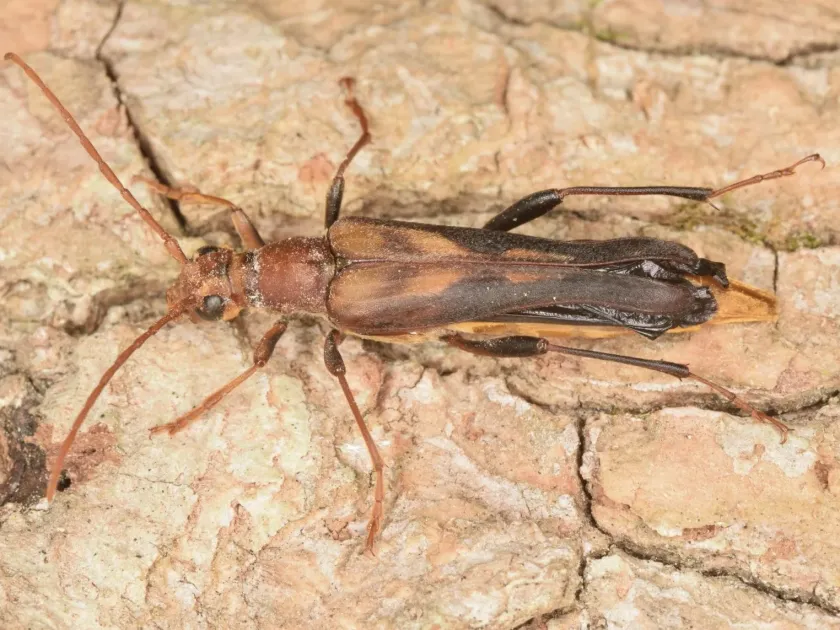
Adult beetles have an elongated, slender body typical of the Lepturinae subfamily, making them quite distinct in appearance.
The coloration of the elytra is typically dark brown or black, featuring striking, stepped light-colored patterns that resemble a ladder.
These insects generally measure between 15 and 25 millimeters in length, with females being typically larger than the males.
The larvae are white, cylindrical, and possess strong, chitinized mandibles capable of boring through various types of wood tissue.
What it damages
This beetle primarily targets a variety of deciduous tree species, including oak, beech, birch, and maple, often seeking stressed individuals.
The damage is caused by the larvae, which create extensive galleries underneath the bark and deeper into the wood structure of the tree.
By tunneling through the cambium and xylem, the larvae disrupt the tree's vascular system, hindering the transport of water and nutrients.
While healthy trees are less prone to infestation, those weakened by drought, disease, or mechanical damage are highly attractive to this pest.
Persistent infestations lead to crown dieback, reduced growth rates, and eventually the death of the affected woody parts or the entire tree.
When it appears
Adult beetles are typically active during the summer months, with their peak flight period occurring from June through August.
After mating, the females deposit their eggs into crevices in the bark of suitable host trees, where the larvae will eventually hatch.
The larval development cycle is quite long and may take several years to complete, depending on the environmental temperature and humidity.
Wintering is conducted in the larval stage inside the wood, providing a safe haven from freezing temperatures during the cold season.
Pupation occurs in spring within the tunnels, followed by the emergence of new adults that chew exit holes through the bark to mate.
Signs of infestation
The most prominent sign of an infestation is the presence of small, oval-shaped exit holes left on the bark by emerging adults.
Frass, which consists of fine wood shavings and excrement pushed out by the larvae, is often found gathering at the base of the tree.
Bark separation or cracking may occur as the larvae bore galleries underneath, leading to loose patches of bark on the tree trunk.
The foliage of infected trees may show signs of yellowing or premature browning due to the compromised water supply to the branches.
Listening for subtle gnawing sounds during quiet periods can occasionally reveal larval activity occurring deep within the wood tissue.
Control measures
Effective management begins with strict sanitation practices, such as the removal and disposal of dead, dying, or infested woody materials.
Do not store fresh firewood or timber near healthy trees, as these provide an ideal environment for the beetles to lay their eggs.
In decorative settings, trunk injections or professional insecticide applications can be utilized to protect high-value specimen trees.
Encouraging general tree health through proper irrigation, fertilization, and careful pruning can significantly increase tree resistance.
Biological control methods include encouraging natural predators, such as woodpeckers, which effectively reduce larval populations in the field.
Taxonomy
- Latin name
- Bellamira scalaris
- Order
- Coleoptera (beetles)
- Family
- Cerambycidae
- EPPO code
- STRLSC
Discussion
No discussions yet — be the first.