
Carrot psyllid
Bactericera trigonica
Description
How to identify
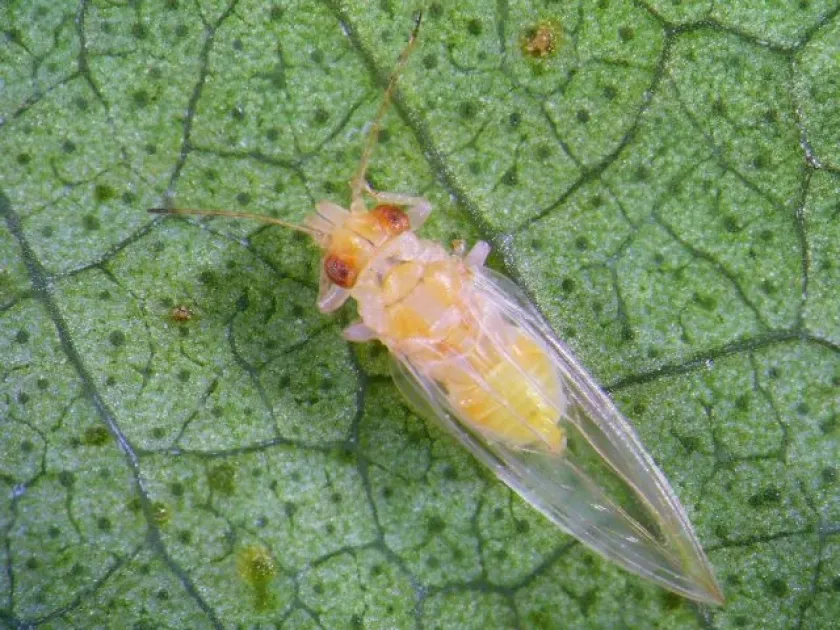
The carrot psyllid (Bactericera trigonica) is a small jumping insect belonging to the order Hemiptera and the family Triozidae. Adults are typically 1.5–2 mm long, exhibiting colors ranging from pale green to brownish.
These insects possess well-developed hind legs adapted for jumping. Adults have functional wings, enabling them to migrate from their overwintering sites, often conifers or evergreens, to carrot fields during the spring.
The nymphs are flattened, yellowish-green in color, and relatively stationary. They tend to reside on the undersides of leaves, where they undergo several instars while feeding on plant sap.
The life cycle is heavily influenced by ambient temperatures. Warm, dry spring weather promotes rapid population growth, allowing the insect to complete several generations during a single growing season.
Females deposit eggs on the petioles or the undersides of carrot leaves. Once hatched, the nymphs immediately begin feeding, leading to rapid development and potential for high infestation levels in young crops.
What it damages
Bactericera trigonica primarily targets cultivated carrots. However, it can also infest other members of the Apiaceae family, including parsley, parsnips, celery, and dill, causing significant crop stress.
Damage occurs primarily through sap extraction, which depletes the plant's essential nutrients. This systemic stress weakens the plant and significantly hinders its ability to grow and produce healthy roots.
Beyond direct feeding damage, the carrot psyllid is a known vector for phytoplasma diseases. These pathogens cause severe morphological changes, essentially ruining the commercial value of the crop.
Heavy infestations reduce the photosynthetic capacity of the plants. As the leaves curl and deform, the energy balance of the carrot plant is disrupted, leading to stunted growth and poor root development.
Damage is most severe during the early stages of carrot development (seedling to 4-leaf stage). Plants affected early in the season often fail to form proper roots, leading to significant yield loss.
Signs of infestation
The most distinctive symptom of infestation is leaf curling and bunching. The leaves become distorted, thick, and brittle, often taking on a stunted "rosette" appearance frequently referred to as "curry-leaf" syndrome.
Examining the underside of the leaves usually reveals the presence of numerous nymphs. They secrete a sticky honeydew that coats the foliage, which often leads to the growth of sooty mold.
Plants struggling with the pest show noticeable growth retardation compared to healthy plants in the same field. The foliage might exhibit color changes, including yellowing or reddish discoloration at the leaf margins.
In cases of severe infestation, the carrots fail to form proper taproots, resulting in woody or misshapen roots that are unsuitable for the market. Recovery for such plants is rarely possible once the symptoms become extreme.
- Severe curling and deformation of the foliage.
- Stunted, rosette-like growth habit.
- Sticky honeydew residues on leaves and stems.
- Chlorosis (yellowing) of the leaf edges.
- Presence of small jumping insects when disturbing the foliage.
Control measures
Cultural control measures include maintaining spatial isolation from conifer forests or windbreaks where the psyllids typically overwinter. Avoiding early planting near high-risk habitats can reduce initial colonization.
Effective weed management is crucial. Removing wild Apiaceae species around the field perimeter eliminates alternative hosts that allow the pest to survive between carrot production cycles.
Chemical control involves the use of systemic or contact insecticides. Treatments should be timed during the peak flight of adults to prevent egg-laying, and products should be rotated to avoid the development of insecticide resistance.
For organic or small-scale farming, covering crops with insect-proof netting or agrotextiles during the early growing stages is highly effective at preventing colonization by adult psyllids.
Biological control can be enhanced by encouraging natural predators such as lacewings, lady beetles, and predatory bugs. Maintaining floral borders around fields helps sustain these beneficial populations, providing long-term suppression of the psyllid.
Taxonomy
- Latin name
- Bactericera trigonica
- Order
- Hemiptera (bugs, aphids, leafhoppers)
- Family
- Triozidae
- EPPO code
- BCTCTR
Discussion
No discussions yet — be the first.