
Canvasback
Aythya valisineria
Description
How to identify
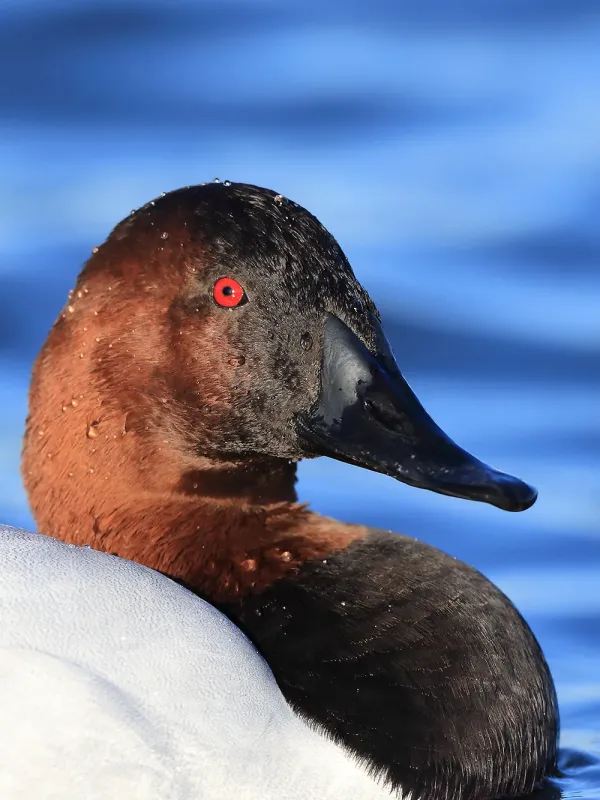
The Canvasback (Aythya valisineria) is a large diving duck belonging to the order Anseriformes and the family Anatidae. Adults are distinguished by their unique sloping forehead profile and a long, dark bill, separating them from other diving ducks.
During the breeding season, males display a white back and flanks—the source of their common name—contrasting with a chestnut-red head and black chest. Females possess a more muted brown plumage, which provides excellent camouflage while nesting in dense shoreline vegetation.
This species is primarily aquatic, being an expert swimmer capable of diving to depths of 3–4 meters to forage. Their high mobility and ease of movement between various water bodies make them a significant concern in agricultural wetland ecosystems.
Their biology is closely tied to shallow lakes and marshes. During migration periods, large flocks often congregate near agricultural fields located in river floodplains, which creates ideal, if problematic, interactions with cultivated rice paddies.
Reproduction occurs during the summer, after which birds form large flocks. It is during these periods that their presence on agricultural sites becomes most evident, posing a potential threat to farmers' crop yields.
What it damages
The primary damage caused by Canvasbacks occurs in active rice-growing regions. The ducks consume rice seedlings, pulling them from flooded fields, which leads to thinning stands and reduced crop density.
Beyond direct ingestion of plant material, Canvasbacks disturb the water environment while foraging on the bottom. Constant diving and flock movement stir up sediment, increasing water turbidity and negatively affecting the photosynthesis of young rice shoots.
In addition to rice, any aquatic or semi-aquatic crops grown in hydroponic systems or open flooded fields are at risk. The consumption of both seeds and seedlings during peak migration periods can result in substantial economic losses.
Furthermore, these ducks can contaminate water with excrement, altering the chemical composition of the paddy water. This can foster the growth of undesirable microorganisms, creating secondary stressors for the crop plants.
The severity of the damage depends heavily on local population density and the proximity of fields to migratory stopover sites. Losses can reach critical levels if sowing schedules align with the peak migration window of these waterfowl.
When it appears
The peak activity of this pest occurs during spring and autumn migrations. During these times, thousands of birds travel long distances, utilizing suitable wetlands and flooded fields as essential stopovers for refueling.
The spring period is particularly hazardous for rice crops, as it often coincides with the seed germination phase. Birds, exhausted from their long journeys, aggressively seek easily accessible sources of carbohydrates and proteins found in rice paddies.
The autumn period also poses a threat to late-harvest varieties, as birds congregate in fields to build up fat reserves before departing for wintering grounds. Large aggregations of Canvasbacks can devastate portions of a crop in a matter of days.
While daytime activity is standard, during peak migration, these ducks may forage almost continuously. This behavior complicates prediction models and makes constant vigilance necessary for farmers in susceptible areas.
Seasonality is also influenced by weather patterns; cold fronts often trigger large-scale migratory pulses, leading to sudden, intense pressure on agricultural sites that may have been previously free of bird interference.
Signs of infestation
The first sign of infestation is the appearance of large flocks on the water surface of flooded fields. Even before physical damage begins, their presence serves as a warning that crop protection measures should be initiated immediately.
Visual inspection of the plants reveals clear evidence of foraging: young seedlings are found floating on the water or are missing entirely from specific spots. This creates noticeable bald patches or gaps in the otherwise uniform crop rows.
An accumulation of excrement along the water's edge confirms a persistent presence of the flock. Additionally, turbid water and disturbed mud indicate that the ducks have been diving and searching the bottom for food.
Nocturnal sounds, such as characteristic calls and splashing, often precede the discovery of actual crop destruction. Farmers should closely monitor bird behavior near their land to detect shifts in activity patterns.
Remote sensing, including drone surveys, is highly recommended for monitoring. This allows for a rapid assessment of the damage area and the size of the flock without causing undue disturbance before control measures are ready.
Control measures
Acoustic deterrents, such as devices mimicking predator calls or emitting high-decibel erratic noises, are a primary defense. These create psychological stress for the flock and encourage them to seek quieter foraging grounds elsewhere.
Visual repellents, including predator effigies, reflective streamers, or rotating blades, can be effective on smaller fields. To remain effective, it is crucial to relocate these devices frequently so that the birds do not habituate to them.
Active field management, including patrols and the use of trained herding dogs, provides a robust defense against waterfowl during high-risk periods. While labor-intensive, this approach is often the most successful in preventing long-term damage.
Agrotechnical solutions involve limiting access to the water using nets over smaller plots or installing specialized fencing. While often impractical for large-scale production, these measures are highly justified for high-value seed production plots.
Strategic monitoring of migratory flyways and adjusting planting dates so that sensitive developmental stages do not overlap with peak migration is essential. An integrated pest management approach, combining physical, acoustic, and behavioral methods, is necessary to minimize total crop loss.
Taxonomy
- Latin name
- Aythya valisineria
- Family
- Anatidae
- EPPO code
- AYTHVA
Discussion
No discussions yet — be the first.