
Common pochard
Aythya ferina
Description
How to identify
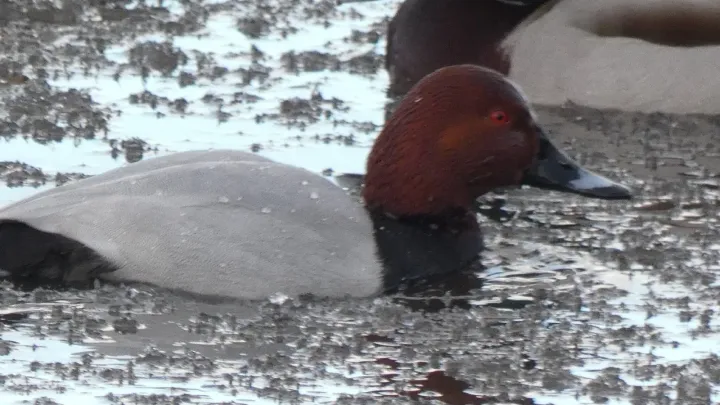
The Common pochard (Aythya ferina) is a medium-sized diving duck belonging to the family Anatidae and the order Anseriformes. Males are easily recognized by their distinct deep chestnut head and neck combined with a black breast.
This species is highly adapted to aquatic life, possessing strong diving skills that allow them to forage for food on the bottom of lakes, ponds, and flooded agricultural fields.
Biologically, they prefer large, open bodies of water with surrounding dense vegetation where they build their nests, making them frequent visitors to wetlands adjacent to farmland.
The social behavior of the Common pochard involves forming flocks, especially during the migration and wintering periods, which can lead to concentrated feeding activities.
Understanding their morphology, specifically their ability to submerge for food, is critical for farmers, as this distinguishes them from surface-feeding ducks that do not reach the grain at the bottom.
What it damages
The Common pochard is considered a pest in rice-producing regions, primarily affecting the fields during the sowing and early germination phases of the crop.
The ducks dive into the water covering the rice fields and consume the seeds directly from the mud, significantly reducing the plant density and emergence rates.
In addition to seed consumption, the birds physically damage young seedlings by treading on them while swimming or resting in the shallow water of the fields.
Large flocks can cause localized destruction of crops, leading to empty patches that often require expensive replanting and disrupt the uniformity of the harvest.
Economic damage is exacerbated by the loss of agricultural inputs, such as seeds and fertilizers, which are wasted if the planting fails to establish due to bird interference.
When it appears
The primary period of risk occurs during the spring migration, typically between March and May, when the ducks are moving towards their breeding grounds.
This coincides with the critical window of rice planting, making the newly flooded fields highly attractive environments for the hungry migratory flocks.
Secondary risks arise in the autumn when birds gather before the southward migration, potentially damaging late-season crops or scavaging in harvested fields.
Seasonal patterns can shift based on local weather conditions, such as early snowmelts or heavy rainfall, which influence the availability of natural wetlands.
Continuous monitoring of migratory bird populations in the region helps agronomists anticipate the intensity of potential bird damage before the planting season begins.
Signs of infestation
Visible signs of infestation include patches of missing or destroyed rice sprouts, often concentrated in areas where the water depth is optimal for diving.
Field staff often report the presence of ducks foraging during dawn and dusk, which are the peak feeding times for the species in agricultural environments.
Physical evidence of activity includes the presence of feathers near the field edges and small craters or disturbed mud where the birds have been diving.
Floating plant debris and reduced water clarity in specific zones can also indicate that the ducks have been actively disturbing the field bottom.
Surveillance using drones or ground-based patrols frequently reveals the presence of large groups of birds well before significant crop loss becomes apparent to the naked eye.
Control measures
Visual deterrents, including reflective tapes, predator-like decoys, and bright motion-sensitive lights, can be effective in discouraging ducks from landing in fields.
Acoustic scaring methods, such as propane cannons or automated sound systems that emit alarm calls, are the most common industrial solutions for large-scale rice farming.
Adjusting the water management schedule to keep levels low during the most vulnerable germination phases can make the fields less hospitable to diving ducks.
Implementing perimeter fencing or netting is rarely feasible for large operations, but can be a useful strategy for smaller, high-value nursery or experimental plots.
Integrated bird management programs that combine multiple deterrents with consistent patrolling are recommended to prevent the birds from habituating to a single scaring method.
Taxonomy
- Latin name
- Aythya ferina
- Family
- Anatidae
- EPPO code
- AYTHFE
Discussion
No discussions yet — be the first.