
Ascotis selenaria
Ascotis selenaria
Description
How to identify
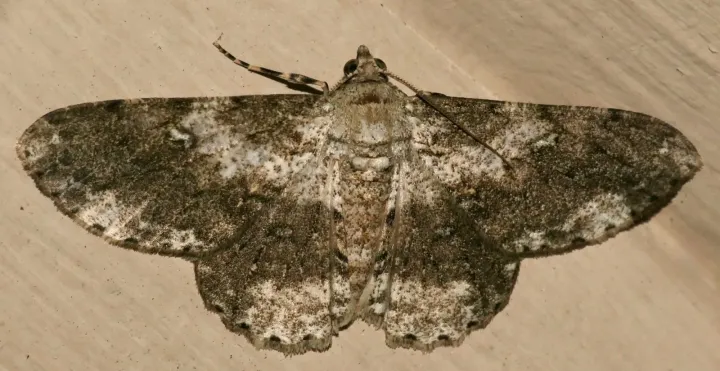
Ascotis selenaria belongs to the Geometridae family within the order Lepidoptera. The adult moth has a wingspan of up to 40–50 mm, characterized by greyish or yellowish-brown wings marked with distinct dark transverse lines.
The larvae, known as loopers, are easily identified by their unique crawling motion, caused by the reduction of abdominal prolegs. Their coloration ranges from light green to brown, providing excellent camouflage on host plants.
The pupa is dark brown with a smooth surface. It typically spends the dormant stage buried in the soil or within a silken cocoon concealed among leaf litter until environmental conditions become favorable.
The life cycle involves complete metamorphosis, consisting of the egg, larva, pupa, and adult stages. Depending on the geographical region and climate, the species may complete several generations per season.
As a polyphagous insect, it poses a threat to a diverse array of agricultural, ornamental, and forest trees, necessitating continuous field monitoring to mitigate potential damage.
What it damages
This pest causes significant economic losses to various crops, including fruit trees, vineyards, and vegetable plants. The larvae feed aggressively on leaf tissue, often leading to total leaf skeletonization.
In cases of severe infestation, Ascotis selenaria can completely strip a plant of its foliage, severely hindering photosynthesis and exhausting the plant's overall vitality.
Damage to young shoots and buds during the active growing season is particularly harmful, leading to reduced yields, lower quality produce, and decreased cold hardiness in perennial plants.
In vineyards, larvae can consume not only the leaves but also the developing flower clusters and fruit, leading to marketable crop losses and rendering the produce unfit for industry use.
Beyond direct feeding, the resulting injuries on the plant tissue create entry points for secondary infections, which can further weaken the plant and lead to localized tissue necrosis.
When it appears
The first generation of moths typically emerges in late spring, once temperatures remain consistently warm. During this time, they actively search for host plants to deposit their eggs.
Larval activity peaks during the first half of summer, as they enter their most intense feeding phase. This is when the pest becomes most visible and destructive in orchards and fields.
In southern regions, Ascotis selenaria can produce two or three generations, extending the potential period of damage from May through September.
The species overwinters as a pupa in the soil. The spring emergence of adults is highly dependent on soil temperatures and the accumulation of degree-days.
Effective management requires the use of light or pheromone traps to monitor adult flight periods and predict the timing for preventive control measures.
Signs of infestation
The most common sign of infestation is the presence of irregular holes or jagged, ragged edges on leaves. In heavy infestations, complete defoliation of branches is observed.
The presence of larval frass (small dark pellets) on the ground beneath the canopy or on the foliage is a strong indicator of an active population.
When inspecting trees, one may find the larvae resting in a stationary position along the stems, where they mimic twigs to avoid detection by predators and observers.
The use of light traps in the evening is a reliable method to detect the presence of adult moths, providing an early warning for potential egg-laying activity.
Damaged plants often show signs of stunted growth, and if flower buds are consumed, early fruit drop or total loss of the yield in the affected clusters may occur.
Control measures
Effective control starts with cultural practices: deep autumn cultivation of the soil around the base of trees helps to destroy the overwintering pupae hidden in the ground.
Biological control agents, such as Bacillus thuringiensis-based products, are effective against young larvae while remaining safe for beneficial insects and predators.
When the economic injury threshold is exceeded, the application of systemic or contact-stomach insecticides registered for the specific crop becomes necessary.
It is vital to rotate insecticides with different modes of action to prevent the development of resistant populations of Ascotis selenaria.
- Regular field and orchard monitoring.
- Installing adhesive bands on tree trunks.
- Weed management to eliminate alternative food sources.
- Encouraging natural enemies and parasitic wasps.
Taxonomy
- Latin name
- Ascotis selenaria
- Order
- Lepidoptera (butterflies)
- Family
- Geometridae
- EPPO code
- ASCTSE
Discussion
No discussions yet — be the first.