
Bog geometer
Arichanna melanaria
Description
How to identify
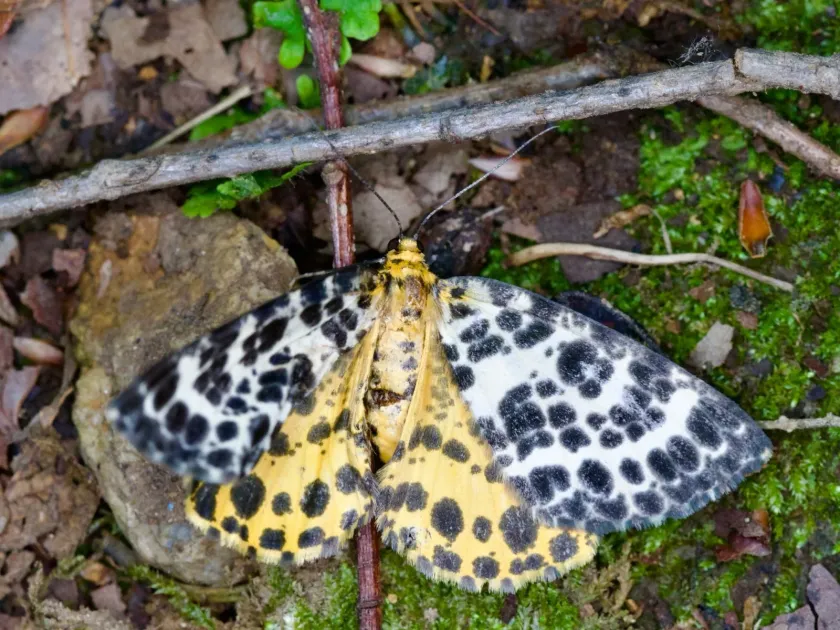
The Bog Geometer (Arichanna melanaria) is a moth species belonging to the Geometridae family, order Lepidoptera. The wingspan of the adult moth reaches 40–45 mm, characterized by white or creamy wings with distinct dark markings and bands.
The insect has a slender body typical of geometer moths. The larvae (caterpillars) are known for their looping movement, achieved by having only thoracic and two pairs of abdominal prolegs.
The larvae possess excellent camouflage, with colors ranging from green to brownish, allowing them to blend perfectly with the stems and foliage of host plants.
The life cycle is univoltine, meaning there is one generation per year, with overwintering occurring primarily as pupae in cocoons within leaf litter or soil debris.
This species is naturally associated with humid environments, such as peatlands and marshy areas, where their primary food plants, particularly Ericaceae, flourish.
What it damages
The caterpillars primarily feed on plants in the Ericaceae family. In agricultural settings, they are known to cause damage to high-bush blueberries and cranberries.
Larvae consume leaf tissue, often starting from the margins or skeletonizing the leaves, which significantly reduces the photosynthetic capacity of the plant.
During heavy infestations, caterpillars may also feed on young shoots and buds, directly impacting the potential yield and overall health of the berry bush.
Weakened plants are more susceptible to secondary fungal infections and often struggle to survive extreme winter weather conditions due to compromised vigor.
The aesthetic and physiological damage leads to stunted growth, which is particularly problematic for commercial berry plantations aiming for high productivity.
When it appears
Adult moths are typically active during the summer months, with mating and egg-laying occurring primarily in June and July.
Larvae emerge in mid-summer and start an active feeding phase that lasts until the onset of autumn cooling, during which they reach their final larval stages.
Overwintering takes place in the pupal stage, buried in the surface layers of the soil or protected by dense vegetation debris near the host plants.
Spring activity begins as soon as the weather warms and the host plants break dormancy, allowing the young larvae to immediately begin feeding on tender tissues.
Monitoring efforts should be focused on the period from mid-summer to early autumn, as this is when the larval density is highest and feeding is most aggressive.
Signs of infestation
The most prominent sign of an infestation is the presence of eaten or skeletonized foliage, often appearing as notched leaf margins or holes in the leaves.
Caterpillars can be identified by their resting position, where they hold their bodies stiffly at an angle to the stem, mimicking small twigs.
The presence of frass (larval droppings) on the leaf surfaces or at the base of the plant is a clear indicator that caterpillars are actively feeding above.
Young, silk-like webbing or slight curling of the leaves may indicate that larvae are using these structures for protection while feeding on the plant tissue.
- Notched or skeletonized blueberry leaves.
- Larvae mimicking twigs on branches.
- Reduced vigor and stunted shoots on berry bushes.
Control measures
Cultural control involves maintaining clean fields by removing weeds that may serve as alternative hosts for the moth, thereby limiting population build-up.
For smaller patches, manual removal of caterpillars is a feasible and eco-friendly strategy, especially when done early in the season before the population spreads.
Biological control using microbial insecticides, such as Bacillus thuringiensis (Bt), is highly effective against larvae while being safe for beneficial pollinators.
Chemical intervention should be reserved for severe outbreaks and must be managed according to regional pesticide regulations and pre-harvest intervals.
Promoting a diverse ecosystem around the plantation encourages natural predators like birds and parasitic wasps, which play a crucial role in regulating the moth population.
Taxonomy
- Latin name
- Arichanna melanaria
- Order
- Lepidoptera (butterflies)
- Family
- Geometridae
- EPPO code
- ARICME
Discussion
No discussions yet — be the first.