
Arhopalus syriacus
Arhopalus syriacus
Description
How to identify
Arhopalus syriacus is a beetle belonging to the Cerambycidae family, commonly known as longhorn beetles. It is a significant pest of coniferous forests, particularly in warmer climates.
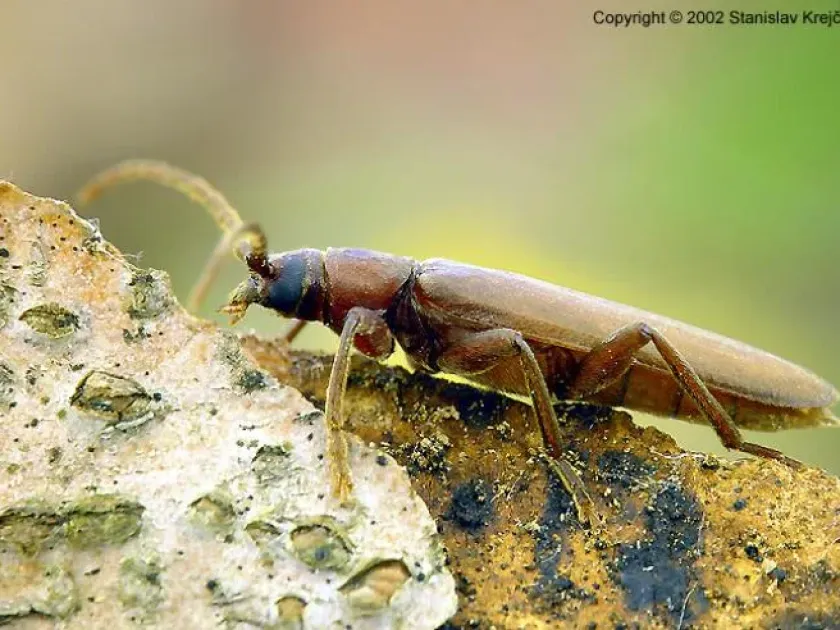
The adult beetle typically measures between 15 and 30 mm in length. Its body is elongated and flattened, with a color palette ranging from reddish-brown to dark brown.
The surface of the elytra features fine punctures, and the head is equipped with strong mandibles, which are characteristic of the Spondylidinae subfamily.
The larvae are cream-colored, legless, and possess a heavily sclerotized head, designed specifically for boring through wood and tunneling through bark.
Adults are primarily nocturnal, often remaining hidden in bark crevices during daylight hours to avoid predators and dehydration.
What it damages
This species primarily attacks coniferous trees, favoring species such as pines, firs, and cedars, which are weakened or stressed.
Larvae bore extensive galleries beneath the bark, feeding on the phloem and cambium layer, which disrupts the transport of water and nutrients throughout the tree.
By tunneling into the sapwood, the larvae not only weaken the tree's physical structure but also provide entry points for secondary fungal infections.
Healthy trees can be attacked if population numbers are high or if environmental conditions, such as severe droughts, diminish the trees' natural defenses.
Economic damage is substantial, as infested wood becomes degraded, losing its structural integrity and commercial value for lumber production.
When it appears
Adult beetles typically emerge during the summer months, with their active flight period often extending into early autumn.
During the mating season, females seek out suitable host trees to deposit their eggs, focusing on cracks in the bark or existing mechanical injuries.
The development cycle from egg to adult is usually prolonged, typically lasting one to two years depending on the local temperature and the host tree's condition.
Larvae continue their feeding activities throughout the warmer months, pausing only during the coldest parts of winter if temperatures become restrictive.
Overwintering occurs at the larval stage within the wood, which provides a stable environment and protection against extreme cold and avian predators.
Signs of infestation
The most evident sign of infestation is the presence of small, oval-shaped exit holes on the surface of the bark, left by emerging adults.
Frass, which consists of fine wood particles and waste material produced by the larvae, is often pushed out and accumulates on the bark or at the base of the tree.
Visible changes in the crown, such as yellowing of the needles (chlorosis) or dieback of branches, indicate that the tree's internal circulation system is failing.
Peeling back the bark often reveals dense, interconnected galleries packed with wood dust, which confirm the presence of a wood-boring infestation.
Heavy infestations may result in the bark loosening entirely, eventually leading to the death of the tree due to complete girdling by the larval galleries.
Control measures
Effective management begins with strict sanitation practices, focusing on the removal and destruction of infested wood before the beetles emerge.
- regular monitoring of forest stands for signs of larval frass;
- prompt removal of wind-thrown or storm-damaged conifers;
- using trap logs to concentrate and later remove the beetle population;
- maintaining tree vigor through proper forest density management;
- encouraging natural enemies such as woodpeckers and predatory wasps.
Avoiding the accumulation of unbarked conifer logs in or near forest areas is crucial to prevent creating a breeding ground for this pest.
When infestation levels in ornamental or high-value trees are critical, professional arborists may apply systemic insecticides to neutralize the developing larvae.
Taxonomy
- Latin name
- Arhopalus syriacus
- Order
- Coleoptera (beetles)
- Family
- Cerambycidae
- EPPO code
- ARHOSY
Discussion
No discussions yet — be the first.