
Argiope trifasciata
Argiope trifasciata
Description
How to identify
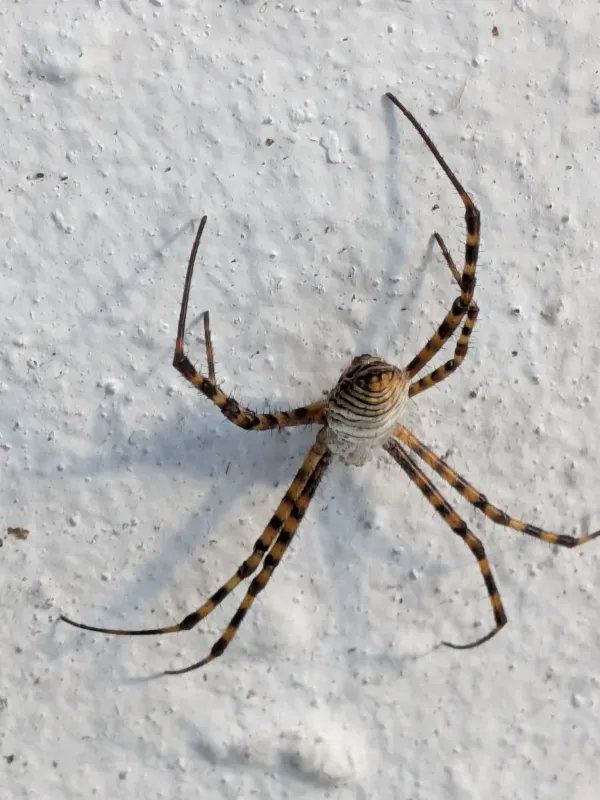
Argiope trifasciata, commonly known as the Banded Garden Spider, belongs to the Araneidae family. It is easily identified by the striking black, white, and yellow bands on its abdomen, giving it an appearance somewhat similar to a wasp.
Females are much larger than males, often reaching lengths of up to 25 mm. A key diagnostic feature is the stabilimentum, a thick, zigzag-shaped silk structure woven into the center of the orb web, which serves both structural and camouflaging purposes.
These spiders prefer warm, sunny, and undisturbed areas. They construct their large vertical webs between high stems of grasses, crops, or shrubs. Once they settle in a spot, they tend to remain there for most of the season, waiting for prey.
The life cycle is dictated by the seasons. Eggs are laid in late summer or autumn within large, papery, vase-shaped cocoons attached to vegetation. These cocoons protect the offspring through the winter until they hatch in the following spring.
In terms of agricultural impact, it is essential to distinguish between harmful pests and predatory arachnids. The Banded Garden Spider is a predator, not a herbivore, and does not feed on plant tissues or sap.
What it damages
Argiope trifasciata causes no direct damage to crops. It is not an herbivorous pest, meaning it does not consume leaves, roots, stems, or fruits. Plants serve merely as physical support structures for the spider's web.
There is no economic damage associated with this species in commercial agriculture. In some rare cases, the presence of numerous webs might be considered a nuisance during hand-harvesting or maintenance tasks, as the sticky silk can be inconvenient for workers.
Some growers worry about dust accumulation on webs, but this is a negligible factor that does not impede photosynthesis or plant health. The spiders do not vector plant diseases nor do they weaken the structural integrity of the host plants.
Instead of damaging crops, these spiders act as beneficial biological control agents. They trap and consume a wide range of insects, including various flying pests, which contributes to the natural regulation of insect populations in the field.
Consequently, the presence of the Banded Garden Spider should be viewed as an indicator of a healthy, biodiverse field environment rather than a pest problem. Their role is ecologically positive, supporting the reduction of harmful insect densities.
Control measures
No formal management or control programs are implemented for the Banded Garden Spider because it does not cross the economic injury level. It is widely regarded as a beneficial species in the context of integrated pest management (IPM).
If the webs interfere with agricultural machinery or maintenance, the most effective cultural practice is consistent weed management. Keeping field margins and fence rows free of tall, thick grasses reduces the availability of suitable nesting sites.
Standard insecticide applications used for major crop pests will naturally reduce the local spider population. However, targeting spiders specifically with chemical pesticides is strictly discouraged due to the disruption of natural pest control services provided by the spider.
For home gardens or small-scale operations where spiders are unwanted, mechanical removal of the webs is sufficient. Simply sweeping away the silk with a broom or a spray of water will encourage the spider to relocate without harming the crop.
It is recommended to focus chemical and mechanical resources on true agricultural threats. The Banded Garden Spider is a passive participant in the ecosystem and should be left alone whenever possible to continue its role as a natural insect predator.
Taxonomy
- Latin name
- Argiope trifasciata
- Family
- Araneidae
- EPPO code
- ARGOTR
Discussion
No discussions yet — be the first.