
Argiope keyserlingi
Argiope keyserlingi
Description
How to identify
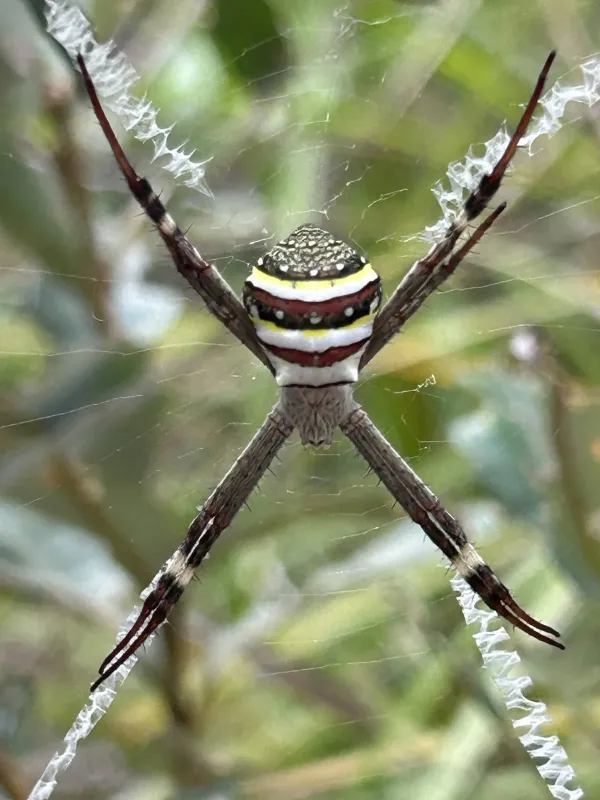
Argiope keyserlingi, commonly known as the St Andrew's Cross spider, belongs to the Araneidae family. This species is native to the eastern coast of Australia and is a prominent inhabitant of gardens and coastal scrubs.
The female displays striking yellow, black, and white bands on her abdomen. She is significantly larger than the male and is known for creating a distinct, cross-shaped stabilimentum in the center of her orb-web.
Males are much smaller and lack the brilliant coloration of the females. They are often found waiting near the edge of the female's web, as the mating process is dangerous and requires precise timing to avoid becoming prey.
The web itself is a complex architectural structure designed to intercept flying insects. The stabilimentum, or zig-zag pattern, is thought to help make the web visible to birds, preventing damage from accidental collisions.
In the agricultural landscape, they are not typically classified as pests. Instead, they function as opportunistic predators that interact with the local insect population within the ecosystem.
What it damages
Argiope keyserlingi causes no direct damage to plant tissues, as it is an obligate predator. The spider does not consume plant sap or leaves, making it ecologically distinct from typical agricultural pests.
The primary concern for growers involves the physical presence of webs. In dense concentrations, webs can wrap around delicate shoots, causing minor mechanical stress or deformities to developing leaves in sensitive ornamental plants.
Large webs may also obstruct the flight paths of pollinators like bees, potentially reducing pollination efficiency in small areas if the spider density is abnormally high during the flowering phase.
During the harvest, the presence of webs can be a nuisance for workers, hindering access to fruits and vegetables. This can lead to increased labor time and minor discomfort during field operations.
As generalist predators, these spiders capture a wide range of insects. This makes them neutral players; they might capture a pest or a beneficial insect depending on the local population density at the time.
When it appears
The lifecycle of Argiope keyserlingi is closely linked to the warm season. Activity begins in spring, as environmental temperatures rise and the supply of flying prey becomes abundant.
Females reach their maximum size and maturity during the peak of summer, which is when their iconic webs are most noticeable across gardens, vegetable patches, and forest margins.
As temperatures begin to drop in autumn, the adult spiders complete their reproductive cycle. After laying their eggs in protected egg sacs, the adult population typically dies off due to the changing climate.
The overwintering stage is strictly limited to eggs contained within durable, silk-wrapped sacs. These sacs are securely attached to twigs or stems, allowing the next generation to survive winter conditions.
Monitoring for the presence of spiders is most effective during the peak summer months. It is during this time that the webs are fully maintained and easy to detect during regular crop scouting.
Signs of infestation
The most prominent sign is the presence of large orb-webs with a distinct white zig-zag structure in the center. These webs are usually placed in sheltered areas between plant stems.
Remains of prey, such as wings or discarded insect exoskeletons trapped in the silk, indicate an active hunting area. This evidence helps identify high-traffic zones for predatory insects and spiders.
The discovery of brown or greyish pear-shaped egg sacs attached to stems is a clear indicator that the population has established a nursery. These sacs are often hidden in the foliage or near the ground.
Dewy mornings provide the best visibility for detecting webs. Moisture highlights the fine silk threads, allowing agronomists to assess the density of the spider population across the fields.
Minor leaf distortion or the pulling together of foliage tips can serve as a sign of heavy web accumulation. This suggests the spider density has reached a point where it may interfere with plant growth habits.
Control measures
Active control is rarely necessary given the spider's minor role as a crop disturbance factor. Mechanical removal of webs during routine crop maintenance is generally sufficient to manage their presence.
The use of insecticides is highly discouraged, as it often eliminates beneficial predators and pollinators, leading to larger outbreaks of genuine insect pests that cause significant economic damage.
To discourage web building, growers should maintain tidy fields by removing excess dry vegetation and pruning dead branches. A cleaner environment offers fewer anchor points for the spiders to construct their webs.
In greenhouse settings, maintaining proper ventilation and managing humidity helps create an environment less suitable for spiders. Ensuring screens are intact prevents the ingress of wandering spiders.
Preserving natural predators of the spider, such as parasitic wasps, is the most sustainable approach. A healthy ecosystem with diverse insect life naturally limits the population of individual predatory species.
Taxonomy
- Latin name
- Argiope keyserlingi
- Family
- Araneidae
- EPPO code
- ARGOKE
Discussion
No discussions yet — be the first.