
Wasp spider
Argiope bruennichi
Description
How to identify
The Wasp spider (Argiope bruennichi) belongs to the orb-weaver family (Araneidae). Females are easily recognized by their striking yellow, black, and white striped abdomen, which mimics the appearance of a wasp.
Sexual dimorphism is highly pronounced in this species: males are significantly smaller, less colorful, and often go unnoticed compared to the large, vivid females that can reach up to 2.5 cm in length.
A defining characteristic of this spider is the construction of orb webs featuring a zigzag pattern in the center, known as a stabilimentum. This architectural feature makes the web exceptionally sturdy and distinct.
These spiders prefer sunny, open areas with tall vegetation, such as field margins, meadows, and forest clearings. They often anchor their webs between stems of high-growing plants or weeds.
Despite their imposing appearance, these spiders are not agricultural pests; they are predatory arthropods that contribute to the regulation of insect populations within the ecosystem.
What it damages
The Wasp spider causes no damage to agricultural crops. They lack the mouthparts required to consume plant tissues, meaning they do not feed on leaves, stems, or fruits of any cultivated plants.
On the contrary, they serve as beneficial predators. By trapping and consuming various flying insects, including those that might otherwise become agricultural pests, they contribute to the natural biological control of the area.
Their presence in the field does not interfere with the growth, yield, or health of crops. They occupy a niche that supports biodiversity and helps maintain a balanced ecosystem within the farm.
In rare instances, their webs might collect debris or dust if situated directly within dense crop foliage, but this is a purely aesthetic or mechanical occurrence with no phytopathological significance.
Overall, the presence of the Wasp spider is a positive indicator of a healthy environment, where natural predatory mechanisms are actively working to minimize insect population outbreaks.
When it appears
The life cycle begins in spring when young spiderlings emerge from overwintering cocoons and disperse to find suitable habitats for establishing their webs.
Growth and active feeding take place during the summer months, specifically June, July, and August, when the spiderlings mature into adult spiders and begin constructing their large, complex webs.
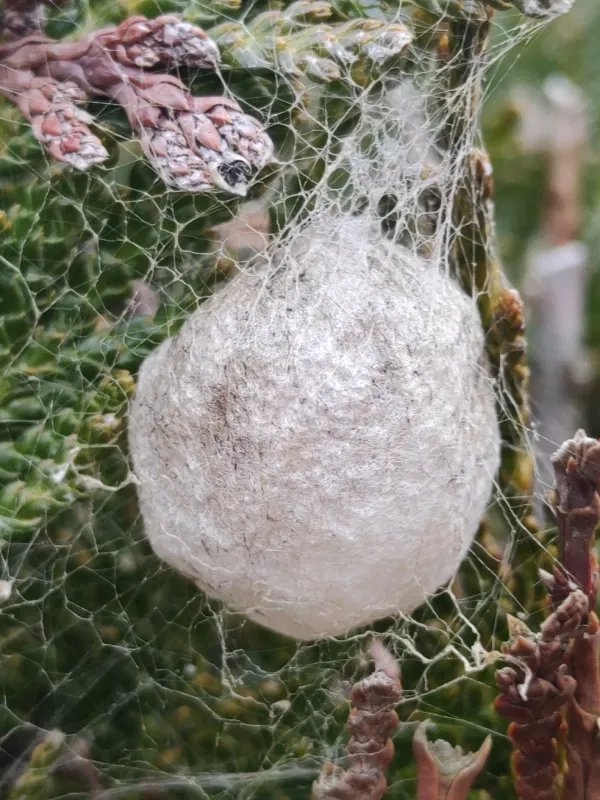
The breeding season occurs in late summer and early autumn. Females lay their eggs in thick, durable, pear-shaped cocoons, which are attached firmly to plant stems or deep within dense grass.
The species overwinters at the embryonic stage inside these protective cocoons. This survival strategy ensures that the population can withstand harsh winter temperatures in temperate climates.
Consequently, the spiders are most visible during the peak of the growing season, reaching their maximum size and frequency toward the end of the summer.
Signs of infestation
The primary sign of a Wasp spider's presence is the large, circular orb web, typically suspended between plant stems at a height of 20 to 50 centimeters above the ground.
The presence of the zigzag stabilimentum at the center of the web is a clear diagnostic feature for identifying an Argiope bruennichi web compared to those of other orb-weaver species.
Remnants of prey, such as wings or empty chitinous shells of small flying insects, are often found stuck in the web, indicating the spider's successful hunting activity.
During autumn, the identification sign is the presence of brown, vase-shaped or pear-shaped cocoons attached to the lower parts of vegetation or grasses near the original web site.
Visual identification of the adult female, sitting prominently in the center of her web, provides the most straightforward evidence of the species' habitation in the field.
Control measures
No control measures are necessary for the Wasp spider, as it is a beneficial insectivore. Eliminating these spiders is counterproductive to maintaining a balanced agricultural system.
If web density becomes a nuisance for manual field operations or equipment movement, simply clearing the webs in those specific paths is sufficient; there is no need for chemical intervention.
The use of broad-spectrum insecticides should be avoided, as these chemicals are indiscriminate and will harm beneficial predators, including Wasp spiders, leading to secondary pest outbreaks.
Implementing Integrated Pest Management (IPM) practices, which prioritize the conservation of natural enemies, is the best strategy. Encouraging Wasp spiders helps naturally reduce pest pressure.
Farmers can maintain biodiversity by preserving small, uncultivated strips of land or meadow-like areas along field edges, which provide ideal habitats for the Wasp spider to thrive.
Taxonomy
- Latin name
- Argiope bruennichi
- Family
- Araneidae
- EPPO code
- ARGOBR
Discussion
No discussions yet — be the first.