
Willow sawfly
Arge ustulata
Description
How to identify
The willow sawfly (Latin: Arge ustulata) belongs to the Argidae family within the Hymenoptera order. It is a common insect pest that specifically targets deciduous trees.
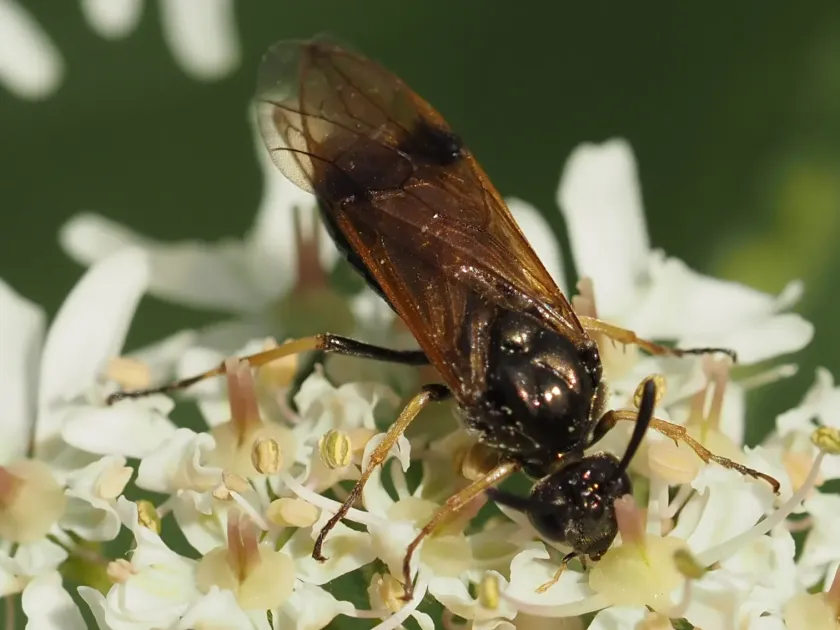
The adult sawfly is a small, robust insect measuring between 7 and 10 mm in length. Its body is primarily black, often exhibiting a noticeable metallic sheen under sunlight.
Its wings are transparent but typically have a slightly darkened, smoky, or brownish tint. This characteristic helps distinguishing them from other similar hymenopterans found in gardens.
The larvae, known as false caterpillars, have a segmented body and a well-developed chewing mouthpart. They usually possess multiple pairs of abdominal prolegs, distinguishing them from true caterpillars.
The pupation process occurs in durable, silk-like cocoons. These are often hidden in the soil or within organic debris, providing the insect with significant protection against environmental changes.
What it damages
The primary host plants for Arge ustulata are members of the Salicaceae family, particularly willows. In some cases, they also infest birch and poplar trees if these are nearby.
The larvae are responsible for the damage. They feed voraciously on the leaf tissue, often starting by skeletonizing the leaf and later consuming the entire leaf blade, leaving only the main veins.
Severe infestations can lead to massive defoliation. When a colony of larvae feeds on a branch, they can strip it of leaves within a matter of days, leading to significant stress for the host tree.
Defoliation reduces the tree's photosynthetic capability, which is essential for nutrient storage. As a result, the trees become weakened and less capable of surviving harsh winters.
In forest nurseries and orchards, this pest can cause stunted growth in young trees, significantly reducing their aesthetic value and overall commercial viability.
When it appears
The life cycle of the willow sawfly is closely linked to the local climate. Typically, there is one generation per year, although warmer climates may support a second generation.
Adult sawflies emerge in late spring, usually coinciding with the onset of new leaf growth. This timing is critical as it provides fresh foliage for the upcoming generation of larvae.
Females insert their eggs into the leaf tissues using an ovipositor. The incubation period typically lasts for one to two weeks, depending on the ambient temperature and humidity levels.
Larval activity reaches its peak during the summer months, specifically June and July. This is the period when the most visible damage occurs and when proactive control is most effective.
The species overwinters in a prepupal stage inside a tough cocoon. This ensures that the population can persist from year to year, even in climates with significant temperature fluctuations.
Signs of infestation
The first signs of infestation are small, irregular holes in the leaf blades. As larvae grow, the holes expand, often giving the leaves a ragged, torn appearance.
One of the most obvious signs is the presence of larval colonies on the underside of leaves. These larvae often exhibit a defensive curling posture when disturbed.
Accumulation of larval excrement (frass) under the tree canopy is another clear indicator. It is often visible on the ground or on the lower leaves of the affected plant.
In advanced stages of infestation, you may notice branches that are completely bare. This rapid thinning of the canopy is a major warning sign of a severe pest outbreak.
- Ragged leaf edges and holes in foliage.
- Groups of larvae feeding on the same branch.
- Premature yellowing and leaf fall during the growing season.
Control measures
Cultural control is the first line of defense. Raking and destroying fallen leaves in the autumn removes the overwintering sites, significantly reducing the population for the following year.
For small infestations, physical removal of the larvae by hand or pruning the affected branches is an effective and environmentally friendly way to manage the pest.
If the infestation is widespread, the use of contact or systemic insecticides is recommended. The best results are achieved when treatments are applied during the early larval development stages.
Biological pesticides, such as those containing specific bacteria or fungi, are highly effective against sawfly larvae while posing minimal risks to beneficial pollinators and natural predators.
Maintaining tree vigor through proper irrigation and balanced fertilization helps the plants withstand the impact of defoliation and encourages faster recovery after an outbreak.
Taxonomy
- Latin name
- Arge ustulata
- Order
- Hymenoptera
- Family
- Argidae
- EPPO code
- ARGEUS
Discussion
No discussions yet — be the first.