
Zigzag elm sawfly
Aproceros
Description
How to identify
The Zigzag elm sawfly (Aproceros leucopoda) is a member of the Argidae family within the order Hymenoptera. Adult sawflies are small, black insects, typically measuring 6–8 mm in length.
The larvae are light green and are known for their distinctively rapid growth and development. This species reproduces primarily through parthenogenesis, meaning females do not require males to produce viable offspring.
Originally native to East Asia, the species has become a significant invasive threat across Europe, where it has successfully established populations in urban areas and forests.
The life cycle is characterized by high reproductive potential, allowing multiple generations to emerge within a single year if the climatic conditions are favorable.
Their morphological adaptability has made them highly successful in exploiting various species of elm, making them a major concern for arborists and foresters.
What it damages
The primary hosts of the Zigzag elm sawfly are trees of the genus Ulmus. It attacks both mature trees in parklands and young saplings in nursery environments.
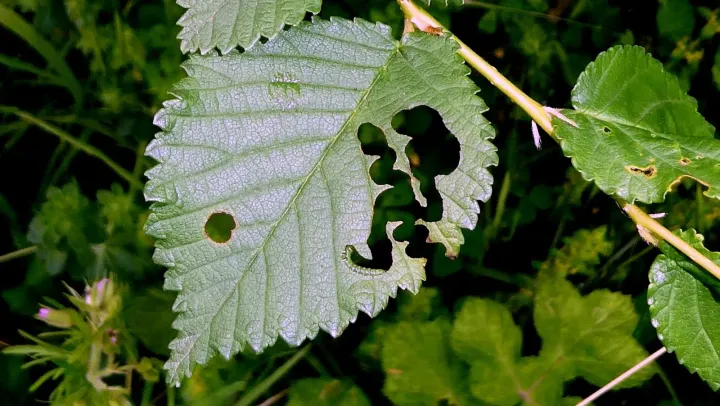
Larvae feed exclusively on the leaves, creating characteristic zigzag-shaped patterns in the leaf tissue, which eventually leads to complete skeletonization of the foliage.
Severe infestations result in extensive defoliation, which drastically reduces the tree's photosynthetic capacity and weakens its overall health and vitality.
Repeated yearly attacks leave trees susceptible to other pathogens, such as fungal infections or the notorious Dutch elm disease, potentially causing tree death.
The cumulative effect of larval feeding can remove the vast majority of leaf biomass, causing premature leaf drop and stunting growth in young trees.
When it appears
The insect's activity begins in late spring, coinciding with the first flush of elm foliage, which provides necessary nutrients for the first generation of larvae.
Development is very rapid; larvae can complete their growth in a matter of weeks before pupating, often directly on the foliage or in bark crevices.
In temperate climates, the Zigzag elm sawfly can produce three to four generations annually, leading to sustained pressure throughout the summer months.
The peak activity period usually occurs during June and July, when temperatures are ideal for the development of both larval and adult stages.
Overwintering occurs at the pupal stage within protective cocoons, usually located in leaf litter or under loose bark, ensuring survival through the cold season.
Signs of infestation
The most diagnostic sign of an infestation is the presence of erratic, zigzag tracks on the leaf surface, which eventually expand into large, irregular holes.
As feeding continues, the leaves take on a lacy, skeletonized appearance, as the larvae consume the soft tissue while leaving the veins largely intact.
Presence of frass (larval excrement) on the lower leaves and the ground beneath the canopy is a clear indicator of a high-density population.
- Distinctive zigzag feeding patterns on leaf blades.
- Skeletonization of elm leaves.
- Premature defoliation during the peak summer period.
- Presence of small, green, slug-like larvae on the undersides of leaves.
Control measures
Managing the Zigzag elm sawfly requires a combination of monitoring, biological control, and, where necessary, chemical interventions.
In urban areas, using environmentally friendly biological insecticides that target sawfly larvae can minimize the impact on beneficial insects and local wildlife.
Chemical control using systemic insecticides applied to the foliage or via soil injection can be highly effective when applied at the onset of larval hatching.
Cultural practices, such as the removal and destruction of leaf litter in the autumn, can significantly reduce the number of overwintering cocoons near the host trees.
Regular visual inspections of elm foliage in early spring are essential for early detection, allowing for timely measures before the population reaches epidemic levels.
Taxonomy
- Latin name
- Aproceros
- Order
- Hymenoptera
- Family
- Argidae
- EPPO code
- APRCSP
Discussion
No discussions yet — be the first.