
Elm zigzag sawfly
Aproceros umbricola
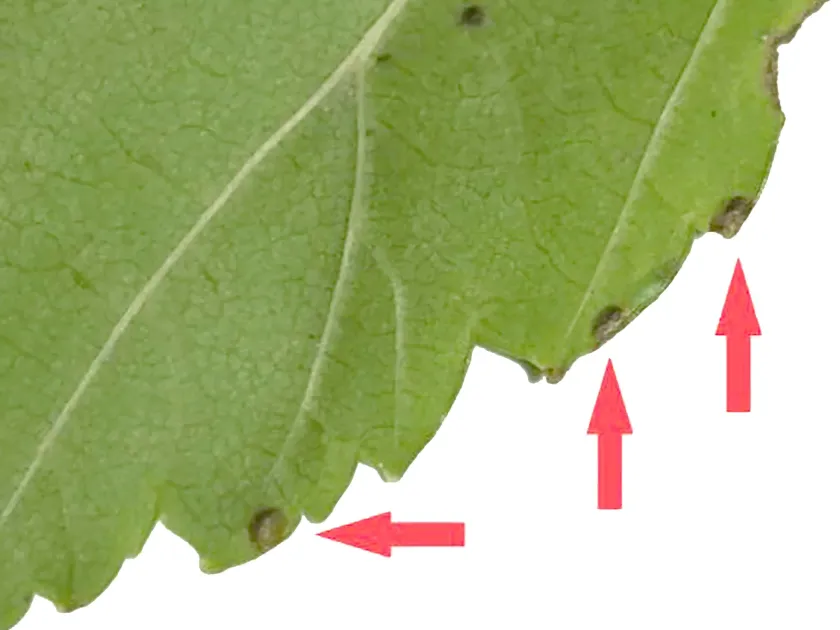
Description
How to identify
The elm zigzag sawfly (Aproceros umbricola) is a member of the Argidae family. It is an invasive Hymenopteran species that has spread rapidly across many regions, specifically targeting elm trees (Ulmus species).
The adult sawfly is a small, black insect. Despite its small size, it can be identified by its distinctive flight behavior during the warmer months of the year.
Reproduction is primarily parthenogenic, meaning females can produce offspring without fertilization. This biological strategy allows the population to explode in number very quickly.
The insect completes its life cycle through egg, larval, pupal, and adult stages. The larvae, which cause the primary damage, are small, green, and often difficult to spot at first glance.
As an introduced species in many parts of the world, it often lacks local natural predators, which allows it to thrive without significant biological regulation.
What it damages
The elm zigzag sawfly is highly specialized and feeds exclusively on the foliage of elm trees. It affects both urban landscaping elms and those found in wild forest settings.
The larvae feed on the leaf tissue, leaving a characteristic zigzag pattern along the leaf margin. As they mature, they consume more of the leaf, often leading to complete defoliation.
Repeated defoliation by multiple generations in a single season significantly drains the tree's energy reserves, weakening the plant's overall vitality.
Weakened trees become susceptible to other secondary threats, including pests and pathogens like Dutch elm disease, which can be fatal to the tree.
Nursery stock is particularly vulnerable, as the loss of foliage stunts the growth of saplings and reduces the aesthetic and commercial value of the trees.
When it appears
The activity of the elm zigzag sawfly begins in late spring, coinciding with the flushing of fresh leaves on elm trees, which provide the initial food source.
Depending on the climate, this sawfly can produce multiple generations per year, often ranging from three to four cycles between spring and early autumn.
Mid-summer represents the peak of larval activity, as the weather conditions typically favor rapid development and intensive feeding.
As autumn approaches, the final generation of larvae pupates, creating protective cocoons that are often attached to the leaves or hidden within the bark.
Monitoring efforts should be intensified during the spring and early summer months when the first signs of larval feeding appear on the leaves.
Signs of infestation
The most diagnostic sign is the S-shaped zigzagging pattern found on the leaf margins. This is caused by the specialized feeding behavior of young larvae.
As the larvae grow, the damage becomes more severe, leading to skeletonized leaves where only the thickest veins remain, effectively ruining the leaf's photosynthetic capacity.
Frass (larval droppings) can often be seen on the leaves or on the ground beneath the canopy, indicating the presence of an active colony of larvae above.
The cocoons are also a key sign; they are small, lace-like structures that can be found attached to the underside of the leaves or in bark crevices.
- Zigzag feeding tracks on leaf edges
- Skeletonized leaves and crown thinning
- Premature leaf drop during summer
- Presence of small green larvae on foliage
- Lace-like cocoons found on leaves
Control measures
Chemical control involving systemic insecticides is the most effective way to manage heavy infestations, especially for high-value ornamental trees in cities.
Biological control methods, such as utilizing biopesticides containing Bacillus thuringiensis, offer a more eco-friendly approach to manage larval populations.
Sanitation practices, including the raking and disposal of fallen leaves during late summer and autumn, can help reduce the number of overwintering cocoons.
Trunk injection techniques provide a precise and effective way to treat specific trees without spraying chemicals into the surrounding urban air.
Early detection through regular inspection is critical, as controlling the population before it reaches the third or fourth generation significantly limits the damage to the trees.
Taxonomy
- Latin name
- Aproceros umbricola
- Order
- Hymenoptera
- Family
- Argidae
- EPPO code
- APRCUM
Discussion
No discussions yet — be the first.