
Rose sawfly
Arge enodis
Description
How to identify
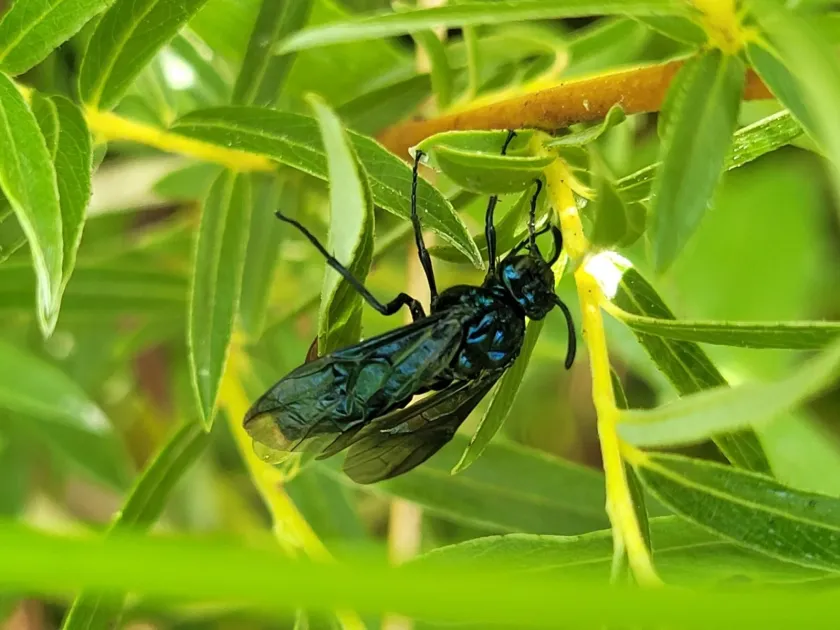
The rose sawfly, Arge enodis, is a member of the Argidae family within the order Hymenoptera. Adults are relatively small, usually reaching 7–10 mm in length, with a shiny, dark, often bluish-black body and clear, membranous wings.
The larvae, often called false caterpillars, have a segmented body reaching up to 20 mm. They are typically gray-green with numerous black spots, providing effective camouflage against the foliage of rose bushes.
Their life cycle includes complete metamorphosis: egg, larva, pupa, and adult. They typically overwinter as prepupae within cocoons buried in the soil or protected under leaf litter near the host plant.
Females use their saw-like ovipositor to make slits in young shoots, depositing eggs deep within the plant tissue. This behavior is distinctive and often leads to noticeable physical damage to the plant's growth tips.
The timing of the adult emergence is usually synchronized with the spring flush of rose foliage, ensuring that larvae have an immediate and abundant food source upon hatching.
What it damages
The primary hosts of the rose sawfly are plants belonging to the genus Rosa. This includes various wild species as well as cultivated hybrid tea, floribunda, and climbing roses common in domestic gardens.
Larvae feed exclusively on the leaves, consuming the leaf tissue and leaving only the larger veins intact. This process is known as skeletonization and significantly impairs the plant's ability to photosynthesize.
Severe infestations can lead to total defoliation of the rose bush, which places extreme stress on the plant and reduces its overall vigor and ability to store reserves for the next season.
Oviposition marks on shoots can cause localized necrosis, leading to stunted growth, wilting, or even the death of terminal buds, which directly impacts the number of blooms produced during the season.
Repeated yearly defoliation weakens the rose bush, making it more susceptible to secondary environmental stresses, such as drought, frost, or opportunistic fungal infections like black spot.
Signs of infestation
The first indicator of an infestation is the presence of small, longitudinal scars on young stems, which are the sites where females have inserted their eggs into the plant tissue.
When feeding, larvae often congregate on the undersides of leaves. Their feeding pattern is characterized by eating from the edges inward or skeletonizing the leaf blade between the veins.
A classic sign of sawfly larvae is their unique resting position; they frequently curl their bodies into an "S" shape or a spiral when stationary on a leaf, which makes them easy to spot.
Visible quantities of small, dark, granular frass (excrement) on the leaves or the mulch beneath the plant are strong indicators of an active and growing population of larvae.
Early-season yellowing or drooping of young terminal growth can also signify internal damage caused by the oviposition activity of the female sawflies.
Control measures
Effective management of the rose sawfly requires a multi-pronged approach that focuses on sanitation and the timely application of control agents.
- Removing and destroying infested plant material, including pruned stems containing eggs.
- Thorough cleaning of the garden bed to remove overwintering cocoons in the topsoil.
- Manual removal of larvae, which is effective for small-scale infestations in home gardens.
- Application of appropriate insecticides during the early larval stage for large populations.
- Encouraging natural predators such as parasitic wasps and birds that prey on sawfly larvae.
Timing is critical for chemical control; treatments should be applied while larvae are still young and before they have caused significant damage. Always rotate chemical classes to prevent the development of resistance in the pest population.
Taxonomy
- Latin name
- Arge enodis
- Order
- Hymenoptera
- Family
- Argidae
- EPPO code
- ARGEEN
Discussion
No discussions yet — be the first.