
Birch sawfly
Arge pullata
Description
How to identify
The birch sawfly (Arge pullata) belongs to the order Hymenoptera, family Argidae. The adult insect is a medium-sized sawfly with a glossy black body and clear, dark-spotted wings. Despite their appearance, they are harmless to humans, as their primary focus is reproduction and feeding on host plants.
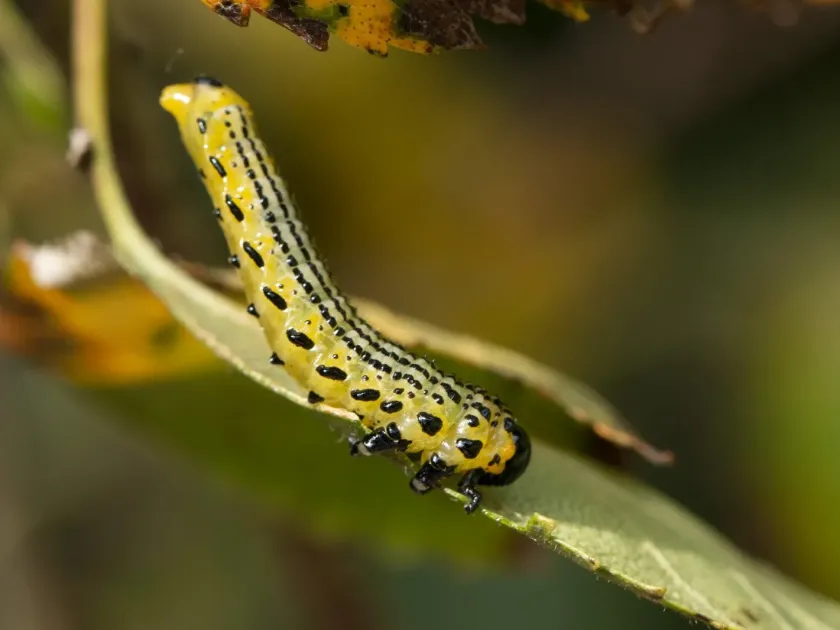
The larvae, often confused with caterpillars, are distinct due to their abdominal leg count. They have a yellowish body with rows of black spots, providing effective camouflage against the birch foliage. The head capsule is dark and prominent, typical for this species of sawfly.
The life cycle involves complete metamorphosis, usually producing one generation per year. They overwinter as prepupae inside tough, brown cocoons located in the soil or leaf litter beneath the host tree, remaining dormant until the favorable spring conditions return.
The female utilizes a saw-like ovipositor to cut slits into the tender tissues of birch shoots or leaf petioles. She then deposits her eggs into these incisions in orderly rows, which often causes the affected shoot to bend or become slightly deformed as the larvae begin to develop.
The biological development is highly sensitive to spring temperatures. Early warming prompts the emergence of adults, potentially leading to an earlier infestation phase. The survival of the offspring depends largely on the availability of young, nutrient-rich leaves during the initial feeding stages.
What it damages
The primary host for Arge pullata is the birch tree (Betula species). While they show a strong preference for birch, their impact is most significant in areas with high density of these trees, such as nurseries, parks, and dense forest edges.
Damage is exclusively caused by the larvae, which are voracious eaters. Early instar larvae gather in small groups and skeletonize the leaves, consuming only the green tissue. Older larvae are capable of consuming entire leaves, leaving behind only the tough midribs and petioles.
Massive feeding can lead to severe defoliation of the crown. This reduces the photosynthetic capacity of the birch tree, depriving it of the energy needed for growth and reserves for the upcoming winter. Repeated annual defoliation can lead to significant canopy thinning.
Trees weakened by sawfly attacks become susceptible to secondary infections and opportunistic pests. Bark beetles and wood borers often target stressed birches, which may ultimately lead to the death of the tree if the infestation is not managed in time.
In ornamental settings, the aesthetic impact is immediate and damaging. The tree loses its lush appearance, and the presence of larvae excrement around the base can be unsightly, making it a priority to manage the population before it reaches high density.
When it appears
Adult sawflies typically emerge from the soil in late spring, around May or June. This timing is precisely coordinated with the period when birch trees produce fresh, tender leaves, which are optimal for the growth of the next generation.
The larval activity begins in June and often peaks in mid-July. During this time, they are most active and visible on the branches, feeding continuously and growing rapidly. This is the optimal window for detection and intervention.
By late summer, the larvae finish feeding and descend to the ground to pupate in the soil. They enter a state of diapause, staying in the soil through the autumn and winter until the next spring, ensuring the species survives even harsh weather conditions.
Monitoring the phenological stage of the birch trees is the best indicator for predicting sawfly appearance. When the leaves are fully expanded but still soft, it is time to start inspecting the undersides of the foliage for early signs of egg laying or young larvae.
Environmental conditions play a huge role in the duration of the cycle. A cool, wet spring can delay the emergence, while a dry and warm spring can accelerate the cycle, potentially leading to a larger and more damaging population of larvae in the summer months.
Signs of infestation
The earliest signs of infestation are the egg-laying scars on the shoots. These appear as small, dark, raised lesions arranged in straight rows, which indicate where the female sawfly has deposited her eggs within the plant tissue.
The most recognizable sign is the presence of gregarious larvae feeding on the foliage. These larvae are usually found on the underside of the leaves. If disturbed, they often perform a characteristic "S-curve" movement, arching their bodies to deter potential predators.
Skeletonized leaves are a clear indicator of a feeding colony. The leaf veins remain intact while the fleshy green parts are consumed, creating a lace-like pattern that eventually leads to the leaves turning brown and drying out prematurely.
Accumulation of frass (larval excrement) on the ground under the tree is a classic sign of a large population overhead. If you notice a fine, dark granular substance on the lawn or pavement beneath a birch, it is almost certainly due to an active sawfly colony in the canopy.
Severe infestation symptoms include early leaf drop in mid-summer. A healthy tree should retain its green foliage until autumn; therefore, sudden and widespread leaf loss before August is a major red flag that the tree is suffering from heavy pest pressure.
Control measures
Physical removal is highly effective for individual or small ornamental trees. Hand-picking the larvae or gently shaking branches over a drop cloth can significantly reduce the population without the need for chemical intervention.
Biological control using Bacillus thuringiensis (Bt) is a target-specific and environmentally friendly approach. It only affects the sawfly larvae and poses no risk to beneficial pollinators or natural predators, helping to maintain a balanced garden ecosystem.
Chemical control via contact or systemic insecticides may be necessary during severe outbreaks. When applying treatments, ensure thorough coverage of the entire canopy to reach larvae hidden in the inner branches, following the manufacturer’s safety guidelines.
Maintaining tree vigor through proper irrigation and soil nutrition is the best long-term preventive measure. A healthy, well-hydrated birch tree is much more resilient to pest damage and can recover more efficiently after a minor sawfly attack.
Tilling the soil under the tree in autumn is an effective cultural practice. By disturbing the soil, you expose the dormant cocoons to predators, birds, and extreme weather conditions, which can lead to a drastic reduction in the following year's sawfly population.
Taxonomy
- Latin name
- Arge pullata
- Order
- Hymenoptera
- Family
- Argidae
- EPPO code
- ARGEPU
Discussion
No discussions yet — be the first.