
Japanese rose sawfly
Arge nipponensis
Description
How to identify
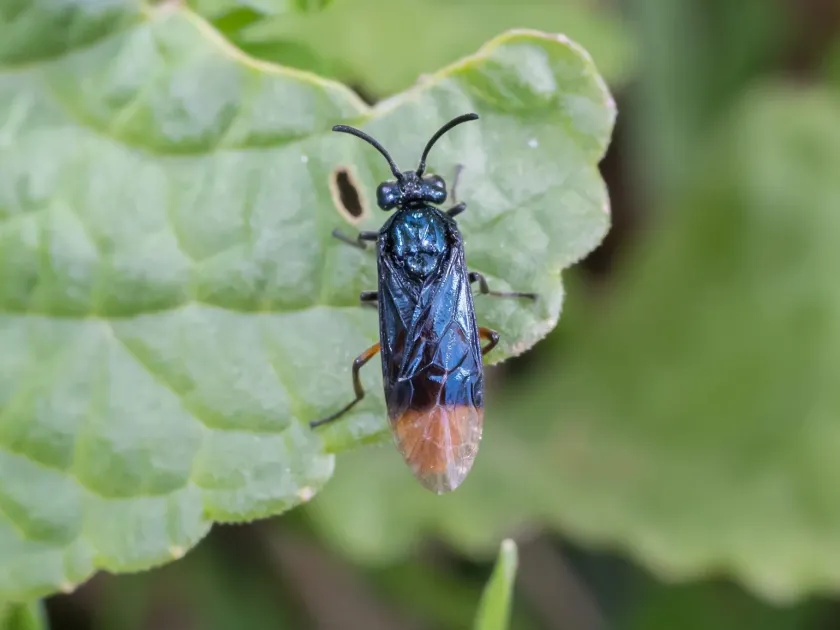
The Japanese rose sawfly (Arge nipponensis) is a member of the Argidae family within the order Hymenoptera. Adult specimens are typically 10–12 mm long, featuring a shiny black body and transparent wings with distinct darkened edges, giving them a wasp-like appearance.
The larvae are the primary stage causing damage. While they look similar to moth caterpillars, they can be distinguished by the number of abdominal prolegs. They usually display a greenish or grayish-yellow color with numerous black spots across their bodies.
Their life cycle includes complete metamorphosis. Adult females use a specialized saw-like ovipositor to make incisions in young rose stems, where they deposit their eggs. These incisions often lead to visible scars and stem deformities.
Depending on the climate, the species can produce multiple generations within a single growing season. This rapid reproduction allows populations to quickly expand if left unchecked during the peak spring and summer months.
Overwintering occurs as prepupae in the soil or within cocoons located in plant debris near the base of rose bushes. This stage is highly resistant to cold weather, ensuring the survival of the population until the next season.
What it damages
The Japanese rose sawfly targets plants within the Rosaceae family, with roses being the preferred host. Larvae are voracious feeders, primarily consuming the foliage of the plant starting from the early growth stages.
Larval feeding typically begins at the leaf margins, progressing inward until only the thickest veins remain. This process, known as skeletonization, significantly reduces the plant's capacity for photosynthesis.
The stems also suffer damage due to the female's egg-laying activity. These incisions can cause the shoots to curl or wilt, and they serve as entry points for various fungal and bacterial pathogens that further stress the plant.
Severe infestations result in heavy defoliation, which severely weakens the rose bush. This stress impacts flower production and can hinder the plant's ability to store energy for the winter, leading to poor performance in the following year.
For young or newly planted roses, heavy sawfly pressure can even threaten the plant's survival, as the loss of leaves during critical growth periods halts the development of the root system.
Signs of infestation
Initial signs of an infestation include small irregular holes or notches appearing on the edges of leaves. Upon closer inspection, larvae can often be found resting on the undersides of leaves or curled into a characteristic "S" shape.
Egg-laying sites on stems appear as small, often brownish, linear scars or bumps. These sites are evidence of adult female activity and indicate that a new generation of larvae will soon emerge in that area.
Accumulation of dark larval excrement on the leaves below feeding areas is a clear indicator of a significant infestation. This debris is often the first thing gardeners notice when checking for pests.
- Skeletonized leaves with missing tissue between veins.
- Twisted or stunted growth on young, succulent shoots.
- Presence of small larvae moving along the stems or leaf edges.
If left unmanaged, the infestation will quickly spread from a single branch to the entire plant, potentially affecting adjacent roses in the garden bed.
Control measures
Controlling the Japanese rose sawfly requires an integrated approach that combines cultural practices with chemical or biological interventions. Regular monitoring is essential to catch the infestation early.
For smaller gardens, hand-picking larvae is a highly effective, eco-friendly control method. Larvae are often sluggish in the early morning and can be easily collected and destroyed to prevent further spread.
When populations are high, the application of systemic or contact insecticides is necessary. Products containing spinosad or pyrethroids are commonly used, though care must be taken to minimize impact on beneficial pollinators.
Cultural control involves thorough cleaning of the area around rose bushes in autumn. Removing leaf litter and lightly tilling the soil can destroy overwintering cocoons, significantly reducing the number of adults that emerge in spring.
Maintaining plant vigor through proper fertilization and watering is key to helping roses recover from pest damage. Strong, well-nourished plants are generally more resilient to sawfly attacks and can produce new foliage more rapidly.
Taxonomy
- Latin name
- Arge nipponensis
- Order
- Hymenoptera
- Family
- Argidae
- EPPO code
- ARGENI
Discussion
No discussions yet — be the first.