
Rose sawfly
Arge humeralis
Description
How to identify
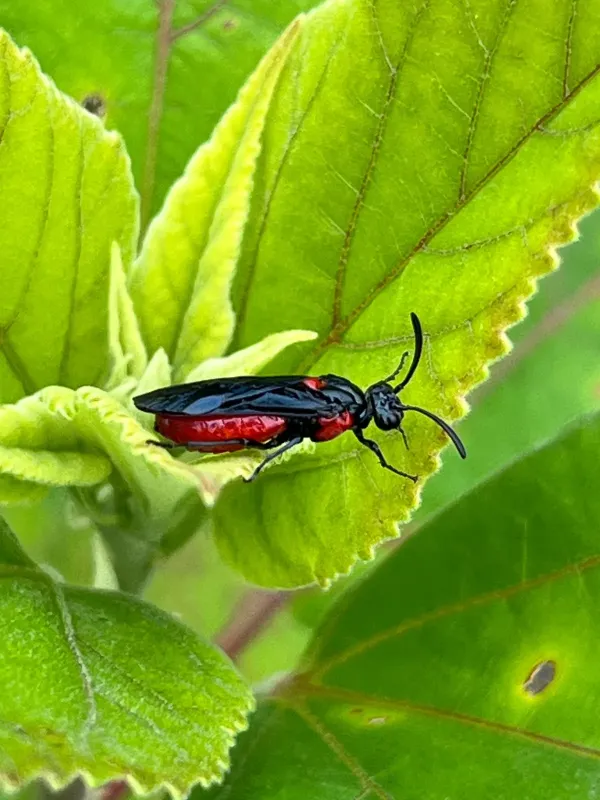
The rose sawfly (Arge humeralis) belongs to the order Hymenoptera, family Argidae. The adult insect is characterized by a black body with transparent wings showing a dark edge, measuring approximately 10 mm in length.
The larvae, often mistaken for moth caterpillars, have distinct morphological features, such as a different number of abdominal prolegs. They are typically greenish in color with dark spots and sparse hairs, making them easily identifiable upon close inspection.
The life cycle encompasses four stages: egg, larva, pupa, and adult. The sawfly overwinters as a mature larva inside a tough, silk-like cocoon situated in the soil around the base of the host plant or hidden under fallen leaves.
During spring, the larvae pupate, and adults emerge. Females use their ovipositor to make incisions in young stems and leaf petioles to lay their eggs, which often results in visible tissue deformation or twisting of the stems.
Depending on regional climate conditions, the species may produce one or two generations per year. Continuous monitoring during the growing season is essential to prevent significant population build-up in the rose garden.
What it damages
The primary hosts for this pest are plants within the genus Rosa. Both wild roses and cultivated garden varieties, including hybrid teas and climbing roses, are susceptible to infestation by this sawfly species.
Equipped with mandibulate mouthparts, the larvae are voracious feeders. They primarily consume the leaf blades, starting from the edges or skeletonizing the foliage, leaving only the primary veins intact.
Under favorable conditions for the pest, massive outbreaks can lead to rapid and total defoliation of the rose bushes. This severe damage disrupts photosynthesis, severely weakening the plant and destroying its aesthetic value.
Plants suffering from heavy defoliation struggle to harden their stems before winter, significantly reducing their cold tolerance. Consequently, infested bushes are more prone to winter kill and overall decline.
Furthermore, the oviposition sites created by females serve as entry points for various bacterial and fungal pathogens, potentially causing secondary infections that exacerbate the stress on the weakened host plant.
Signs of infestation
The most immediate sign of infestation is the presence of irregular holes or notched edges on the foliage. Leaves may appear skeletonized, turn yellow prematurely, and eventually drop from the stems.
Inspecting the underside of the leaves usually reveals clusters of larvae. When disturbed, these larvae frequently curl into an S-shaped posture, a distinct defensive behavior characteristic of many sawfly species.
Careful observation of the stems may reveal small swellings or linear scars where eggs were inserted. These areas might become darkened or slightly distorted, indicating internal tissue damage caused by the female's ovipositor.
The presence of small, dark granular droppings on the leaf surfaces directly beneath feeding sites is another clear indicator. These frass deposits confirm that active feeding is occurring on the plant.
During peak adult activity in sunny weather, one may observe the sawflies flying around the bushes. Their presence signals the beginning of the egg-laying phase, indicating the need for immediate preventive action.
Control measures
Mechanical control is highly effective for small gardens; it involves hand-picking the larvae during the morning or evening. Furthermore, pruning and destroying affected stems containing egg clusters significantly reduces the pest population.
Cultivation practices such as deep hoeing or tilling the soil around the base of the bushes in autumn and spring help disrupt the pupation sites and destroy cocoons present in the upper layers of the soil.
In cases of heavy infestation, chemical control using contact or systemic insecticides is necessary. Products approved for residential use should be applied according to the manufacturer's label to maximize efficacy.
Rotating insecticides with different modes of action is recommended to prevent the development of resistance. Applications are most effective when timed with the mass hatching of young larvae, which are highly susceptible to treatment.
Biological control involves maintaining a garden environment that supports natural predators, such as parasitic wasps and predatory bugs. Incorporating these natural enemies is a sustainable way to keep sawfly populations in check.
Taxonomy
- Latin name
- Arge humeralis
- Order
- Hymenoptera
- Family
- Argidae
- EPPO code
- ARGEHU
Discussion
No discussions yet — be the first.