
Arethusana arethusa
Arethusana arethusa
Description
How to identify
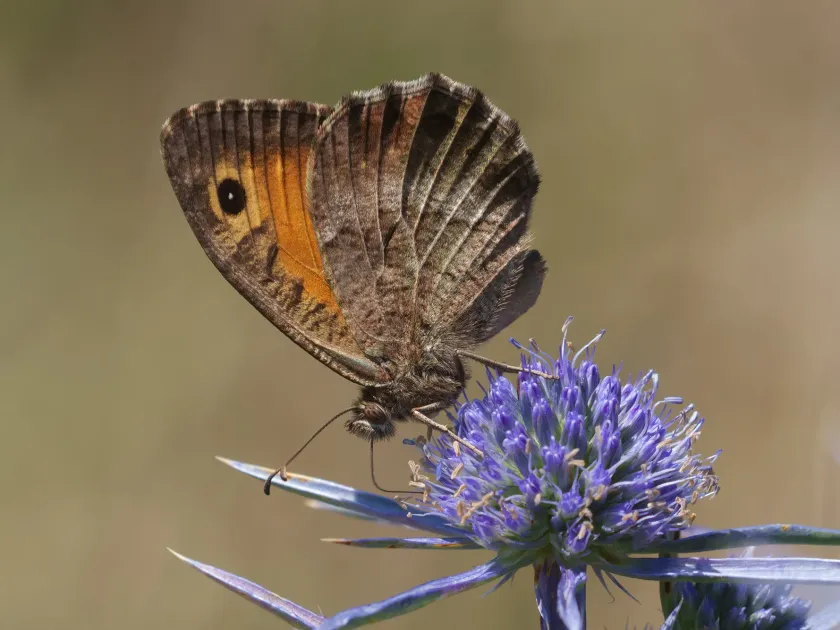
Arethusana arethusa, commonly known as the False Grayling, is a butterfly species within the Nymphalidae family and the Satyrinae subfamily. Adults are easily recognized by their dark brown wings featuring a prominent ochre-yellow band that contains several dark eye-spots. The typical wingspan ranges between 40 and 50 millimeters.
The larvae, or caterpillars, exhibit a light green or brownish coloration adorned with longitudinal light stripes. The body is covered in fine, short hairs, which is a common characteristic among many species of the Satyrinae subfamily. The head capsule often displays a slightly reddish tint, providing a useful diagnostic feature for field identification.
Eggs of this species are spherical with a finely ribbed surface. Female butterflies lay them individually on the stems or leaves of host plants. When reaching the pupal stage, the caterpillar constructs a silken shelter, often attached to the vegetation, where it undergoes metamorphosis into the adult butterfly.
Morphological differentiation from closely related species can be achieved by examining the underside of the hindwings, where the light band is intersected by thin, dark, jagged lines. This specific wing pattern is a reliable key for entomologists to distinguish Arethusana arethusa from other sympatric species.
The preferred habitat of the False Grayling includes open, dry landscapes such as steppic grasslands, rocky slopes, and field margins. These regions serve as the natural reservoir from which the population can occasionally expand into agricultural fields containing host grasses.
What it damages
The primary food source for Arethusana arethusa larvae consists of various wild and cultivated grass species (Poaceae). This dietary preference positions the insect as a potential pest for pastures, forage crops, and sometimes grain crops situated near wild habitats.
Larvae feed actively on the vegetative biomass, often consuming the margins of leaf blades. In cases of high population density, the feeding activity can lead to a significant reduction in the biomass of pastures, thereby decreasing their nutritional value for livestock grazing.
Damage caused by this insect hinders the photosynthetic capacity of the plants, resulting in stunted growth and development. Stressed plants are also more susceptible to opportunistic fungal infections and other pathogens, which exacerbates the overall yield loss beyond the direct feeding damage.
Increased damage is often observed during drought years, when natural grass resources become scarce. During such periods, the larvae are more likely to migrate toward cultivated fields in search of succulent food, creating localized hotspots of infestation.
While not a major pest compared to mass-outbreak lepidopterans, the False Grayling holds economic importance as a localized pest of forage. Effective management requires awareness of its life cycle to prevent population surges in agricultural environments.
When it appears
The life cycle of Arethusana arethusa is strictly synchronized with the summer season. The flight period of adult butterflies typically occurs from mid-July through the end of August, during which mating and egg-laying take place.
Larvae hatch toward the end of summer and progress through several instars. The species overwinters in the larval stage, hiding near the base of grasses or within plant debris, which provides the necessary protection against cold temperatures during winter.
In spring, as temperatures rise, the overwintered larvae resume feeding. This coincides with the rapid growth phase of grass species, allowing the larvae to gain significant mass before reaching the pupal stage at the beginning of the summer season.
Therefore, the primary period of concern for crop protection is spring, when the larvae are most active. As the species is univoltine (producing one generation per year), the abundance of the population is largely determined by the success of the previous year's reproductive cycle.
Monitoring the adult population during late summer is crucial for forecasting potential pressure for the following spring. Field data collected at this time allows agronomists to anticipate the necessity of control measures.
Signs of infestation
The primary sign of infestation is localized damage to the leaf blades of grass crops. The edges of the leaves often appear ragged or eaten away, with characteristic irregular gnawing marks that may brown over time.
During field inspections, the presence of larval frass (excrement) around the leaf axils or at the base of the stems is a strong indicator of an active population. These deposits are often easier to spot than the larvae themselves, which tend to be well-camouflaged.
A high concentration of adult butterflies at the periphery of fields and adjacent scrubland is a clear indicator that egg-laying is occurring. This serves as a warning signal for future larval presence on the crop.
Stunted growth or patches of yellowing vegetation can also suggest larval activity, particularly when larvae feed at the crown or base of the plant, compromising the plant's overall health and structural integrity.
The discovery of empty pupal cases attached to the stems of weeds or lower crop leaves indicates the completion of the life cycle. This confirms that a population has successfully developed and may necessitate intervention for the next generation.
Control measures
The most effective management strategy is based on agrotechnical control. This involves the systematic removal of grassy weeds along field margins, which serve as crucial reservoirs for larvae during their development.
Post-harvest tillage, such as disking or plowing, is highly recommended to disrupt the overwintering sites of the larvae. This physical disturbance significantly reduces the survival rate of the population for the following season.
When necessary, biological control options such as formulations of entomopathogenic fungi or bacteria can be applied. These products are effective against early-instar larvae and are generally safer for the surrounding ecosystem and beneficial insect populations.
Chemical control should be employed only when the economic threshold of damage is exceeded. Insecticides must be chosen based on current agricultural regulations, ensuring that application rates and pre-harvest intervals are strictly observed to protect both yield and consumer safety.
Integrating biological diversity, such as maintaining wildflower buffers near fields, promotes the presence of natural enemies like parasitic wasps. These predators play an essential role in keeping the population of the False Grayling below damaging levels.
Taxonomy
- Latin name
- Arethusana arethusa
- Order
- Lepidoptera (butterflies)
- Family
- Nymphalidae
- EPPO code
- ARETAR
Discussion
No discussions yet — be the first.