
Orange Underwing
Archiearis parthenias
Description
How to identify
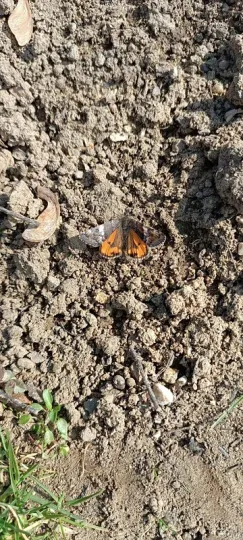
The Orange Underwing (Archiearis parthenias) is a diurnal moth belonging to the Geometridae family. Adult specimens have a wingspan of 30 to 40 mm, with grey-brown forewings featuring intricate dark patterns and bright orange hindwings with black borders.
The larvae, which are typical geometer caterpillars, possess a unique "looping" gait due to the reduction of prolegs. Their body is usually green with longitudinal pale stripes, providing excellent camouflage against birch foliage.
A key morphological feature is the presence of sparse fine hairs on the caterpillar's body, though they do not possess stinging properties. Their mouthparts are well-developed for consuming leaf tissue during the larval stages.
The pupa is dark brown with a hardened chitinous shell. This stage is highly resilient to temperature fluctuations, allowing the insect to successfully overwinter in temperate climates.
The moth is noted for its extremely early flight period, often appearing in sunny spots as early as March or April, making it a harbinger of spring in woodland ecosystems.
What it damages
The primary host plant for the larvae is the birch tree. In cases of population outbreaks, caterpillars may occasionally migrate to other deciduous trees, including alder, aspen, and certain willow species.
Damage is caused exclusively by the larvae, which feed on the foliage. In forest stands and urban park areas, they can cause significant defoliation of individual branches or even entire trees.
For young birch saplings, feeding damage can be critical, leading to reduced vigor and weakened immune response. Stressed trees subsequently become susceptible to secondary pests, such as wood-boring insects or fungal pathogens.
The economic impact is primarily seen in the reduction of the aesthetic value of urban plantings. In nurseries, this pest can cause direct losses by stunting the growth of seedlings and reducing their market quality.
The intensity of damage is closely linked to weather conditions in the spring. In years with an early and warm spring, caterpillar activity coincides perfectly with bud burst, leaving young leaves highly vulnerable.
When it appears
The Orange Underwing has a univoltine life cycle, meaning it produces only one generation per year. Adults emerge very early in the season, typically from March to April.
The flight period of the adults lasts several weeks, depending on the latitude. After mating, females lay their eggs singly or in small clusters on the buds and young leaves of host trees.
Larval hatching occurs synchronously with the unfolding of the leaves. The active feeding stage takes place during late spring, when the tree is producing its maximum amount of foliage.
Once feeding is completed, the caterpillars descend to pupate. They typically choose cracks in the bark, leaf litter, or other sheltered spots where the pupa remains dormant through the summer, autumn, and winter.
The pupal stage is a period of diapause, ensuring the species survives the harshest months of the year until the next cycle begins in early spring.
Signs of infestation
The first sign of infestation is the appearance of small holes in the birch leaves, which gradually increase in size. In the early stages, caterpillars consume only portions of the leaf tissue, leaving the veins intact.
When the population is high, extensive leaf margins are consumed. If the infestation is severe, trees may lose almost their entire foliage cover by the beginning of summer.
Larvae can be detected by carefully inspecting the undersides of leaves, where they hide during the day. When disturbed, they may drop on a silk thread, which is a characteristic behavioral pattern for this family.
The presence of frass (droppings) on leaves or beneath the tree canopy is another clear indicator of active pest feeding.
Adult moths may be spotted near tree trunks in the spring, though the primary indicator of infestation remains the visible reduction of green mass and leaf skeletonization.
Control measures
In forestry settings, control measures are rarely necessary as natural predators such as birds and parasitic wasps effectively regulate the population levels.
For the protection of decorative birch trees in park environments, biological preparations based on bacteria (such as Bacillus thuringiensis) can be applied. These are safe for non-target species, including pets and humans.
In cases of severe threats to valuable specimens, contact systemic insecticides may be used. Applications should be timed to coincide with the early larval hatching period for maximum efficacy.
Cultural control methods include cleaning the bark of older trees to remove overwintering sites and maintaining overall tree health through adequate irrigation and fertilization.
- Encouraging insectivorous birds by installing nesting boxes.
- Using pheromone or light traps for population monitoring.
- Promoting tree vigor to enhance natural resistance against defoliators.
Taxonomy
- Latin name
- Archiearis parthenias
- Order
- Lepidoptera (butterflies)
- Family
- Geometridae
- EPPO code
- ARCRPA
Discussion
No discussions yet — be the first.