
Cucumber green spider
Araniella cucurbitina
Description
How to identify
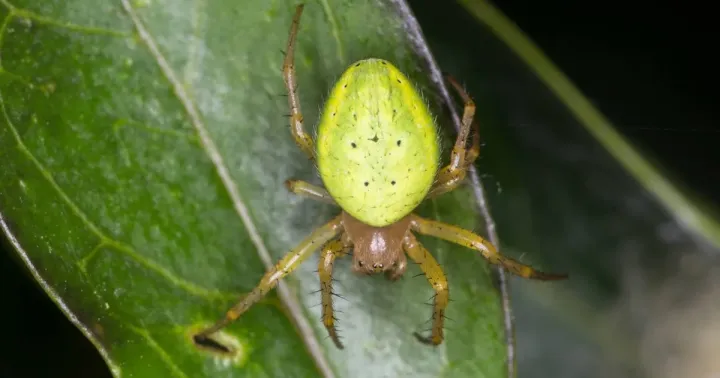
The cucumber green spider (Araniella cucurbitina) belongs to the orb-weaver spider family (Araneidae). It is easily identified by its bright, leaf-green abdomen, which allows it to camouflage perfectly on plants.
Adult females are typically 8–10 mm in length, while males are slightly smaller. The abdomen often features a dark, reddish-brown patch at the spinnerets, which is a distinctive characteristic for this species.
Despite their name, these spiders are not pests of cucumber plants. They are opportunistic predators that thrive in garden settings, woodlands, and orchards, feeding on various small insects.
The life cycle of Araniella cucurbitina spans one year. They emerge in the spring and go through several molts before reaching maturity in the mid-summer months.
They are widely distributed throughout Europe and parts of Asia, frequently found on broad-leaved trees and garden vegetables where they construct their webs.
What it damages
The cucumber green spider does not consume plant tissues, sap, or fruits. It is strictly a predator, meaning it causes no physiological damage to agricultural crops.
In fact, these spiders are highly beneficial to gardeners and farmers. They capture a variety of insect pests, including aphids, leafhoppers, and small flies that could otherwise harm your plants.
The only interaction they have with plants is the construction of small, orb-shaped webs. These webs are essentially harmless and do not restrict plant growth or cause wilting.
Mistaking these spiders for pests often leads to unnecessary chemical treatments, which can disrupt the natural balance and kill other beneficial insects like bees and ladybugs.
From an agronomic perspective, the presence of these spiders should be encouraged as part of an integrated pest management strategy to keep insect populations in check naturally.
When it appears
The activity of Araniella cucurbitina begins in late spring when temperatures rise, allowing juveniles to disperse and establish their hunting territories on garden vegetation.
Peak activity occurs in June and July. During this time, they are most visible as they reach adulthood and actively search for mates and prey among the lush garden foliage.
Mating and egg-laying happen in the mid-to-late summer. Females construct silk cocoons in sheltered areas, often under leaves or near the bark of trees, to protect their future offspring.
As autumn approaches and temperatures drop, the adult spiders die off. The next generation typically overwinters in a juvenile stage, tucked away in bark crevices or dry plant litter.
Understanding this seasonal cycle helps gardeners realize that the spiders are temporary residents that naturally disappear as the colder seasons approach.
Signs of infestation
The most common sign of their presence is the appearance of small, neatly constructed orb webs woven between leaves or thin stems of garden plants.
Observing the spider itself is possible by looking for the bright green, drop-shaped body resting in the middle or at the edge of the web, often camouflaged against the green leaf tissue.
The absence of typical pest damage, such as leaf yellowing, stippling, or necrotic spots, confirms that the spider is merely utilizing the plant as a physical anchor for its web.
Unlike mites, which leave visible damage and mass webbing across entire leaves, this spider constructs isolated, clean webs that do not impact the overall health of the plant.
Their presence is a good indicator of a balanced and healthy garden ecosystem that supports a wide variety of predatory insects and spiders.
Control measures
There is absolutely no need to control or remove the cucumber green spider from your garden. It is a natural biological control agent that should be protected rather than eradicated.
If the webs become a nuisance during the harvesting of vegetables, a simple manual removal or a gentle spray with a water hose is sufficient to clear them without harming the spiders.
Avoid using broad-spectrum insecticides, as these chemicals do more harm to the beneficial predator populations than to the spiders themselves.
Sustainable gardening involves tolerating these small builders, as they contribute to the natural suppression of aphids and other harmful insects.
- Promote biodiversity by avoiding unnecessary chemical applications.
- Use physical removal (water or hand) if webs interfere with harvesting.
- Value these spiders as natural pest managers in your garden.
Taxonomy
- Latin name
- Araniella cucurbitina
- Family
- Araneidae
- EPPO code
- ARAUCU
Discussion
No discussions yet — be the first.