
Mulberry longhorn beetle
Apriona rugicollis
Description
How to identify
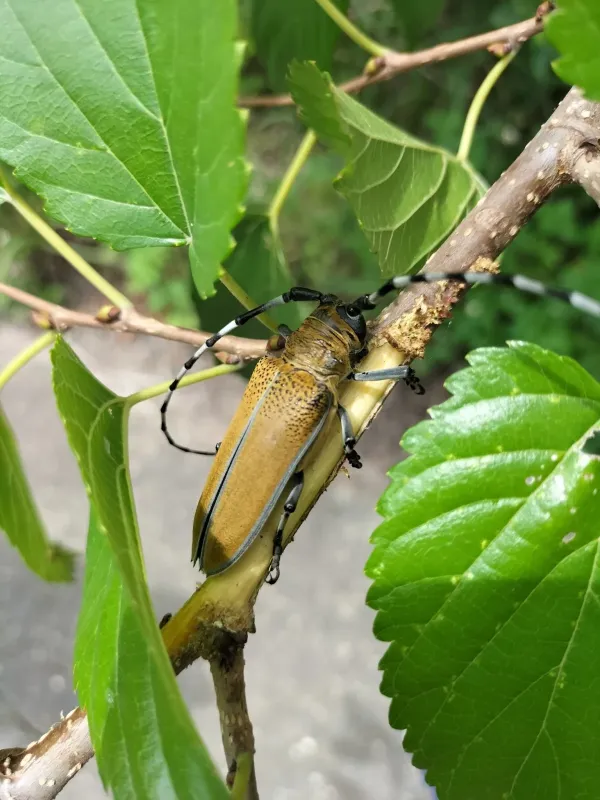
The mulberry longhorn beetle (Apriona rugicollis) belongs to the Cerambycidae family. These insects are large, often reaching 35–55 mm in length, with a body covered in fine yellowish-gray pubescence.
Adult beetles possess long antennae and noticeable tubercles on the pronotum. The larvae are cylindrical, legless, and creamy white, featuring a strong sclerotized head designed for tunneling through tough woody tissues.
What it damages
This pest is a significant polyphage known for causing substantial damage to various woody plants. Its preferred hosts include mulberry trees (Morus spp.) and various fruit trees from the Rosaceae family.
Other economically important species affected include willow, poplar, elm, ash, and various citrus fruits. Young and older trees alike suffer from nutrient flow disruption caused by extensive internal tunneling.
When it appears
The life cycle is lengthy, typically spanning 2 to 3 years depending on local temperature conditions. Adult activity is concentrated in the summer months, usually starting from June.
Females create precise slits in the bark to deposit their eggs. Once the eggs hatch, the larvae bore into the sapwood and heartwood, where they spend most of their developmental stages protected from environmental factors.
Signs of infestation
The most visible sign of an infestation is the presence of frass and wood shavings (sawdust-like material) accumulating at the base of the trunk or on tree branches.
Early-stage infestations are marked by distinctive T-shaped or U-shaped scars on the bark where eggs were laid. Advanced cases manifest as thinning of the canopy, wilting of limbs, and severe weakening of the tree's structure.
Control measures
Stringent quarantine measures are the first line of defense to prevent the spread of the beetle to new regions. Importing nursery stock from infested areas should be strictly monitored.
Integrated management involves regular inspection and manual extraction of larvae from galleries. Systemic or contact insecticides can be injected into the larval holes, followed by sealing the entry points to kill the pest within.
Severely infested trees act as reservoirs for the beetle and must be removed and destroyed by burning. Pruning and destroying infected branches can significantly reduce the local population density in orchards.
Taxonomy
- Latin name
- Apriona rugicollis
- Order
- Coleoptera (beetles)
- Family
- Cerambycidae
- EPPO code
- APRIJA
Discussion
No discussions yet — be the first.