
Aphrodisium
Aphrodisium
Description
How to identify
The genus Aphrodisium belongs to the family Cerambycidae (longhorn beetles), specifically the subfamily Cerambycinae. These insects are characterized by their elongated bodies, often displaying a metallic luster, and long antennae, which are typical of the family.
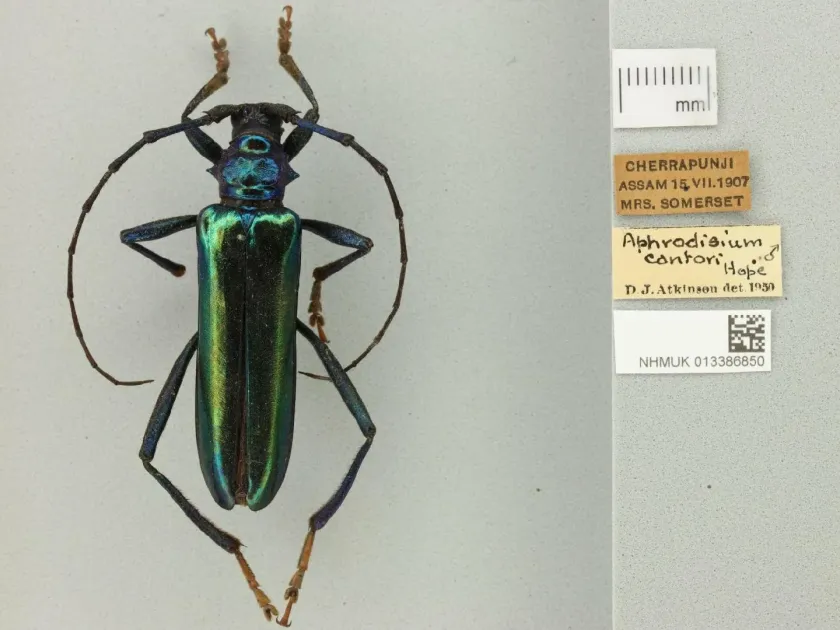
Adult specimens are usually medium to large in size. Their coloration often ranges from green to bronze or blue-black, allowing them to camouflage effectively among leaves and tree bark.
The larvae of Aphrodisium are typical wood-borers, white or yellowish in color, featuring well-developed mandibles. They lead a cryptic life inside the wood, making detection difficult during the early stages of infestation.
The life cycle is closely linked to the condition of the wood. Pupation occurs within the tunnels bored by the larva under the bark or deep within the trunk, after which the adult beetle chews an exit hole.
Accurate identification requires careful observation of regional fauna, as the genus Aphrodisium comprises several species primarily distributed across the forests of Asia and neighboring regions.
What it damages
The primary hosts of this pest include deciduous trees, specifically members of the family Rutaceae (citrus family), as well as certain other ornamental and forest species.
The pest attacks both weakened and relatively healthy trees if the population density is high enough in a particular area. The larvae feed on the cambium layer and the sapwood.
Damage to the cambium disrupts the nutrient supply to the upper parts of the tree, causing gradual wilting of individual branches or the total death of the tree in cases of severe infestation.
In commercial agriculture and orchards, this pest poses a significant threat to citrus groves by reducing yield and fruit quality due to the overall decline in tree health.
While Aphrodisium serves a functional role as a decomposer in natural forest ecosystems, its activity is strictly classified as damaging in commercial and managed plantations.
Signs of infestation
One of the first signs of an Aphrodisium presence is the appearance of characteristic circular or oval exit holes on the surface of the bark on trunks and large branches.
The presence of frass (fine wood shavings mixed with excrement) accumulating at the base of the tree or within bark cracks indicates active larval feeding within the trunk.
The canopy of an infested tree begins to thin gradually, with leaves potentially yellowing and dropping prematurely. Dieback at the top of the tree is observed, caused by disrupted sap flow.
Peeling back sections of the bark in infested areas reveals winding tunnels packed with frass and wood debris. This is a critical indicator confirming the presence of a stem-boring pest.
- Premature yellowing of leaves in the upper canopy.
- Presence of 5-8 mm diameter exit holes in the bark.
- Accumulation of frass on the trunk surface.
- Winding tunnels visible under the bark upon inspection.
Control measures
Sanitary pruning and the immediate removal and destruction of heavily infested trees are mandatory measures to prevent the spread of the pest to neighboring areas.
Maintaining high horticultural standards is a vital protective step: timely irrigation, proper fertilization, and protection from mechanical damage significantly increase tree resistance.
Systemic insecticides can be effective during the adult flight period. Treatments should be applied based on systematic monitoring of population numbers using pheromone traps.
Sealing wounds and cracks in the bark with pruning paint or special antiseptic mixtures prevents females from identifying suitable sites for oviposition.
In some integrated pest management programs, biological control methods are employed, utilizing natural enemies such as entomopathogenic fungi or specialized parasitic wasps.
Taxonomy
- Latin name
- Aphrodisium
- Order
- Coleoptera (beetles)
- Family
- Cerambycidae
- EPPO code
- APRDSP
Discussion
No discussions yet — be the first.