
Lilac beauty
Apeira
Description
How to identify
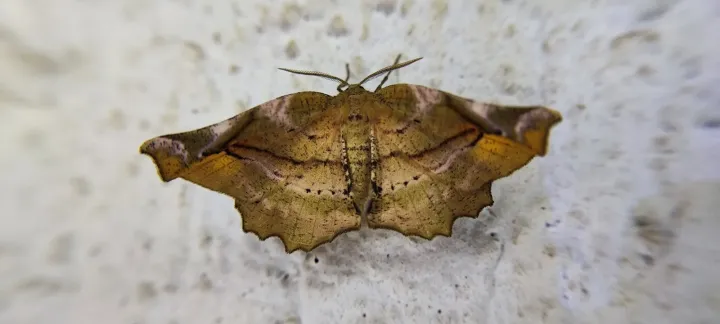
The Lilac beauty (Apeira syringaria) is a moth belonging to the Geometridae family. Adult specimens possess distinctively colored wings, ranging from ochre-yellow to reddish-brown, which provide effective camouflage against dead leaves.
The wingspan of the adult moth typically reaches 40–50 millimeters. The edges of the wings are jagged and irregular, giving the insect the appearance of a dried leaf fragment when at rest.
The larvae, known as caterpillars, have an elongated body characteristic of geometer moths and are capable of mimicking small twigs. Their coloration varies from green to brown, depending on age and food source.
The pupa is formed within a loose cocoon made of silk threads, often hidden between leaves. Its protective coloration helps it remain undetected by predators within the tree canopy.
The moth undergoes complete metamorphosis, including egg, larval, pupal, and adult stages. Each life stage is highly dependent on environmental conditions and the availability of host plants.
What it damages
The primary food sources for the larvae are members of the Oleaceae family, with common lilac being the preferred host. Other plants, such as ash and privet, are also frequently infested.
In gardens and parks, the caterpillars can cause significant damage to the foliage of ornamental and fruit trees. During outbreaks, they can strip large sections of the canopy of leaves.
The damage is primarily caused by the larvae, which voraciously consume leaf tissues. Extensive damage to young shoots can lead to a significant decline in the overall vigor of the plant.
Beyond direct foliage loss, high pest populations disrupt photosynthesis processes. This stunts tree growth and drastically reduces the aesthetic value of ornamental landscape plantings.
In commercial nurseries, the activity of the Lilac beauty can lead to the rejection of nursery stock. The economic importance of this pest increases during favorable climatic conditions for its development.
When it appears
The first generation of adults typically emerges in late spring or early summer. Depending on the region, adult flight activity may continue until the end of June.
The larvae develop throughout the summer, actively feeding on leaves until the onset of autumn. This period is the most critical time for monitoring and population control.
Young larvae overwinter on the host plants or in the litter around the base of the tree. This biological adaptation allows them to survive low winter temperatures.
In spring, with the rise in temperatures and sap flow, the overwintered larvae resume feeding and grow rapidly. It is during this time that their impact becomes most visible.
A second generation may develop faster than the first, depending on cumulative temperature levels. Management is complicated by the staggered emergence of adults and pupation periods.
Signs of infestation
The first signs of infestation are specific patterns of leaf damage, where edges appear ragged or eaten. Larvae often consume the leaf from the margins inward towards the midrib.
Upon close inspection of branches, one can observe caterpillars mimicking twigs by remaining perfectly still. They often attach themselves by their hind legs, making them difficult to spot.
The presence of silken threads used to bind leaves during pupation is a reliable indicator of infestation. This gives the canopy an untidy and damaged appearance.
Accumulated frass (caterpillar droppings) on lower branches often points to active feeding by a large population in the upper canopy. This is a crucial sign to monitor for arborists.
Wilting of individual young shoots after the spring feeding period indicates severe infestation levels. In such cases, a thorough inspection of neighboring plants is highly recommended.
Control measures
Manual removal of caterpillars is an effective control method for small private gardens when pest density is low. Picking them off manually prevents further spread of the population.
The use of biological products containing Bacillus thuringiensis allows for selective control of larvae. These products are most effective when applied during the early larval stages.
In cases of severe infestation on ornamental trees, systemic or contact insecticides may be necessary. Treatments should be applied in the evening to minimize impact on beneficial pollinators.
Good agricultural practices include regular pruning of dead branches where eggs or larvae might overwinter. Keeping the area under the canopy clean reduces the risk of recurrence.
Attracting natural predators, such as birds and beneficial insects, is a key component of integrated pest management. Maintaining biodiversity in the garden helps naturally suppress moth populations.
Taxonomy
- Latin name
- Apeira
- Order
- Lepidoptera (butterflies)
- Family
- Geometridae
- EPPO code
- APEISP
Discussion
No discussions yet — be the first.