
Anthocoris bug
Anthocoris nemoralis
Description
How to identify
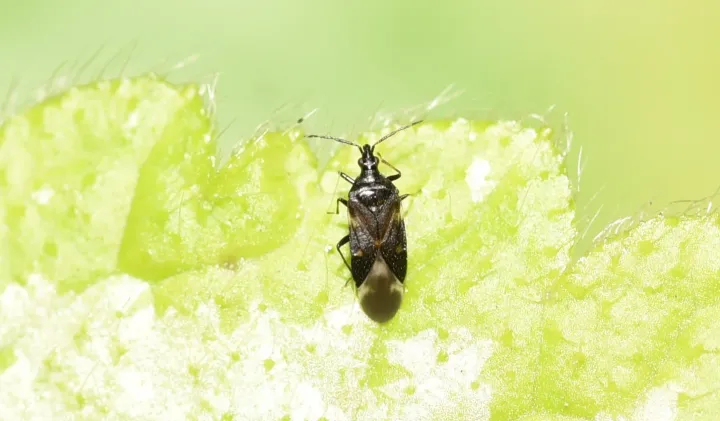
The Anthocoris bug (Anthocoris nemoralis) belongs to the Anthocoridae family of the order Hemiptera. These insects are small, typically measuring between 3 and 4 mm in length.
The adult insect has a flattened, oval body shape, which allows it to hide efficiently within bark crevices and plant foliage during the day or when inactive.
Adult coloration ranges from dark brown to deep black, with shiny hemelytra featuring distinctive transparent areas at the tips of the wings.
The larvae go through five developmental instars, gradually increasing in size and transitioning through various shades of orange and brown.
Although widely known as a beneficial predator, it can occasionally exhibit phytophagous behavior, causing damage to sensitive plant tissues if its natural prey is scarce.
What it damages
Anthocoris bugs are known to affect various orchards and berry patches, including apple trees, pear trees, raspberries, and blackcurrants.
The primary damage is caused by the piercing-sucking mouthparts of the bug, which extract sap from developing shoots, leaves, and young fruit.
Continuous feeding by large populations can lead to stunted shoot development, causing the plant to lose its typical vigor and growth rate.
Young buds and developing fruitlets may show signs of tissue necrosis, often leading to premature shedding and significant reduction in overall yield.
In nursery environments, infestation can result in leaf deformity, impacting the plant's ability to photosynthesize and develop strong branches.
When it appears
The insects overwinter as adults, seeking protection in sheltered environments such as deep tree bark, leaf litter, or debris at the base of trees.
Activity resumes in early spring once ambient temperatures consistently exceed 10°C, marking the beginning of their search for food and mating sites.
The first generation appears in late spring, and multiple overlapping generations can occur throughout the summer depending on favorable climatic conditions.
Population peaks are typically observed during the mid-to-late summer months, coinciding with the rapid growth and ripening of fruit crops.
As autumn approaches and temperatures drop, the bugs enter a diapause state, moving into hibernation spots to survive the winter months.
Signs of infestation
An early indicator of infestation is the appearance of small, light-colored necrotic spots on leaves where the bugs have punctured the tissue.
Leaf curling or crinkling, especially on younger shoots at the crown of the plant, serves as a visual indicator of localized feeding damage.
- Dark, granular frass or excrement on the undersides of leaves.
- Distorted growth and yellowing or browning of leaf margins.
- Premature fruit or bud drop resulting from nutrient depletion.
Upon shaking branches over a white sheet, one may observe adult bugs and larvae, confirming the presence of the pest within the canopy.
Over time, damaged leaf sections can become brittle and fall out, creating a characteristic shothole appearance across the affected foliage.
Control measures
Effective management begins with good orchard hygiene, including the removal of weeds and plant debris where the bugs successfully overwinter.
Biological control strategies should be prioritized, such as maintaining populations of spiders and other predators that naturally feed on Anthocoris bugs.
If chemical intervention becomes necessary due to high population levels, systemic or contact-based insecticides are applied as a targeted measure.
It is essential to rotate between different chemical classes to prevent the development of resistance within the insect population over successive seasons.
Applications should be timed carefully to avoid spraying during peak blooming periods to protect essential pollinators and other beneficial garden insects.
Taxonomy
- Latin name
- Anthocoris nemoralis
- Order
- Hemiptera (bugs, aphids, leafhoppers)
- Family
- Anthocoridae
- EPPO code
- ANTONA
Discussion
No discussions yet — be the first.