
Bean goose
Anser fabalis
Description
How to identify
The Bean Goose (Anser fabalis) is a large migratory bird belonging to the Anatidae family, known for its ability to aggregate in large flocks on open agricultural landscapes.
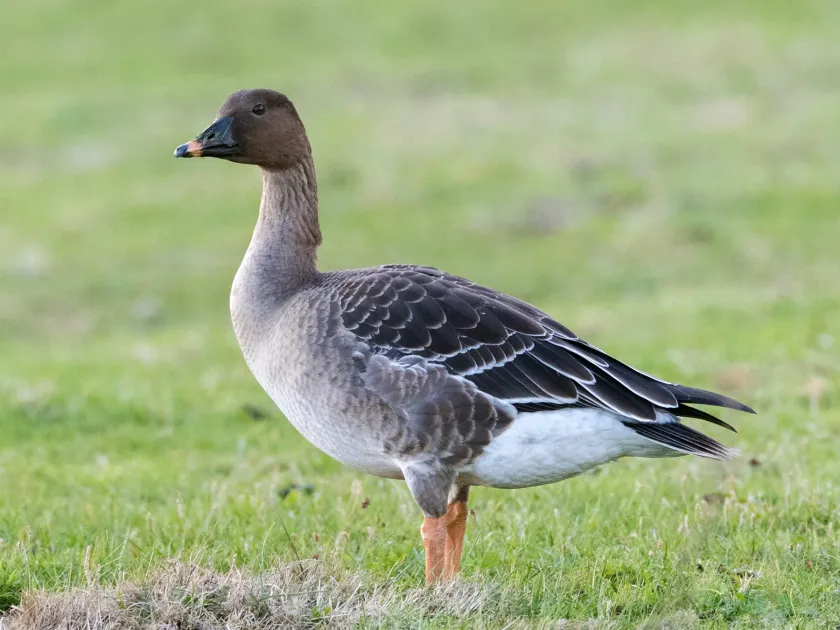
The species is distinguished by its dark brown plumage, a black bill with an orange-yellow patch, and orange legs, which are distinct characteristics of this migratory waterfowl.
Bean Geese are highly social animals, often moving in massive groups that allow for efficient foraging across large agricultural expanses during their migration stopovers.
These birds follow specific traditional flyways, which often cross vast areas of arable land, making fields in these corridors susceptible to periodic infestation and feeding.
Understanding their behavior, such as their preference for open fields with good visibility and proximity to water, is essential for identifying potential high-risk areas on a farm.
What it damages
Bean Geese primarily target young winter cereal crops, including wheat and rye, causing significant damage by grazing on the green foliage during early developmental stages.
In addition to consuming the leaves, the birds frequently pull the plants out by the roots, which can lead to complete denudation of sections of the field and severe thinning of the stand.
The physical act of trampling by large flocks leads to soil compaction, which hinders root growth and reduces the overall vigor of the crop long after the birds have left.
By grazing heavily on the foliage, the birds force the plants to utilize stored reserves for regrowth, thereby reducing the plant's potential for high-yield productivity at harvest time.
The economic impact is proportional to the flock size and duration of stay, which can lead to localized yield losses ranging from minor reductions to total crop failure on specific patches.
When it appears
Feeding activity on agricultural land is strictly seasonal, occurring during the spring migration in March and April and the autumn migration from September through November.
Spring is particularly critical as winter cereals are emerging from dormancy; the tender, nutrient-rich regrowth is highly attractive to geese building energy for the final leg of their journey.
Autumn migration sees geese feeding on post-harvest remnants and emerging winter seedlings as they prepare their energy reserves for the wintering period.
The birds operate on a daily cycle, alternating between daytime foraging on fields and nighttime roosting on nearby water bodies, necessitating regular monitoring during these times.
Environmental factors like early frost or delayed spring snowmelt can alter the duration of their stay, making field scouting critical during the entire migratory window.
Signs of infestation
The presence of Bean Geese is signaled by clear footprints in the soil and a significant amount of fecal matter left behind, which can be found in large patches throughout the feeding area.
Fields exhibit a 'mowed' or 'grazed' appearance, with plants missing their green tops and showing clear, mechanical cutting marks caused by the goose's beak.
The audible signs of a flock, including loud honking and the sound of hundreds of birds taking flight simultaneously, are unmistakable indicators of their presence.
Damage is often characterized by uneven, patch-like patterns across the field, reflecting where the flock has spent the most time foraging undisturbed.
Soil compaction is visibly apparent on wet, soft soils, where the ground may appear muddy and churned, further indicating that a large group of birds has been actively congregating there.
Control measures
Effective management against the Bean Goose relies on deterrent strategies aimed at disrupting the birds' sense of security and making the field an unfavorable site for feeding.
- Installation of automatic propane cannons to produce regular, disturbing sounds.
- Deployment of dynamic decoys such as predator silhouettes or reflecting tapes.
- Frequent patrols and human presence to provide a consistent disturbance factor.
- Usage of bioacoustic bird distress call devices to trigger avoidance behavior.
Success depends on an integrated approach, as geese quickly habituate to static deterrents, requiring farmers to frequently move or alternate their scare tactics.
A proactive agricultural approach includes optimizing seeding rates and fertility programs to ensure crops develop enough biomass quickly to withstand moderate grazing pressure.
Taxonomy
- Latin name
- Anser fabalis
- Family
- Anatidae
- EPPO code
- ANSEFA
Discussion
No discussions yet — be the first.