
Snow goose
Anser caerulescens
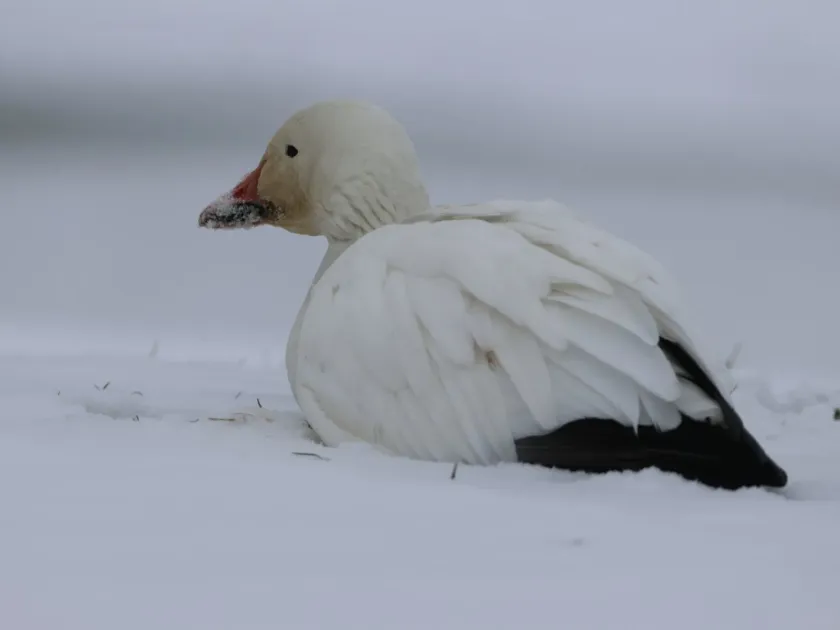
Description
How to identify
The snow goose (Anser caerulescens) is a member of the Anatidae family, known for its distinct white plumage with black wingtips. These birds are highly social and form massive colonies in Arctic regions.
They are migratory birds that undertake long-distance flights. During their stopovers, they form large flocks that can quickly deplete the available food resources in agricultural areas located along their migration routes.
The species exists in two color morphs, white and blue, but both have similar feeding behaviors. Their strong, serrated beaks allow them to graze efficiently on young vegetation and dig up underground plant parts.
Biology of the snow goose is adapted to rapid weight gain before and during migration, which leads to intensive foraging pressure on any available green fields they encounter during their travels.
Their life cycle includes seasonal migrations between breeding grounds and wintering areas, frequently passing through major agricultural belts where they interact with cultivated crops.
What it damages
The primary damage caused by snow geese is the destruction of winter cereal crops, including wheat and rye. They feed on young sprouts, which can lead to complete loss of the crop stand.
Soybean and corn fields are also heavily impacted. The birds are known to dig up freshly sown seeds, forcing farmers to re-sow the fields, which significantly increases production costs.
Vegetable plantations, especially leafy greens and brassicas, suffer from grazing pressure. Birds remove the growing points of plants, resulting in stunted growth and severe yield reduction.
The mechanical damage to the soil structure caused by thousands of geese trampling over a field creates compaction, which negatively affects water infiltration and subsequent plant root development.
- Consumption of young cereal sprouts.
- Excavation and eating of sown corn and soybean seeds.
- Grazing damage to leafy vegetable crops.
- Soil compaction from large flock movements.
- Contamination of forage and crops with bird excrement.
Signs of infestation
Visible patches of bare soil on fields that were previously green are the most obvious sign of heavy snow goose foraging activity, often accompanied by clear webbed foot imprints.
Finding plant remnants that have been pulled up by the roots provides evidence of aggressive grazing. The affected areas usually show a distinct, uniform boundary as the flock moves across the field.
Accumulated bird droppings across the field are an immediate indicator that a large flock has been feeding there for an extended period, requiring urgent intervention.
Discovery of disturbed soil where seeds were planted indicates that geese are targeting the nutrient-rich seeds, often leaving small holes where they have probed the earth.
Auditory signs, such as the loud, constant honking of a flock during daylight hours, serve as a clear alert for farmers to deploy bird control measures immediately.
Control measures
Bioacoustic deterrents that broadcast distress calls or predator sounds are highly effective in scaring geese away and preventing them from settling on valuable crop fields.
Visual deterrents, such as predator kites, inflatable effigies, and reflective materials, can be deployed to create an environment that the birds perceive as dangerous or uncomfortable.
Agricultural practices, such as deeper seed placement during sowing, can help reduce the attractiveness of fields by making seeds harder to reach for the birds during the critical germination phase.
Active patrol and the use of pyrotechnics or lasers can disrupt the birds' feeding routines, encouraging them to migrate towards less sensitive habitats instead of remaining on farms.
Integrated pest management strategies that combine monitoring migratory pathways with the strategic use of scare devices are essential to minimize agricultural losses caused by these birds.
Taxonomy
- Latin name
- Anser caerulescens
- Family
- Anatidae
- EPPO code
- ANSECA
Discussion
No discussions yet — be the first.